
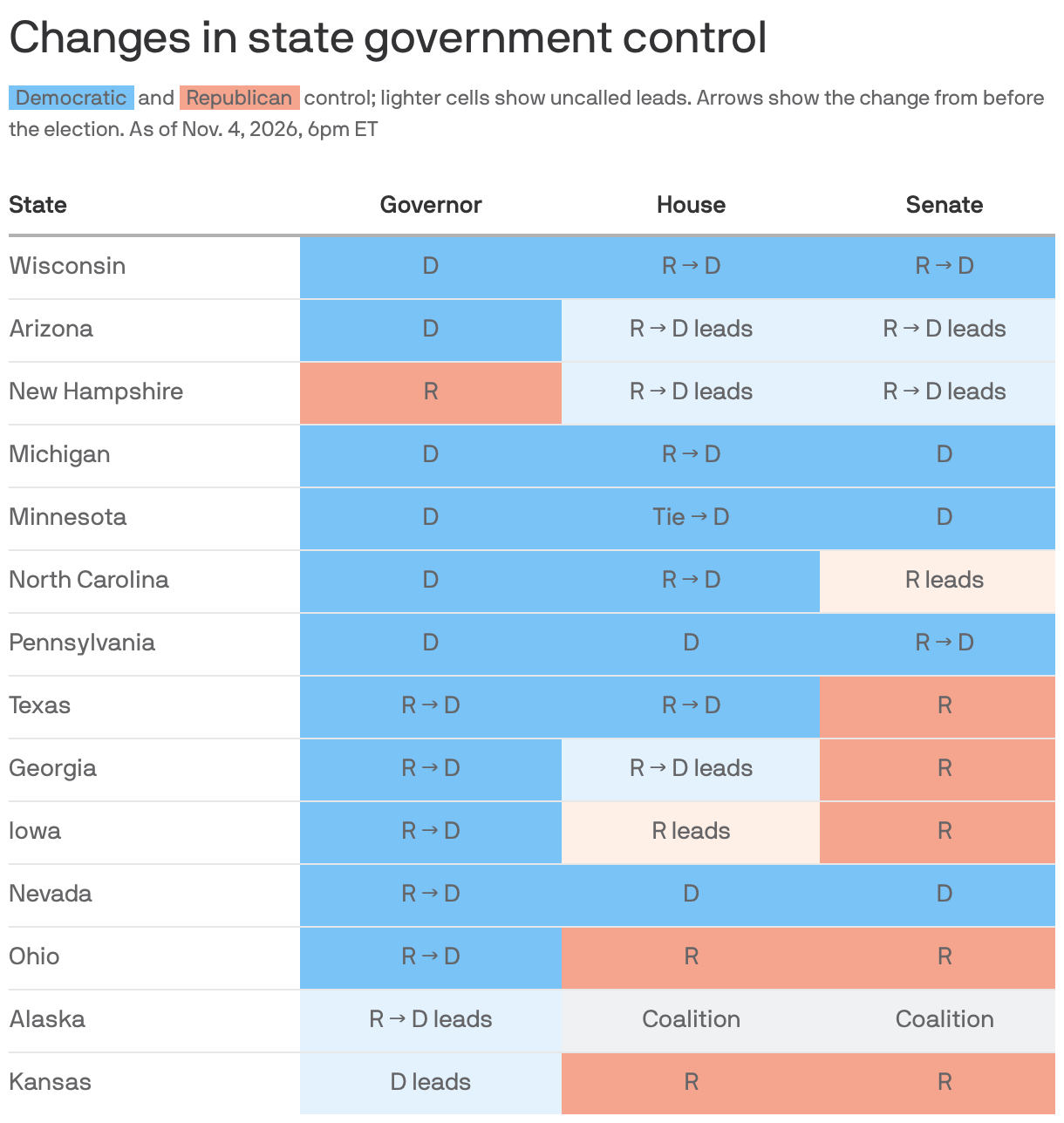
Driving the news: The party is poised to flip 12 legislative chambers, dismantle five Republican state trios, break 11 Republican supermajorities and build 12, according to AP returns Wednesday at 6 p.m. ET.
- If the lead holds, Democrats will control the governor’s office and both chambers in five of the seven 2024 presidential battlegrounds: Arizona, Michigan, Nevada, Pennsylvania and Wisconsin.
- They also broke one-party Republican rule in the sixth (Georgia) and flipped the House in the seventh (North Carolina).
The Democrats have turned around five GOP-held governors (Georgia, Iowa, Nevada, Ohio and Texas) and leader in Alaska.
- Republicans have not unseated any, although they have targeted Arizona, Michigan, Oregon and Wisconsin. Kansas, where Democrat Cindy Holscher led by about a half-point Wednesday night, is not called.
The big picture: Since the Tea Party wave of 2010, Republicans have used their grip on the states to reshape American life: banning abortion, loosening gun laws, restricting collective bargaining, and expanding vouchers for private schools.
- They drew maps that kept them in power even during years when Democrats won more votes statewide.
- Tuesday’s Democratic gains broke that firewall.
In figures: Republicans entered Election Day with 23 trifectas (control of the governor’s office and both chambers) to Democrats’ 16. If the lead holds, the Democrats will have 22 and the Republicans 18.
- 24% of Americans will live under a GOP trio, up from 42%.
- Democrats will control 51 of the 99 chambers, up from 39. Republicans will control 46, up from 57. (The Minnesota House was tied, and the Alaska Senate and House were controlled by a bipartisan coalition.)
A combined swing of 5,000 votes in six states would have given Democrats control of six additional legislative chambers.
Zoom: Democrats won veto-proof majorities against Republican governors in both Vermont chambers and the New Hampshire House, and they are one seat short in the New Hampshire Senate.
- Republicans lost two-thirds majorities in eight chambers, including Iowa and Kansas, where Democratic governors’ vetoes would now remain. In Kansas, it depends on Holscher winning.
- Democrats have built supermajorities in nine other chambers, including the Arizona Senate, and in states they already govern.
Policies Democrats Could Reshape
Paychecks: Pennsylvania and Wisconsin still use the federal minimum wage of $7.25.
- The Pennsylvania House of Representatives has already passed increases, but the Republican Senate has not accepted them.
- Wisconsin Democrats can repeal what remains of Act 10, the 2011 law that stripped most public sector workers of the right to collective bargaining. A judge overturned most of them in 2024, and that decision is under appeal.
- Nevada Democrats may revive a paid leave bill that the Republican governor vetoed.
Abortion: New Democratic attorneys general in Georgia and Texas will decide how well they will defend their states’ abortion bans in court and whether Texas will continue to pursue doctors who send pills from states with the shield law.
- In Iowa and Ohio, and in Kansas if Holscher wins, Democratic governors can veto new restrictions.
Schools: Arizona Democrats may cap the state’s universal voucher program, which Gov. Katie Hobbs has unsuccessfully tried to curb.
- Texas’ new billion-dollar voucher program could survive because the Republican Party held the state Senate, but Democrats will now have a say in how it is funded.
Elections: Pennsylvania and Wisconsin prohibit officials from processing mail-in ballots before Election Day. This rule is one of the main reasons why the two states’ counts can drag on for days.
- Democratic triumphs in both states could change the situation before 2028.
- New Democratic secretaries of state from Georgia, Ohio and Indiana will run those states’ presidential elections.
Yes, but: In Texas, Georgia, Ohio, Iowa and Kansas, divided government leads to more vetoes than new laws.
- Several new majorities are very slim. The Pennsylvania Senate has a 26-24 vote and the Wisconsin Senate has a 18-15 vote.
- New Democratic governors also inherit the Medicaid and SNAP cuts in last year’s Republican megabill, and filling them would come from state budgets.
The bottom line: Republicans spent 16 years building a majority in the state. Democrats erased it overnight and now have two years to show voters what they will do with it.
Gn headline