21 Democratic Senators Join GOP to End Debate on Big Oil-Backed ‘Kill Switch for Future Action Climate’

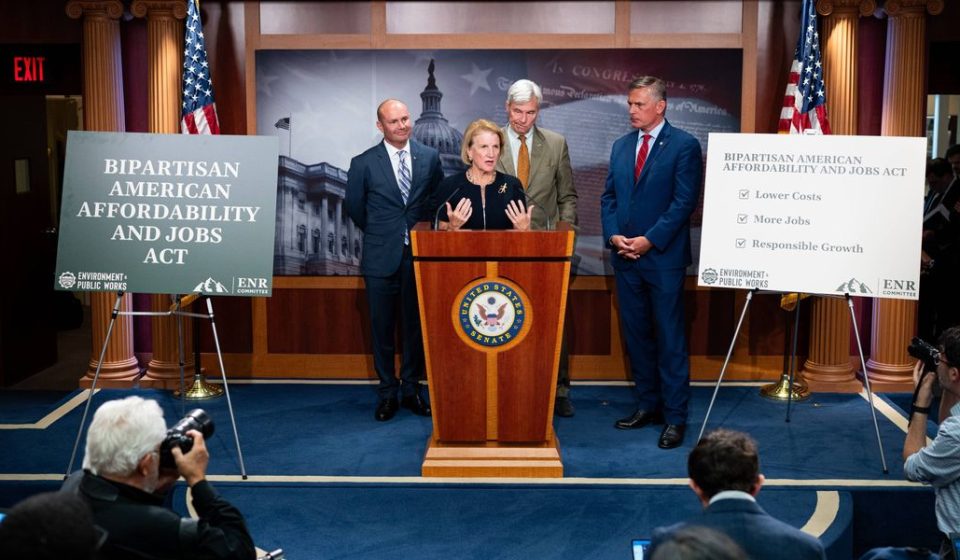
U.S. senators, including 21 members of the Democratic caucus, voted Monday night to end debate on authorizing reform legislation that would weaken critical environmental safeguards to speed up the federal approval process for energy projects, including fossil fuel infrastructure and data centers.
One Democratic senator, Catherine Cortez Masto of Nevada, opposed the cloture motion Monday after voting in favor of the bipartisan American Affordability and Jobs Act (BAAJA), legislation backed by the oil lobby, tech giants and the climate-destructive Trump White House, as well as major labor unions. Cortez Masto said after last week’s procedural vote that she would vote against advancing the bill to final passage if changes to the National Historic Preservation Act were not removed.
Members of the Senate Democratic Caucus who supported the cloture motion, which sets the stage for final passage, were: Richard Blumenthal (Conn.), Chris Coons (Del.), John Fetterman (Pa.), Ruben Gallego (Ariz.), Kirsten Gillibrand (D-N.Y.), Martin Heinrich (NM), John Hickenlooper (Colo.), Andy Kim (NJ), Angus King (Maine), Amy Klobuchar (Minn.), Jon Ossoff (Georgia), Gary Peters (Mich.), Jack Reed (RI), Jacky Rosen (Nev.), Brian Schatz (Hawaii), Chuck Schumer (NY), Jeanne Shaheen (NH), Elissa Slotkin (Mich.), Mark Warner (Virginia), Raphael Warnock (Georgia) and Sheldon Whitehouse (RI).
“The senators who voted for BAAJA simply betrayed the voters who came together in droves to demand that Congress curb data center development, end corruption and lower electricity costs,” said Elizabeth Bast, executive director of the advocacy group Oil Change International. “BAAJA would double down on Trump’s failed energy policies, which enrich Big Oil and his own stock portfolio at the expense of communities and our climate. Even analysis from the American Petroleum Institute, a major backer of BAAJA, shows the bill does not stop energy prices from rising.”
“BAAJA would act as a circuit breaker for future climate action without delivering meaningful emissions reductions,” Bast warned. “At best, this bill leaves U.S. emissions more than 2.1 billion tons short in 2040 of even a modest climate goal. Big Oil and Big Tech have spent millions lobbying for this behind-the-scenes deal, which has not had a single hearing, and are urging Congress to pass the bill before the new Congress is sworn in.”
If, as expected, the Senate votes to finally pass BAAJA, the bill would move to the closely Republican-controlled House, where it has drawn significant opposition from Democratic lawmakers, including the Congressional Progressive Caucus (CPC). Environmental groups and other opponents have urged lawmakers in both chambers to hold off on passing the bill until Democrats take control of Congress in January.
“BAAJA includes important policies that the CCP has advocated for, including stronger federal authority to approve much-needed transmission lines to accelerate the clean energy transition,” the caucus said in a statement last week. “However, it also contains provisions that would undermine tribal sovereignty and repeal key environmental laws, such as the National Environmental Policy Act, the Clean Water Act, the Endangered Species Act, and the National Historic Preservation Act. As a result, the public would lose key tools used to protect the environment and hold the administration accountable for ICE detention centers, Trump vanity projects, and more.”
The Senate’s cloture vote came days after about 100 environmental and energy law experts warned in a letter to the chamber’s Democratic leadership that BAAJA would “inflict permanent and significant damage on the nation’s key environmental laws (and the people and environment they are intended to protect).”
“Whatever modest emissions reductions his energy transportation reforms may bring, they cannot justify the rollback that accompanies them,” the letter reads. “And the threat posed by this lame-duck initiative provides a model and momentum for rollbacks far beyond environmental protections, potentially undermining enforcement of public health protections, civil rights, public education, consumer credit, and much more.”
Gn headline