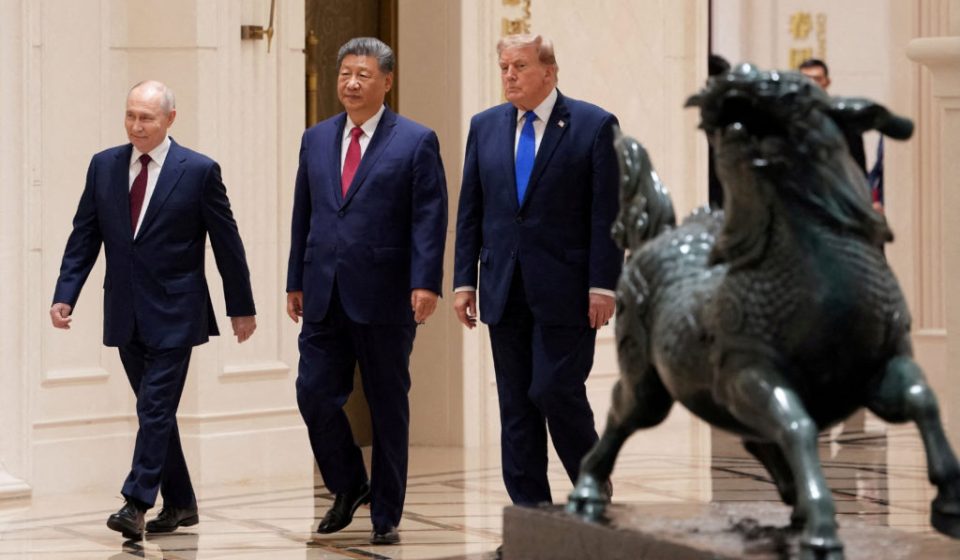

SHENZHEN, China (AP) — The meeting between U.S. President Donald Trump, China’s Xi Jinping and Russia’s Vladimir Putin on Thursday was the first-ever meeting between the leaders of the three countries.
They began by talking about a shared responsibility for maintaining peace as victors in World War II and as world powers. But the readings made after the meeting by the three nations reflect more symbolism than substance.
LEARN MORE: No progress in three-way negotiations between Trump, Xi and Putin on nuclear risks
The “peace declaration” issued after their meeting made no mention of the Russian-led war in Ukraine or the US-led war in Iran. They said they agreed on the need to reform the United Nations, increase oil supplies and reduce nuclear risks. The statement did not specify the type and extent of U.N. reforms the leaders agreed to.
The three sides also agreed that state officials should be granted immunity from prosecution, objecting to what they call an “abuse of jurisdiction” by the International Criminal Court, according to reports.
Here are the key takeaways from the discussions, which lasted more than an hour.
China’s Xi chairs 21st century power summit
Xi added to China’s already burgeoning diplomatic stature simply by hosting the event.
He said discussions with Trump and Putin were positive and fruitful, and the three countries had aligned views on safeguarding world peace, according to China’s official Xinhua News Agency.
They agreed that major powers should take seriously the legitimate security concerns of all countries and believe that disputes should be resolved through negotiation and cooperation, Xinhua reported.
“As long as the dialogue does not stop, the doors remain open, there is hope for peace,” Xi was quoted as saying. “The seeds planted at today’s trilateral meeting will surely take root, sprout, flower and bear fruit.”
China’s insistence on its right to reclaim the democratically governed island of Taiwan, possibly by force, was not addressed in the leaders’ general agreement. China considers this an internal issue.
China likes to position itself as a different superpower from the United States and Russia — one that doesn’t get involved in wars and defends the interests of small states, said Ruby Osman, a senior policy adviser at the Tony Blair Institute for Global Change in London.
Beijing’s priority was to keep the meeting away from details, she said. “Beijing wanted to be seen as the adult in the room.”
Trump claims a place in history
Trump called the leaders’ gathering “truly history-making” and he suggested to Xi and Putin that together they were making a difference by abandoning the “old school” that adversaries engage in.
The White House has set low expectations for the negotiations. But Trump presented them Thursday as just the beginning — a chance to start the conversation about solving some of the world’s thorniest problems.
“A lot of wonderful things can come from this, or at least begin,” Trump told Putin in a one-on-one meeting before their three-way meeting with Xi.
The carefully crafted event was a welcome break for Trump after a rotten few weeks of his presidency in which his Republican Party was trounced in the midterm elections, widespread technology outages scared Americans and Iran stepped up its attacks on U.S. allies.
Trump said Iran was on the agenda, as was Russia’s war against Ukraine. China and Russia exert enormous influence over Tehran and have also been accused by the United States of supporting the Islamic Republic.
He reiterated Thursday that he and Xi agreed that Iran must fully reopen the Strait of Hormuz, a critical waterway for global energy supplies that has become a chokepoint since the war began. They also agree that Iran cannot acquire nuclear weapons, Trump said.
But there is no indication that Trump has secured any agreement from Xi or Putin to help resolve the Iran conflict.
After the talks, Trump hosted a meeting in Berlin between U.S. envoys Jared Kushner and Steve Witkoff and Ukrainian President Volodymyr Zelenskyy alongside more than 40 European leaders who support Ukraine’s war effort.
Trump said at the Berlin meeting that he had discussed with Xi and Putin about seeking a peaceful end to the war in Ukraine, Witkoff said.
Putin shares the spotlight with Trump and Xi
For Putin, the three-way talks on the sidelines of the APEC summit – and his meetings with the two leaders separately earlier – offered the Kremlin leader a coveted opportunity to show that he leads a superpower on par with the United States and China.
Trump and Putin have found common ground in their opposition to the ICC. The Russian leader is wanted by the ICC on an arrest warrant for his alleged war crimes in Ukraine. The United States opposes the ICC’s arrest warrant for former Israeli Prime Minister Benjamin Netanyahu.
LEARN MORE: For Putin, sharing the spotlight with Trump and Xi boosts his profile on the world stage
Putin last attended an APEC summit in 2017. His presence as guest of honor and Russia’s status as the world’s leading power – at least at the Shenzhen summit – mark a diplomatic breakthrough.
Just before the summit, Russia sent two nuclear-capable Tu-95 bombers to visit Vietnam as a reminder of its nuclear power. And as Putin arrived in China, Russian television focused on an officer in his suite who carried a briefcase with codes for Moscow’s nuclear forces.
Putin called Xi a “dear friend” during their talks on Wednesday and smiled Thursday as he shook hands with Trump, who called him “my friend” and boasted of their “great relationship for many years.”
Speaking at the start of the three-way talks, Putin highlighted the global clout of Russia, China and the United States. The three nations are “united not only by our status as victors in World War II, but, more importantly, by our shared responsibility in maintaining international peace and security,” he said.
They are also among the founders of the United Nations, Mr. Putin noted, adding that “we bear the responsibility to preserve and strengthen the system of international law.”
“Our nations share many common interests regarding the resolution of regional conflicts, including, of course, the conflict in Ukraine,” Mr. Putin said.
Russia’s war in Ukraine was the focus of Putin’s bilateral meetings with Trump and Xi. This was not the main topic of the three-way talks, Putin spokesman Dmitry Peskov said.
The Kremlin released video of the Chinese leader escorting the Russian president to his car at the end of the talks and the two men shaking hands.
“I don’t think anyone expected things to go this well,” Putin told Xi as the two men parted ways.
Madhani reported from Washington and Leung from Hong Kong.
A free press is the cornerstone of a healthy democracy.
Support trusted journalism and civil dialogue.
Gn headline