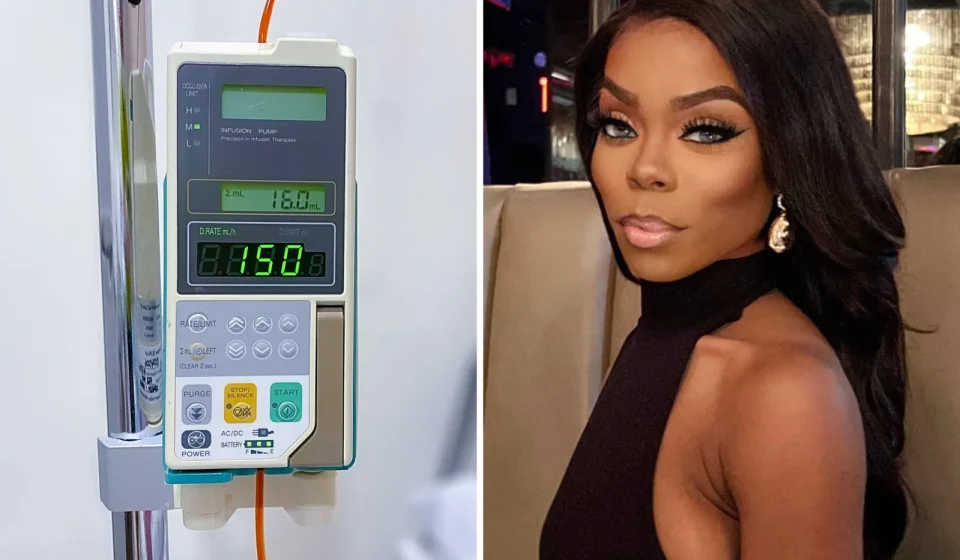
When Colleen Latrice received a new iron infusion, she thought it would help her regain some of the energy that chronic illness had taken away from her and raise her ferritin levels to a worryingly high level.
Instead, the 33-year-old New Yorker then found herself curled up in the fetal position, screaming in pain as an ambulance was urgently called.
Latrice suffered from extreme fatigue, hair loss, dark circles under her eyes, and a persistent feeling of cold, even during the hottest seasons. Blood loss associated with ulcerative colitis made the problem worse, she said, and recent tests showed her ferritin level had dropped to 5. Optimal scores for blood proteins that store iron are above 15.
Learn more on Health
“My gastroenterologist recommended iron infusions after discussing my symptoms,” said health and lifestyle content creator Latrice. News week. “My ferritin levels came back low, indicating that my iron stores were severely depleted.
“Addressing my iron deficiency has become a priority. »
What was supposed to be a new step in managing her health became, for Latrice, a frightening reminder of how quickly a seemingly routine treatment can change course.
She was to receive six weekly infusions of Venofer, with each appointment lasting approximately an hour: 30 minutes for a 200 mg iron infusion, followed by an additional 30 minutes of observation by a practitioner.

Latrice said she has already undergone five FerInject infusions without experiencing a serious reaction. His first treatment with Venofer was therefore his sixth iron infusion in total. The main difference between the two intravenous iron preparations is their dosage profile, with Injectafer generally providing greater and faster iron transfers.
Latrice remembers sitting in the infusion center eating rice crackers after the procedure when a nurse came in and asked if she was feeling okay. At that moment, she was.
“But shortly after, I started feeling severe, sharp abdominal pain near my ribs,” Latrice said. “It felt like someone was squeezing and stabbing me, and the pain spread to my back and both sides. »
Dealing with an unexpected emergency
The pain quickly became overwhelming.
“As the pain intensified, I dropped my phone,” she said. “I was screaming and crying, curled up in the fetal position because the pain was unbearable.”
Latrice said she was not asked to take any premedication before the infusion. When asked about medication allergies, she revealed an allergy to Benadryl, but was not given the medication at the appointment.
Once his symptoms appeared, his nurse gave him Pepcid, Zyrtec and Tylenol. About 15 minutes later, Latrice said, a nurse asked her if she wanted an EpiPen, too. By then his symptoms had started to ease and paramedics were already on their way to take him to hospital.
“The pain was so bad that the infusion center called an ambulance,” Latrice said. “I was taken to the emergency room, where I was eventually given morphine, which relieved the pain.”
The episode was particularly surprising because her five previous iron infusions had gone without such a reaction.
“I didn’t expect my sixth infusion to turn into an emergency,” she said.
The consequences continued beyond emergencies. Latrice said all of her remaining iron infusion appointments have been canceled.
His next steps are to find a hematologist to manage his iron levels and an allergist to evaluate what happened during the Venofer infusion. In the meantime, the original problem remains.
“I still feel extremely tired and my ferritin level remains at 5,” she said.
Since canceling the infusions, Latrice has been taking over-the-counter supplements and working with a nutritionist. The ordeal shook her and came at a time when she was already recovering from treatment for uterine fibroids, ovarian cysts and endometriosis.
Dr. Steven Goldberg, board-certified physician and Chief Medical Officer of HealthTrack, spoke with News week on the rarity of Latrice’s experience.
“Anaphylaxis after an IV iron infusion is very rare,” he said. “The risk depends on the type of iron used, but for most products it is about 1 in 10,000 first doses or less. One estimate puts the risk at about 1 in 200,000 infusions.
“Milder reactions are much more common, occurring in about 1 in 100 infusions. Symptoms may include flushing, chest or back tightness, and joint pain. These reactions usually improve when the infusion is stopped briefly and slowly restarted. These reactions are different from anaphylaxis and should be treated differently.”
Dr. Gail Clifford, medical consultant at Paramount Wellness Retreat in Connecticut, agrees, adding an explanation of why different reactions to different infusions can occur.
“It is possible to tolerate Injectafer containing iron-sucrose, while having a reaction to Venofer containing iron-sucrose,” she said. News week. “If intravenous iron is administered too quickly, a person may be at greater risk of infusion reactions. As both products carry warnings about serious hypersensitivity reactions, if a hypersensitivity reaction is suspected, the infusion should be stopped immediately and the patient evaluated clinically in a setting where emergency treatment is immediately available.
“Preventive measures should be taken before infusion, including informing patients of possible infusion reactions and identifying those at increased risk of hypersensitivity or contraindications to intravenous iron.”
Although experts point out that serious reactions to iron infusions are rare, Latrice says the experience had a lasting impact on her.
Sharing the infusion experience with those around her produced what she describes as a mixture of “relatability, shock, fear and worry.”
Other patients began telling him their own stories, including one woman who claimed she had a heart attack following a similar procedure.
For Latrice, however, discussing this episode isn’t about convincing people to fear treatment. It’s about making space for the more complicated realities of being a patient.
“I don’t want my experience to cause unnecessary fear,” she said, “but I want people to understand that patients’ experiences are worth hearing and discussing.” »
News week contacted Venofer for comment via email.
Gn Health