5 takeaways from the Massachusetts midterm elections, from the gubernatorial race to voting issues

Choose your favorite verb: Massachusetts Democrats prevailed, raged, cruised or were crushed in Tuesday’s midterm elections.
This is perhaps no surprise, given the party’s historic gains across the country and the state’s reputation. But a foray into Massachusetts’ election results maps, showing the various victories and defeats, offers some interesting insights into what they mean for the Bay State, both this year and potentially four years from now.
Here are five takeaways:
1. What a blue wave looks like in Massachusetts
Parts of Massachusetts went red in 2024 when Kamala Harris faced Donald Trump in the presidential election. Fall River, for example, narrowly won Trump in 2024 — the first time the city has run for Republican office in 100 years. Meanwhile, Harris won but underperformed in the state’s cities with the most Hispanic voters, like Lawrence, Lynn and Holyoke.
But this year, Fall River returned to the Democratic side. Democratic Gov. Maura Healey defeated Republican candidate Mike Minogue in the city 52% to 44%. And she dominated in Lawrence, Lynn and Holyoke with about 73%, 68% and 67% of the vote in those cities, respectively, similar to past levels of Democratic support. Rich Parr, an election analyst and vice president of the MassINC Polling Group, said it’s part of the same story nationally — as seen in redder states like South Carolina, Georgia and Texas — where black and Hispanic voters have shifted back to Democrats.
2. The glimmer of hope for Minogue
Tuesday’s card for Minogue had similarities to 2022, when Healey, then attorney general, crushed Trump supporter Geoff Diehl in his first gubernatorial campaign.
The bad news for Minogue is that he doesn’t appear to have expanded the map – despite investing almost $20 million in his own campaign. (With more than 90% of precincts reporting, Minogue has 34.7% of the vote; Diehl got 34.6% in 2022.)
According to Parr, the good news for Minogue is that, if he runs in 2030 (which Minogue did not rule out on Tuesday), Trump will not be president. Parr said voters tend to forget about losing candidates in these types of races, giving them the opportunity to reintroduce themselves. Former Governor Charlie Baker is an example. The Republican first ran for the Corner Office in 2010, when the anti-Obama Tea Party was ascendant, but lost to then-incumbent Gov. Deval Patrick. Lessons learned, Baker came back and won in 2014 with more moderate behavior and campaign experience.
3. The urban-suburban divide of question 7
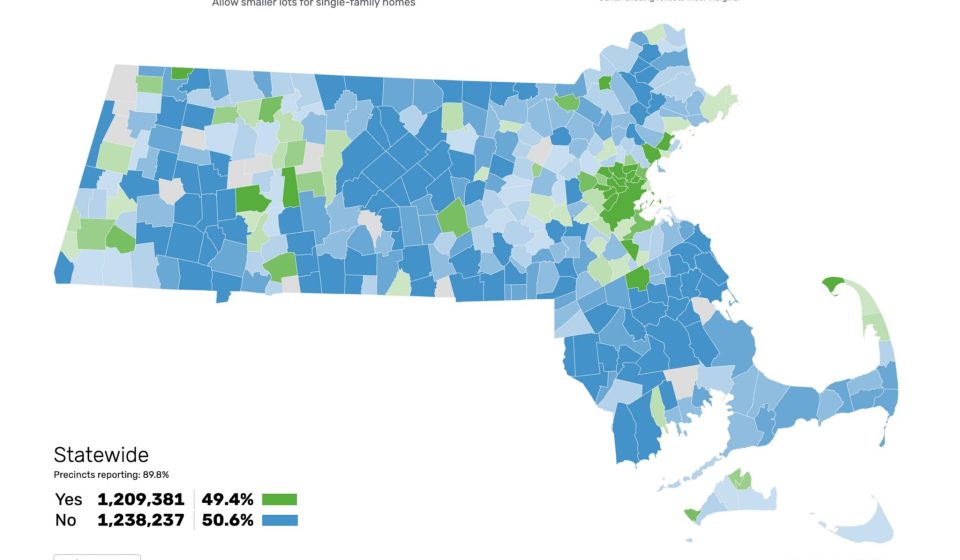
Question 7, the closest statewide contest, remains too close to vote on Wednesday night, with the “no” vote up just one percentage point. But there is a clear divide on the issue between urban and suburban/rural areas. Cambridge, Somerville and Boston all voted overwhelmingly for the measure, an attempt to curb housing prices by making it easier to build single-family homes on small lots. (Somerville liked it the most of all municipalities, with 76% voting yes.)
“We could talk about people who live in cities that are used to density and aren’t as afraid of it,” Parr said. “They don’t have these large lots that are at risk of being subdivided or reduced.”
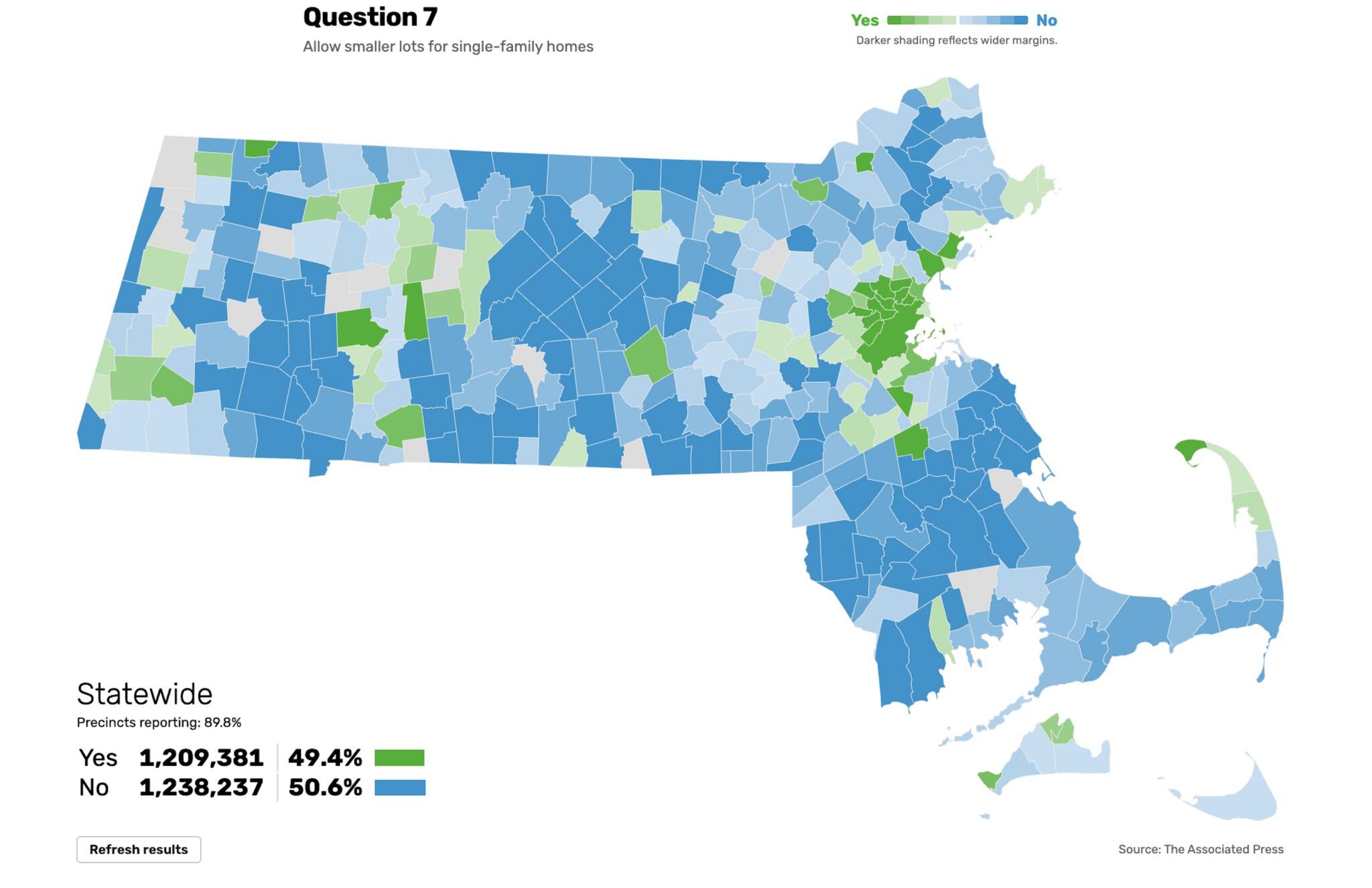
However, the large margins achieved by the “yes” campaign in the cities were canceled out by the dominance of the “no” vote in small communities. The “no” camp on question 7 won in 265 of the 337 cities and towns that published their results Wednesday evening. Rehoboth, a suburban, rural city on the Rhode Island border, had the highest “no” percentage at 75 percent.
4. The wealth gap from question 5
Question 5 sought to amend a rarely triggered state tax revenue limitation law to make rebate checks more frequent for taxpayers coming out of Beacon Hill. While the Associated Press has yet to call the still-close race, Question 5 supporters have acknowledged defeat — while sometimes blaming more liberal and wealthier communities for the outcome.
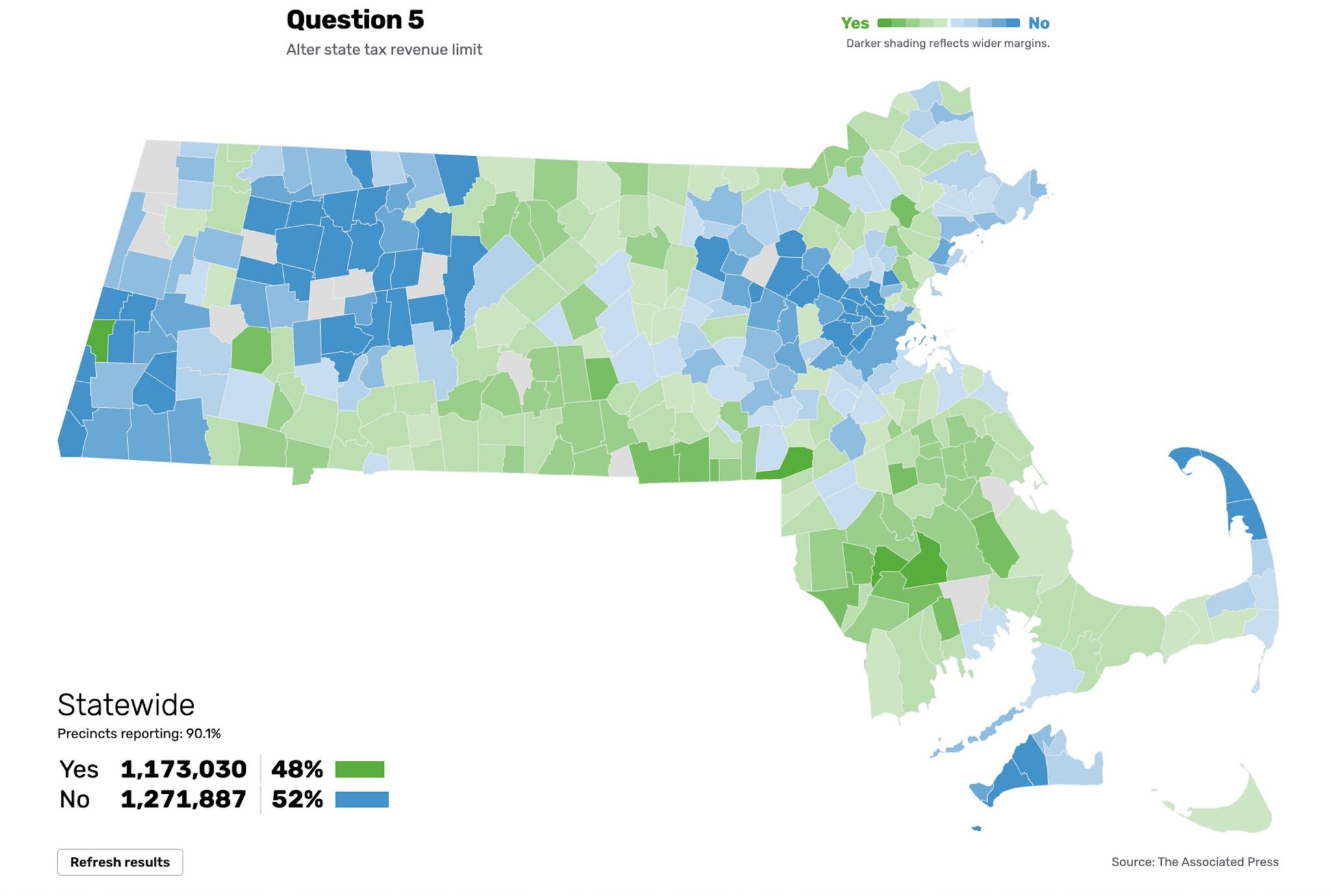
The state’s top Democratic elected officials rallied against Question 5, arguing it would cut funding for public schools and health care. Jim Stergios, executive director of the Pioneer Institute, which supported the measure, said Question 5 faced the most opposition in places like Cambridge, Newton, Brookline and Somerville. In fact, more than two-thirds of voters voted against question 5 in these communities. The “no” vote also exceeded 60% in many northwest Boston suburbs (Lexington, Lincoln, Concord, for example) and in many communities in western Massachusetts.
“But if you look at communities like Springfield, New Bedford, Chicopee and Lawrence, that’s where it’s won,” Stergios told WBUR’s Simón Rios. “There is a growing political divide between the haves and the have-nots in terms of power.”
5. Pollsters had a good night overall
Pollsters have tended to take a beating during the Trump era due to their failings (e.g., underestimating Trump’s support in some states in 2016). Nate Cohn, an analyst at the New York Times, noted that one can “be sure that polls are generally in the order of things, but one cannot be sure that they are exactly ‘real'” due to the natural level of imprecision.
In Massachusetts, last month’s Suffolk University and UMass polls may have been slightly lower than what appears to be Healey’s margin, with 90 percent of precincts.
Polls of candidates are also different from polls of voting issues, in which the “lead” is not as indicative of the outcome, in part because undecided voters decide late and often answer “no.” In September, Parr’s MassINC polling group showed Question 5 below 50%, Question 7 at 51%, and the “no” side on Question 8 won by a wide margin.
“On Fox News, they said the pollsters lived to fight another day and I think that’s accurate,” Parr said.
Gn usa