9th Circuit again denies Trump administration’s request to block 20,000 ballots in California

A federal appeals court on Friday rejected for the second time a Trump administration request to block 20,000 ballots from California voters who the administration said might be noncitizens — ruling that the administration had failed to demonstrate that “such an extraordinary measure, in a current election, is clearly required by law.”
Trump administration officials did not immediately respond to a request for comment, including on whether it would appeal to the U.S. Supreme Court.
The three-judge panel of the 9th U.S. Circuit Court of Appeals — made up of two appointees of President Trump and one of President Biden — ruled 2-1 that the U.S. Constitution gives the state and Congress the power to decide how elections are conducted, and that allowing the Trump administration to “misuse” federal laws to “prescribe” how California must handle ballots would “overstep the dictates clear and manifest of the Constitution itself.
“Because Congress has not exercised the specific authority granted to it under the Elections Clause to override California’s established laws to challenge ballots or exclude ineligible voters, the statutory scheme of the State Legislature remains the only method for doing so,” the justices concluded.
The majority of the panel — comprised of Mark J. Bennett, a Trump appointee, and Gabriel P. Sanchez, a Biden appointee — wrote that “if the United States believes that different procedures are necessary for mail voting, we believe it should take this suggestion to Congress, not the courts.”
They also wrote that separate federal laws prohibit sweeping changes to voter rolls 90 days before an election, especially given questions about the reliability of the Trump administration’s list of so-called noncitizens.
“The suspect reliability of these lists found by the district court reflects the concern that Congress sought to alleviate with the 90-day quiet period,” they wrote.
Judge Patrick J. Bumatay, the other Trump appointee on the panel, disagreed, arguing that his colleagues erred in refusing a basic request from the Trump administration to ensure that only citizens voted.
“The federal government proposes a modest remedy: prevent California from mixing the ballots of citizens and presumed noncitizens,” Bumatay wrote. “This solution would not void any votes but would allow time to verify the eligibility of alleged non-citizens. The district court, and now our court, denies this reasonable request.”

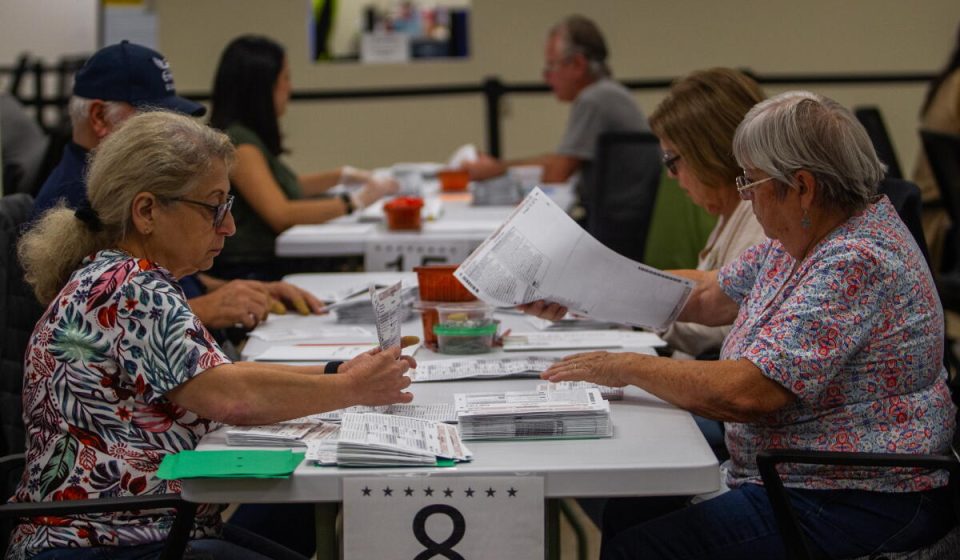
Ballots are scanned to be counted at the Orange County Registrar of Voters office Oct. 28 in Santa Ana.
(Apu Gomes/Getty Images)
Previous rejections
The same three-judge panel had already rejected the same requests on Monday, citing some of the same concerns, while a Los Angeles lower district judge rejected them on Wednesday.
Justice Department lawyers appealed the lower court’s ruling to the appeals court Thursday, arguing that irrevocable harm is being inflicted on the federal government with each day that passes without a court order blocking the counting of potential noncitizen ballots, in part because those votes — once cast and processed — cannot be removed from state and local vote tallies.
Lawyers for California and Los Angeles County, in their appeals court filings Friday morning, argued that the Trump administration’s requirements were unconstitutional, impossible to comply with, dependent on error-riddled data and deeply threatening to eligible California voters.
California officials and independent voting rights groups hailed the appeals court’s latest ruling as a major victory for the state. California Atty. Gen. Rob Bonta said this and the state’s other court victories “clearly show that the Trump administration has no authority to interfere in California’s elections,” already making “exceptionally rare” incidents of voter fraud illegal.
“The administration’s baseless claims of widespread fraud are an attempt to sow doubt in our democratic process and risk disenfranchising eligible voters,” Bonta said.
Gov. Gavin Newsom called the Trump administration’s efforts “an attack on our democracy” and said state officials “will continue to fight them for their illegal power grabs every step of the way and deliver free and fair elections, as we always have.”
The decision came as California county election officials faced a new threat: criminal grand jury subpoenas demanding that they provide Homeland Security investigators and federal prosecutors with emails, texts and other internal documents related to their handling of the administration’s requests, and that they soon appear in federal court to testify about that process.

Mariachi Lindas Mexicanas plays as people march to cast their ballots at the Coalition for Humane Immigrant Rights Flex Voting Center in Los Angeles on October 30.
(Genaro Molina/Los Angeles Times)
It’s unclear how many subpoenas have been sent, although The Times reviewed at least three received by officials in the office of Los Angeles County Registrar-Recorder/Clerk Dean Logan, who is a defendant in the appeals court case — along with the state and Secretary of State Shirley Weber. The Associated Press reported that subpoenas were pending in California’s four federal judicial districts.
The ruling also comes amid separate challenges to the Trump administration’s use of such lists in California and other states in federal court in Washington, DC.
In one such case, Senate Minority Leader Chuck Schumer (D-N.Y.), House Minority Leader Hakeem Jeffries (D-N.Y.) and several national Democratic groups claimed that the administration’s efforts to block ballots and threaten election officials was a “pretext to take control of elections” in which the Republican Party appears poised to lose power.
Taken together, these debates represent an unprecedented battle between federal, state and local authorities over voting procedures in the midst of an election. They highlight how the Justice Department ignored longstanding rules barring such mid-election investigations in order to prove Trump’s claims that U.S. elections are riddled with widespread fraud.
Election experts say such fraud is extremely rare. California has more than 23 million registered voters, meaning the entire list of 20,000 reported voters represents about 0.087 percent of them, or less than one-tenth of 1 percent.
The wider battle
The administration’s list of 20,000 voters — which it said it compiled from a mix of public records, immigration files and commercial databases — has been defended by administration officials as reliable and including only people in whom the administration has “great confidence” and who are noncitizens.
But state and county officials and various voting rights organizations have described it as unreliable and inaccurate. Some county officials said their own cursory examinations of a subset of voters revealed the presence of people who appear to have been born in the United States, who are not registered and who have never voted.
State officials have pointed out these inconsistencies, and the fact that the same federal prosecutors who have alleged widespread fraud in court have brought criminal charges against just 28 people in the state, shows that the true scale of the problem is far less than they and Trump have made it out to be.
Trump said this week, without any evidence, that “there are hundreds of thousands of bad ballots, bad votes, in California. Millions, in my opinion.”
In a recent social media post, Trump wrote that California election officials who don’t comply with federal requests to throw out flagged ballots “will all go to jail for a long time!!!” »
This hyperbolic threat from the president, denounced by legal experts, has nevertheless gained credibility in recent days, as federal prosecutors have issued their grand jury subpoenas to election officials.
At the very least, such subpoenas mean that federal prosecutors believe that internal discussions that local elections officials have had about how best to respond to the Trump administration’s so-called non-citizen lists are relevant to one or more ongoing criminal investigations.
Unions representing California election workers sued the Justice Department on Thursday, accusing federal government officials of engaging “in a coordinated campaign to intimidate, threaten, and coerce state and local officials and employees.”
Unions including the Service Employees International Union, the AFL-CIO and the American Federation of State, County and Municipal Employees are asking a federal judge to bar the Trump administration from threatening to sue election workers who count ballots from voters the administration has flagged.
The Trump administration’s list has not been made public, although the administration has sent it to state officials and then sent subsets of voters from that list to individual counties where the administration believes they are registered. Some county officials pointed out errors in those lists, including that people on them appeared to live in different parts of the state.
On Friday, U.S. District Judge James E. Boasberg, sitting in Washington, D.C., held a hearing in a separate case challenging the administration’s use of such lists in California’s UCLA Voting Rights Project on behalf of the Coalition for Immigrant Human Rights, or CHIRLA, and a California voter named Pedro Trujillo.
Boasberg ordered the Trump administration to provide CHIRLA with its lists, so the group could verify whether any of its members were on them.
Gn headline