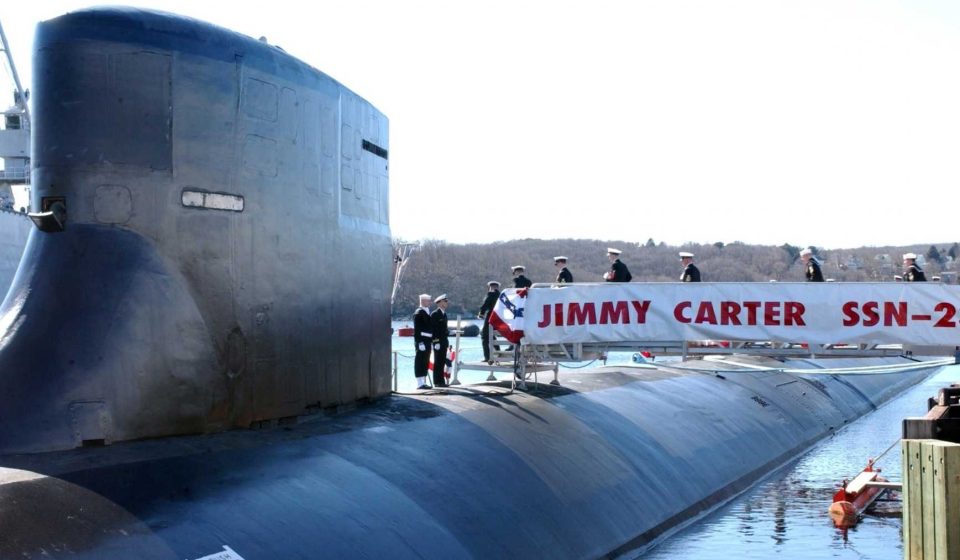
A 453-foot submarine stretched by a 100-foot section spliced in the middle operated as the U.S. Navy’s only special warfare support boat for 21 years, carrying divers, robots and cable-handling equipment, and its replacement has just surfaced in a job posting at a shipyard.

When the Navy wants you to know something, you get a naming ceremony, a press release, and an admiral saying the word “lethality” a dozen times. If it doesn’t, you get nothing. And then there is a third category, where the news is published via a job posting on a job site. This is how we found out what happens in the future USS Baltimore.
Naval News spotted the listing on September 18. General Dynamics electric boat is hiring systems engineering test managers in Groton, Connecticut, for SSN 812, the penultimate Block V Virginie class attack submarine, ordered in 2024 and still under construction. (The hull number is apparently a nod to the War of 1812, which I would call pretty solid committee work.)
And Electric Boat’s ad, dated August 9, doesn’t read like a normal job offer at a shipyard. “SSW is a new capability for a single Virginia-class submarine of the latest Block V version,” it says, and SSW stands for Subsea and Seabed Warfare.
Navy budget documents fill in the rest. The Baltimore is being converted into a special operations and seabed warfare submarine, the boat that will ultimately succeed the USS Jimmy Carter, which spent two decades as the Navy’s only special warfare support submarine.
Naval News reports that the conversion focuses on a special mission insert with an extended keel, accommodations for saturation diving, controls for tethered underwater vehicles and its own version of the non-propulsion electronic system. The latter is Navy parlance for just about anything electronic on board that doesn’t operate the reactor.
So why would a nuclear submarine need divers on board?
Saturation diving allows humans to work at depth for weeks. Divers live in a pressurized chamber and go to the bottom, instead of decompressing after each trip, which would take up their entire schedule. If you’re building this in a submarine, you’re looking at parking it on top of a construction site and doing actual physical work there, rather than driving past and taking photos.
So what does a seabed warfare submarine actually do?
Most of the time it’s about what’s already there. SlashGear has more than 900,000 miles of fiber optic cables running through the ocean floor, and virtually everything you do online passes through some of them, as well as a network of oil and gas pipelines. About 70 percent of the damage to these cables comes from accidents, mainly from anchors and fishing gear, but there have been repeated reports of deliberate cutting and it has not been easy to determine who did what.
The Navy decided it was worth having a dedicated hull. “When it comes to seabed defensive and offensive warfare capability, that’s really, really an area of growth,” Vice Adm. Richard Seif, commander of the Navy’s submarine forces, said at the Combined Naval Events Europe Conference earlier this year. And it’s not a new hobby either. In 1898, a navy operation raised and cut a communications cable off the coast of Cuba. The tools have improved, but the interest has always been there.
It didn’t start with a job offer, either. The June 2025 Navy research and development budgets already listed integration and test plans for the Baltimore’s seabed warfare electronics, the FY 2027 budget kept the money flowing, and General Dynamics was showing renderings of a Virginia seabed warfare as early as 2023. At first glance, the list is just the first part of the program with a start date attached to a human.
The boat it replaces is one of a kind
If you want to know what the Baltimore is getting into, look at the boat she’s lifting. The USS Jimmy Carter is the third and final Seawolf-class submarine, and it has been in service since 2005. During construction, the Navy inserted a 100-foot section called a multi-mission platform into the middle of it.
This section extended the hull to 453 feet compared to 353 for her two sisters. It also made room for remotely operated vehicles, cable handling equipment, divers and special operations teams. Baird Maritime considers it the Navy’s only special warfare support submarine, meaning this entire category of work has relied on a single hull for 21 years.
That’s a pretty slim margin for what the Navy now calls an area of growth, so a designated successor was arguably overdue. Smaller machines already do some of this work. The Navy has pointed a 65-foot drone at the Atlantic to map the seafloor for a year, and researchers have already lowered an 11-ton drilling rig to the bottom with a single cable. A converted attack submarine can transport this type of equipment to a contested location and remain there quietly for months.
The holder
453 feet
USS Jimmy Carter. Third and final Seawolf, lengthened by a 100-foot mission section, in service since 2005.
Standard Virginia
377 feet
The hull of the basic attack submarine, blocks I to IV.
Block V with missile module
460 feet
An 84-foot midsection adds four payload tubes and 28 Tomahawks.
TARGET
Social Security Number 812 Baltimore
SSW
Special mission insert, extended keel, saturation diving, tethered vehicles. Final length not disclosed.
What happens to missile tubes?
The Block V Virginias are built around the Virginia Payload Module, an 84-foot midsection with four large payload tubes that takes a boat from 12 Tomahawk cruise missiles to 40, according to Navy figures. Baird Maritime notes that the Baltimore was previously scheduled to receive this module, and Naval News reports that it is unclear whether the seabed conversion retains this volume, rebuilds it, or cedes part of it.
The Navy hasn’t said whether the module will survive the overhaul, so I can’t even tell you how long the finished boat will last: 460 feet with it, 377 without it.
I’m guessing some of that missile space ends up as mission space, since a saturation diving complex and tethered vehicle handling equipment have to live somewhere inside a pressurized hull. But that’s honestly just a guess. Naval News reads the trade the same way for this boat: working on the seabed beats carrying a full load of missiles.
Marines are also experimenting with complete crew removal. The 39-foot British drone submarine fired a heavy torpedo with no crew on board. The Baltimore is the opposite bet: a full-size nuclear boat, a full crew and possibly a workshop where the missiles were supposed to go.
I can’t find a delivery date or cost in public Navy documents, and the only estimate available comes from SlashGear, which puts the Baltimore’s completion around 2036. The electric boat list increased on Aug. 9, the hull has been under construction since the 2024 order, and until the new boat arrives, 21-year-old Jimmy Carter keeps what is arguably the Navy’s strangest job.
Gn bussni