
The six candidates for the post of Secretary General of the UN all defended Thursday July 23, during a civilized debate in the very symbolic hall of the General Assembly, the importance of restoring the credibility of an organization in crisis, a week before the formal start of a crucial selection process in a fragmented world.
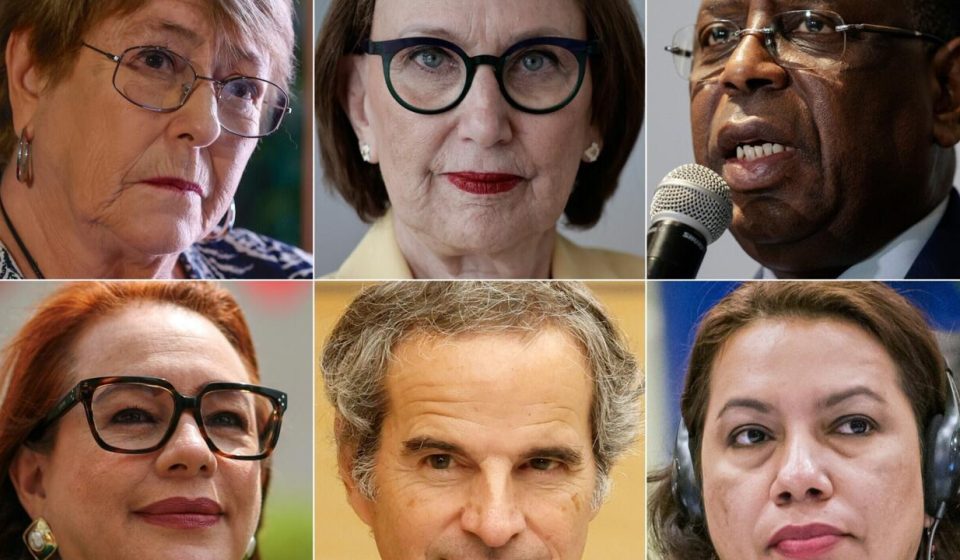
While the campaign without a clear favorite is struggling to generate real enthusiasm, the Chilean Michelle Bachelet, the Ecuadorian Maria Fernanda Espinosa, the Argentinian Rafael Grossi, the Costa Rican Rebeca Grynspan, the Guyanese Carolyn Rodrigues-Birkett and the Senegalese Macky Sall answered for almost two hours questions from diplomats, UN employees, representatives of civil society and two journalists from Bloomberg, which piloted and broadcast this event. Without ever directly addressing each other.
First question: “What makes you the best person to be secretary general?” In two minutes each, they highlighted their strengths in facing a particularly difficult time in a world ravaged by conflicts, discussing their national or international experiences and their ability to speak to everyone. And all subscribed to the same diagnosis of a UN in financial crisis, widely criticized and which needs to further pursue the ongoing reform launched by Secretary General Antonio Guterres who will leave his post on December 31, 2026.
“I don’t want anyone to ask me ‘where is the UN?'”
“In five years, I don’t want anyone to ask me ‘where is the UN?’ (…) I would like to see the UN back at the table in conflict scenarios,” declared Rebeca Grynspan, boss – withdrawn for the campaign – of the UN agency for Trade and Development.
“During my first 100 days, I want to restore confidence and put the UN back on a path to become more agile, more efficient, more ready to listen, to act and to bring together,” assured former Senegalese President Macky Sall, presenting himself as a “bridge builder”.
Insisting like her opponents on the need to strengthen the role of the secretary general, Guyanese ambassador Carolyn Rodrigues-Birket stressed that the occupant of this post does not have “the luxury” of not trying to act. “I would be that secretary general who tries, whether in Iran, Haiti, Sudan or the Democratic Republic of Congo.”
Rafael Grossi, head of the International Atomic Energy Agency, also pleaded for the secretary general to “intervene” when any member state “provokes a war”. “We need this to restore the credibility of the UN.”
The UN faces a deep financial and confidence crisis
Former Chilean President Michelle Bachelet assured that she would not give in to pressure from a powerful donor country that would like to avoid criticism: “I will express loud and clear what I consider to be my moral authority and my duty.”
Former President of the UN General Assembly Maria Fernanda Espinosa insisted on conflict prevention, “not a slogan but an operational principle”, promising to be on the ground herself, “carrying the UN flag”.
The UN is facing a deep financial and confidence crisis, accused in particular by the Donald Trump administration of spending lavishly, in a dispersal manner, and without satisfactory results. While the United States and the four other permanent members of the Security Council (France, United Kingdom, Russia, China) can use their veto during the selection, candidates must navigate between American demands and the red lines of other states, which are not always clear.
In this context, the race remains cautious, with the candidates wanting to “avoid offending the United States and other powers with the right of veto,” said Richard Gowan of the International Crisis Group.
A first indicative vote on July 30
On July 30, the 15 members of the Security Council must decide behind closed doors and anonymously for the first time on their preference among the candidates. This first “indicative vote” will be followed by an undefined number of other similar votes until a candidate can muster the necessary 9 votes without any veto from the five permanent members. The name of the candidate thus chosen will then be transmitted to the General Assembly for the formal appointment of the Secretary General who will take office on January 1, 2027.
“I have the impression that Grossi is still the most frequently cited as a favorite, but he has not locked the race. Other candidates like Grynspan and Rodrigues-Birkett also have a lot of admirers,” notes Richard Gowan, stressing that the surprise could come from a candidate not yet declared.
Many names are circulating, notably that of FIFA President Gianni Infantino whom Donald Trump would like to see take the helm of the UN, according to the New York Post.
By virtue of a tradition of geographical rotation not always followed, the position is claimed this time by Latin America. Many states also advocate for a woman to occupy it for the first time.
With AFP