A mousetrap in Paris: the raid of August 20, 1941 remained in the shadow of that of the Vél d’Hiv

“I am in this camp so far from you. Like a criminal I am being guarded, but my thoughts fly over the rooftops.” On December 31, 1942, Berek Grimbaum wrote a letter to his wife Chaja from the Drancy internment camp. “My wife, my darling children. Ease the burden that I carry. Let me know you without worries. About the one who loves you. A few weeks and I will be among you. And after these dark hours. Justice will triumph in the end. Joy will fill our home”, he confides to his loved ones, consumed by sorrow.
The wish of this Jew born in Warsaw in 1895 will not come true. He died a few months later on April 12, 1942 in the Auschwitz extermination center in Poland. The destiny of this upholsterer, father of three children, changed on August 20, 1941.
That day, he was in his apartment at 92 avenue Ledru Rollin in the 11th arrondissement. “My mother, who was 19 at the time, told me that my grandfather had heard a noise and that he had gone upstairs. Two French police officers then knocked on my door and asked where he was,” says her granddaughter Patricia Chandon-Piazza. “My grandmother replied that he was not there. The police then told her that they would come back in an hour and that if he had not returned, they would arrest him instead. My grandfather, who was above, heard everything and came down to protect his family,” describes the descendant of Berek Grimbaum.

Berek Grinbaum in his foreign volunteer uniform at the start of the Second World War. © Family archives
Also readA 1,500 km race between Drancy and Auschwitz: “Another way to fight against oblivion”
“A second major raid”
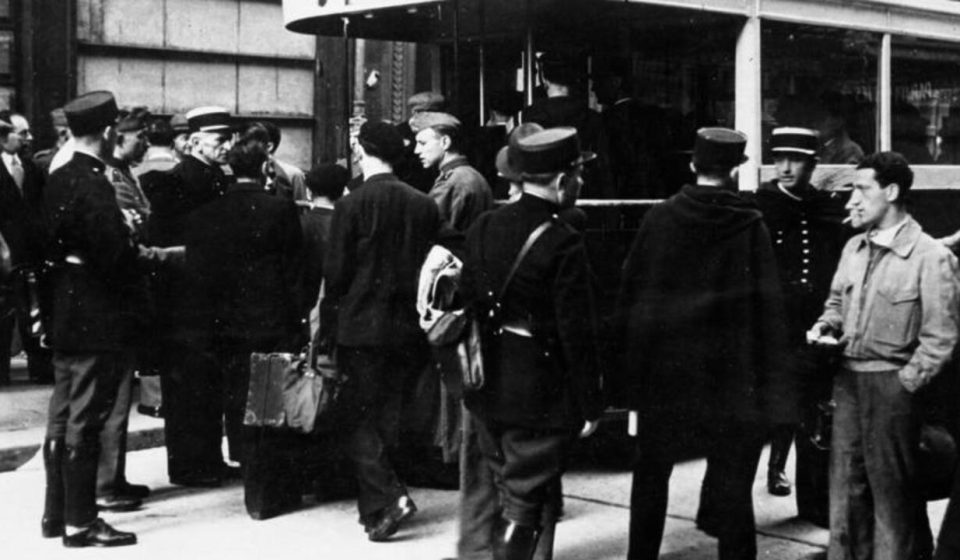
On this summer day, a mousetrap was set up in this district in the east of the capital. Roadblocks block the streets. The Charonne, Voltaire, Saint-Ambroise and Oberkampf metro stations remain closed. From 5:30 a.m., 2,400 French police officers supervised by the Feldgendarmerie cordoned off the 11th arrondissement where the Jewish population was very numerous. They are equipped with cards with the identities of nearly 6,000 men of various nationalities to be arrested, aged between 18 and 50.
“The roundup of August 20, 1941 was the second large-scale roundup that affected the Jews of France and more particularly those of Paris, after the so-called ‘green ticket’ roundup which took place on the previous May 14,” explains historian Alexandre Bande, a specialist in the Shoah. “In the very particular context of Operation Barbarossa initiated on June 22, 1941 by Nazi Germany and its allies against the USSR, the German occupation authorities in France chose to radicalize their policy of repression and make communists and Jews their preferred targets,” specifies this doctor of history, associate professor at the Janson-de-Sailly high school.
Also readThe kiss of the “greenback” roundup: “a unique photo on the Shoah”

The French police patrolled the 11th arrondissement during the raid of August 20, 1941. © Historical Library of the City of Paris
The orders come from the Militärbefehlshaber in Frankreich (MFB), the highest authority of the German military administration based in Paris. “This raid is organized by the Jewish Affairs Department of the Gestapo (Sipo SD) and is carried out by the Parisian municipal police, without the French government having been consulted or informed, and is controlled by German soldiers,” explains the historian.
Arrests take place at the homes of the wanted people and even in the street. Almost everywhere, Jewish men are checked, then taken to the police stations of the 11th arrondissement. On the evening of August 20, 3,022 Jews were arrested. Theodor Dannecker, representative of Adolf Eichmann and head of the Jewish affairs department of the gestapo in Paris, considers this result insufficient. The arrests therefore continued for several days. “On the evening of August 25, 4,230 Jews, foreigners but also French, around 1,500 including 40 lawyers from the Paris bar, were arrested,” counts Alexandre Bande.
The opening of the Drancy internment camp
Like Berek Grimbaum, all were taken to the Drancy camp, opened in haste. After temporarily hosting French and British prisoners of war held by the Wehrmacht in July 1940, it was requisitioned to intern newly arrested Jews. “This camp was set up by the occupation authorities in a large building that was then unfinished, belonging to a collective housing complex called the Cité de la Muette. It is a U-shaped building with four floors, around a courtyard approximately 200 meters long and 40 meters wide,” describes Alexandre Bande.

The arrival of the first internees in the Drancy camp on August 20, 1941. © Mémorial de la Shoah/coll. Bundesarchiv
Arrested on August 20, 1941, Jacques Angel, then aged 19, from a Jewish family in Turkey, recounted in his memoirs published in the Revue d’histoire de la Shoah the shock felt upon arrival in Drancy: “The end of the day is trying. We are all tired, standing all day without eating or drinking anything, with now the added bonus of the absolute certainty of having to go through difficult times.”
As the days go by, the young man, arrested with his father, becomes more and more despondent: “Still the hunger that grips us all. We only think about that. Fatigue is starting to take its toll; people are talking less and less. Even those who displayed rock-solid morale are becoming silent.” Guarded by French gendarmes, the first internees thus suffered precarious living conditions. Overcrowded rooms, beds without mattresses, undernourishment, lack of hygiene, dysentery spread quickly among the prisoners.

Internees upon their arrival in the Drancy camp on August 20, 1941. © Mémorial de la Shoah/coll. Bundesarchiv
Convoy number 1
Released on medical grounds, Jacques Angel survived the war. Berek Grimbaum will not be so lucky. On March 27, 1942, he was deported to the Auschwitz-Birkenau camp by the first convoy of Jewish deportees from France. The train is formed from the Bourget-Drancy station with 565 men from the Drancy camp, then it heads towards Compiègne, where it is completed with 547 men detained at the Royallieu camp.
“The victims of the roundup of August 20, 1941 therefore represent 53% of the total of 1,115 deportees attested to date from this first convoy,” observes Alexandre Bande. “The roundups of August 1941 also constitute the main group of deportees from convoy no. 3, which left on August 22, 1942. The others will, for the most part, be deported to Auschwitz by the convoys of summer 1942.”

A deportation convoy transformed into a memorial in Compiègne station. © Stéphanie Trouillard, France 24
Also readThe departure of the first deportation convoy of Jews from France
Despite its scale and its tragic consequences, this roundup has not been remembered, as Patricia Chandon-Piazza observed: “Many of my friends who know that my grandfather was deported think that he was arrested during the Vél d’Hiv roundup. Most people think that the roundups began in July 1942.” For Berek Grimbaum’s granddaughter, former President Jacques Chirac had the merit of recognizing the responsibility of the French State in the Vél d’Hiv roundup, but in return, it eclipsed the other waves of arrests. “We don’t compete between victims, whoever they may be, but it’s true that these raids are less known to the general public,” she regrets.
The historian Alexandre Bande shares this point of view. “The roundup whose memory dominates is that of July 16 and 17, 1942, known as the Vél d’Hiv, which became ‘National Day in memory of the victims of racist and anti-Semitic crimes by the French State and in homage to the Righteous People of France’, because of its scale and its impact with more than 13,000 arrests, but also because of its nature since for the first time in France, women and children were involved”, he summarizes, even if he emphasizes that the roundup of August 20, 1941 has been the subject of numerous historical works, notably on the part of Serge Klarsfeld, president of the association of Sons and Daughters of Jewish Deportees from France.
Also readVél d’Hiv raid: meeting with the last witnesses
“Don’t sum it all up at Vél d’Hiv”
To try to raise awareness of this roundup and these victims, the Convoi 1 association, which brings together descendants of those deported on March 27, 1942, decided to organize a gathering on the anniversary date, August 20, in front of the Paris Center town hall, in the 3rd arrondissement, to lay a wreath in front of the war memorial.
“It is true that it is complicated to organize things at this time of summer. The town hall is more focused on the demonstrations of the Liberation of Paris which take place a few days later. On August 20, the elected officials are still on vacation,” laments its president Roger Fajnzylberg. “But it is important to highlight this roundup because it is linked to the first convoy which initially had the particularity of not being a convoy of extermination, but of repression. There is a whole symbolism. We cannot summarize everything at the Vél d’Hiv”, adds this son of a deportee.
Also read“What I saw at Auschwitz”: the notebooks of a member of the Sonderkommandos revealed by his son
Alongside the families, the historian Alexandre Bande will be present. The co-author of the “New History of the Shoah” (Pastés Composés editions) spares no effort in publicizing this event. “Due to the period we are going through where some seem to forget where hatred of others and more particularly anti-Semitism can lead, it is important to talk about this episode which came to disrupt the lives of men, French or foreign, modest or more well-off, young or older, on the simple fact that they were Jewish,” he insists.
Even though he has been working on the subject for several decades, Alexandre Bande is still marked by these shattered destinies. Among these thousands of shattered lives, he especially remembers the fate of the Benezera brothers, David, Vital and Sabetaï, all three born in Constantinople (today Istanbul). These three men were all arrested during the roundup of August 1941. Deported to Auschwitz by convoys 1 and 2, none of them returned. “The death of most of them during deportation, most often at Auschwitz, makes this roundup one of the links in the genocidal process of which the Jews were the victims during the Second World War; it is essential not to forget this,” believes Alexandre Bande.
Patricia Chandon-Piazza also tirelessly maintains this memory. When her mother died, she added the name of her grandfather murdered in Auschwitz to the family grave “so that he would be somewhere”. Since her retirement, she has also been active within the Convoi 1 Association to highlight the fate of these men arrested 85 years ago. In particular, she created an interactive map listing all the addresses of deportees from the 11th arrondissement. In their memory, she will of course be at the commemoration of August 20: “I have the impression of bringing them back to life. It is essential to pass on this story, particularly to children and middle school students. To make them aware of it and to make them think.”