In the mid-2000s, a young woman in the South African province of KwaZulu-Natal was infected with HIV. Her story could have been just one more sobering statistic about the epidemic ravaging the region, but instead it became a source of inspiration for scientists and hope for millions. Enrolled in a study to track the course of newly acquired infections, the woman developed a fierce immune response against the virus over the next several years as study doctors treated her and took regular blood samples to monitor what was happening in her body.
Although she was unable to control the virus without the help of medication, the antibodies she developed against HIV are recognized as some of the most powerful ever discovered.1. The woman is known in literature as CAP256.
Scientists now believe that by mimicking some of the key elements of an infection like his, they might be able to train other people’s immune systems to produce equally powerful antibodies that can block a wide range of HIV strains. Ultimately, they say, they could achieve one of the most elusive goals in biomedical research: a vaccine that can stop HIV in its tracks.

The world has a golden chance to improve HIV prevention: don’t waste it
“We have prospects for an effective vaccine,” says Mark Feinberg, president and CEO of the International AIDS Vaccine Initiative (IAVI) in New York. “The scientific promise is greater than ever.”
This year, several teams have described vaccination strategies that, in monkeys, can trigger the production of what are called broadly neutralizing antibodies (bnAbs), molecules that can completely stop an infection from a wide range of HIV strains before it starts.2–4. “No one has reached this goal before. This is a very important step,” says Rogier Sanders, a virologist at the University Medical Center Amsterdam.
Humans who have received similar vaccine components may produce precursors of these bnAbs5–7suggesting that with further improvements, an effective vaccine is possible.
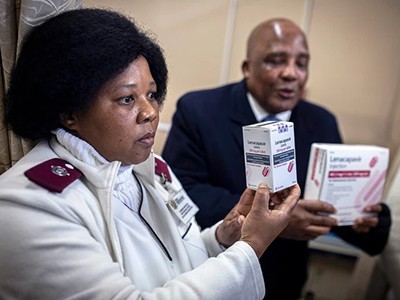
Success is by no means guaranteed, Feinberg says. HIV has proven to be a formidable foe for vaccine developers in the past. And there is another factor that adds to the complications. The availability of effective drugs, such as lenacapavir, that prevent HIV infection could make it difficult to assess the effectiveness of a vaccine. Meanwhile, devastating cuts in U.S. funding that supported preclinical and clinical HIV research have left some efforts on the precipice.
“We’re in a better position than ever, and right now we’ve seen funding sources cut off,” says Dennis Burton, an immunologist and virologist at Scripps Research, a research institute in La Jolla, California.
Shots in the dark
The last glimmers of success follow decades of failure. Initially, scientists seeking to develop an HIV vaccine followed a strategy that has proven successful for many other viruses, including hepatitis B: administer a lab-made version of the proteins that viruses use to attach to host cells, and the body should begin producing antibodies that will block infection. In the case of HIV, it is the surface protein known as the envelope that attaches to a molecular receptor on human T cells so that the virus can infect them. “There was only one protein, and so it seemed simple,” says Sallie Permar, a vaccinologist and pediatrician at Weill Cornell Medicine in New York.
Starting in the 1980s, researchers made vaccines containing the HIV envelope protein to produce antibodies against it, but these vaccines failed to prevent infection in clinical trial participants. HIV mutates rapidly and most circulating strains are still capable of developing infection. “With HIV, millions of strains are circulating simultaneously. Taking one out doesn’t do anything,” says Richard Wyatt, a viral immunologist at Scripps Research.

Trump has exploded the global fight against AIDS. Can he recover?
Researchers tried other strategies, such as vaccines that recruited “killer” T cells to eliminate infected cells, and those that delivered a greater diversity of proteins to overcome HIV’s penchant for mutation. In 2009, a clinical trial in Thailand found modest signs of protection for a vaccine that triggered both T-cell and antibody responses.8. But efforts to replicate these results failed and this strategy was also abandoned.
According to Feinberg, one of the main problems was that no one knew what the immunological signature – the measurable biological response after injection – looked like for an effective HIV vaccine. So the only way to evaluate a candidate was to conduct large-scale efficacy trials and hope for the best. “It was all just a shot in the dark,” says Burton.
This attitude began to change after the discovery of bnAbs. In the 1990s, teams led by Burton and microbiologist Hermann Katinger, then at the University of Natural Resources and Life Sciences in Vienna, identified the first of these in people living with HIV.9,10. These bnAbs could protect monkeys against infection with strains of HIV circulating in Europe and America, but would require high doses, which were unlikely to be achieved and maintained with a vaccine. And the protection was less effective against certain strains from Africa.
In the 2000s, Burton’s team developed a way to sort through large numbers of B cells — the immune cells that produce antibodies — to look for the rare cells that make bnAbs. After examining about 1,800 people living with HIV, they identified two highly potent bnAbs, made by a donor in Africa, that blocked infection by dozens of strains of HIV.11. “It set the field on fire,” says Burton.
In search of talented B cells
Researchers should learn how to train the immune system to produce these types of bnAbs. Strategies to achieve this have emerged from the recognition that bnAbs often develop gradually in HIV-infected individuals, such as CAP256. This happens through a “cat and mouse game” between a fast-evolving virus and an immune system that’s struggling to keep up, says Penny Moore, a virologist at South Africa’s National Institute for Communicable Diseases and the University of the Witwatersrand, both in Johannesburg, who analyzed CAP256’s blood.
To mimic this struggle in an uninfected person, researchers first deliver a “primer” immunogen – a part or full copy of the HIV envelope. This injection wakes up the B cells, prompting them to divide and become active. Subsequent doses deliver distinct versions of the HIV envelope to first “shape” and then “polish” the antibodies produced. The goal is to guide awakened B cells through a process called affinity maturation, in which antibodies develop extensive mutations that improve their binding and magnitude. The key is that the most capable B cells are recruited early and the antibodies they produce are perfected over time (see “Targeted Vaccines”).

Source: PJ Class et al. Nature Rev. Microbiol. 23734-752 (2025).
Sanders says this strategy, sometimes known as germline targeting, is a bit like searching for an elite footballer among groups of young players. Rather than trying to train everyone to an expert level, they want to identify talent as early as possible and bring them to superstar level. “We’re looking for talented B cells,” says Sanders.
Booster shots
Researchers have taken different approaches to detect these cells. After Moore and his colleagues discovered the CAP256 antibodies, they sequenced the viruses circulating in his blood to identify what might have triggered and shaped the production of the antibodies.
A modified version of the coat protein of one of these viruses has shown promise as an immune system priming agent in monkeys and is currently being tested in humans, says virologist George Shaw, who co-led preclinical work on this topic.2 with virologist Beatrice Hahn, both at the University of Pennsylvania in Philadelphia.
Another team, led by William Schief of Scripps Research, used computational structural modeling and cellular studies to design immunogens that activate a specific subset of B cells that make antibodies that can block the binding site by which HIV latches on to T cells.5.

Trump Team Destroys AIDS Eradication Program, Cuts HIV Research Grants
In small vaccination trials with protein- or mRNA-based versions of this immunogen12called eOD-GT8, almost all participants developed “bnAb precursors.” These are antibodies with the desired genetic and structural features of a bnAb that block the T cell binding site on the coat protein, but not the multitude of mutations that make bnAbs elite. In participants who also received a booster shot of a different immunogen, the antibodies detected mutations that improved their binding and neutralization abilities. “It worked wonderfully,” says Schief, who is also vice president of protein design at Moderna Therapeutics in Cambridge, Massachusetts.
Gn Health