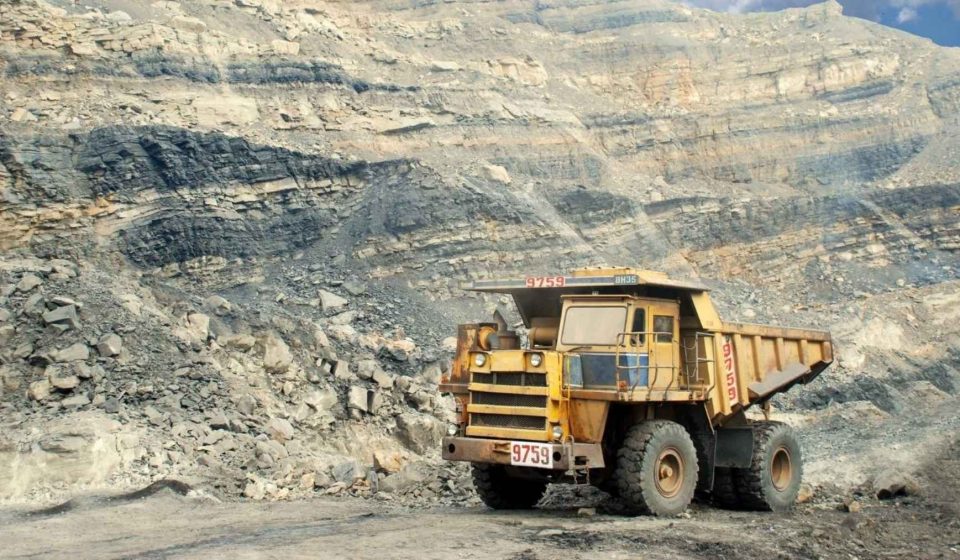
A stockpile of 261,000 tonnes of arsenic dust stored frozen in chambers up to 250 feet deep on the outskirts of Yellowknife gave researchers a sample that they transformed into more than 99 per cent pure metallic arsenic, from waste that would fill seven 10-story buildings.

There’s a good chance the phone in your pocket contains some arsenic. Gallium arsenide provides radio functions in many electronic devices, arsenic appears in some solar and battery technologies, and metallic arsenic is now on critical mineral lists in several countries, including the United States. So here’s a question I didn’t expect to be asked this week: what if one of the best untapped sources of an essential mineral was arguably Canada’s nastiest pile of mining waste?
This pile lies beneath the Giant Mine, a closed gold mine located just outside of Yellowknife, Northwest Territories. The mine’s roasters left behind 261,000 short tons (237,000 metric tons) of arsenic trioxide dust, and the Canadian Light Source says that’s enough to fill seven 10-story buildings or 9,480 dump trucks. Canada’s response so far has been to keep the frozen dust underground.
Now a team from the University of British Columbia and the Geological Survey of Denmark and Greenland has taken samples of this dust and converted them to metallic arsenic, which is more than 99% pure. Researchers put the converted material under the synchrotron beam at the Canadian Light Source in Saskatoon to study it, and it didn’t look like the arsenic you’d buy. The sample is very pure, explains GEUS researcher Case van Genuchten, but “its structure is completely different from that of commercial arsenic”.
So where do 261,000 tons of arsenic dust come from?
Giant was a productive gold mine, with The Northern Miner estimating its production at 7.6 million ounces between 1948 and 2004. The catch was the ore itself. Giant’s gold was encased in arsenopyrite, a mineral composed of iron, sulfur and arsenic. Back in the day, the way you broke arsenopyrite was by roasting it. Roasting expelled the arsenic as a gas, and this gas cooled into a fine dust of arsenic trioxide.
The mine collected the dust and piped it to mining stopes and workings at depth, and it continued to do so until owner Royal Oak Mines went bankrupt in 1999. According to Crown-Indigenous Relations and Northern Affairs Canada, the dust now fills 14 of the 16 stopes and workings set aside for it, all located between 80 and 250 feet below the surface and sealed behind cement partitions. The government’s own explainer goes out of his way to point out that dust doesn’t stay in barrels. The rooms also stay away from the lake and Yellowknife itself.
The stored dust contains about 79 percent arsenic trioxide, with iron, antimony and remnants of gold mixed in. Keep this thought about gold.
The stock
261,000 tonnes
Arsenic trioxide dust beneath the Giant Mine, equivalent to 9,480 dump truck loads.
The depth
80 to 250 feet
14 rooms and operated sites sealed behind cement partitions.
Cleaning
4.4 billion Canadian dollars
Remediation of frozen blocks, approved for a period of 100 years.
LABORATORY RESULT
The sample
>99% pure
Metallic arsenic converted from Giant Mine dust, verified at the CLS synchrotron.
The current plan is a freezer that will work for a century
Canada studied the possibility of removing the dust and decided against it, partly because removal would expose workers to the materials and partly because the rock around the sites is irregular enough that thousands of tons would remain anyway. The plan the government settled on is the frozen block method: freezing the ground around the chambers and keeping it frozen, at an estimated cleanup cost of C$4.4 billion. Natalie Plato, the federal sanitation official, told the Northern Miner the freeze was approved for 100 years.
Frankly, freezing your problem for a century is the kind of plan you come up with when all other plans seem worse. The government pretty much admits this, since its own documents indicate that there is no real opt-out option. The pumps must maintain groundwater below the chambers, and any seepage is collected and treated. If parking hazardous waste underground while everyone else seriously considers a permanent solution sounds familiar, Germany released a version of this film featuring radioactive barrels in a former salt mine.
The Giant Mine Oversight Board, the independent cleanup watchdog, continues to push research toward a solution that actually ends the problem instead of monitoring it. The new newspaper looks exactly like this.
Chemistry is pretty simple, at least on paper
The process, published in Environmental Science & Technology Letters, involves two steps that you can draw on a napkin. The first step dissolves the dust in water or a weak lye solution, and the team reports that 99% or more of the arsenic goes into solution, most of it within the hour the lye is involved. The second stage doses the liquid with thiourea dioxide, an industrial reducing agent, and more than 99 percent of the dissolved arsenic falls back as a metal in the best cases.
Basically, you rinse the poison from the dust, then force it to fall back out of the water as metal.
Do you remember gold? It doesn’t dissolve in the reaction, and the Canadian Light Source says this makes it easier to recover the precious remains once the arsenic is removed. A toxic waste treatment process that earns you gold is a pretty easy thing to love.
So why is the different structure important?
Chips don’t just care what item you feed them; they care about how the atoms line up. Commercial arsenic is in the form of an ordered crystal, while recycled material is poorly crystalline or downright amorphous. Van Genuchten wants to know if this difference helps or hurts when you try to build semiconductors from it, and as far as I know, no one knows yet.
Don’t order a phone from mining waste yet
A 99 percent pure product represents a big problem for processed mining waste and is still far from a wafer. The arsenic used in chip manufacturing is refined to a purity containing several extra nines, so there’s real chemistry between this powder and your next gadget. So far, the work is also lab-scale, done on samples rather than tons. And the paper doesn’t put a price on running the process in volume; I also haven’t found a cost estimate anywhere else.
The team isn’t looking down on any of this. Tamara Etmannski, the UBC engineer on the project, wants large quantities of metallic arsenic for electronics manufacturing, and she wants the stockpiles themselves to disappear. Canada has recently taken a liking to this sort of thing; an Ontario project is turning captured carbon into stone. “It would be exploiting its own waste,” Etmannski told CBC.
Etmannski and van Genuchten published the results in Environmental Science & Technology Letters on August 11, 2026, and Etmannski says the next step, once the team shows it can make a semiconductor from the converted arsenic, will be to determine whether the process can be scaled up at the Giant mine itself.
Gn bussni