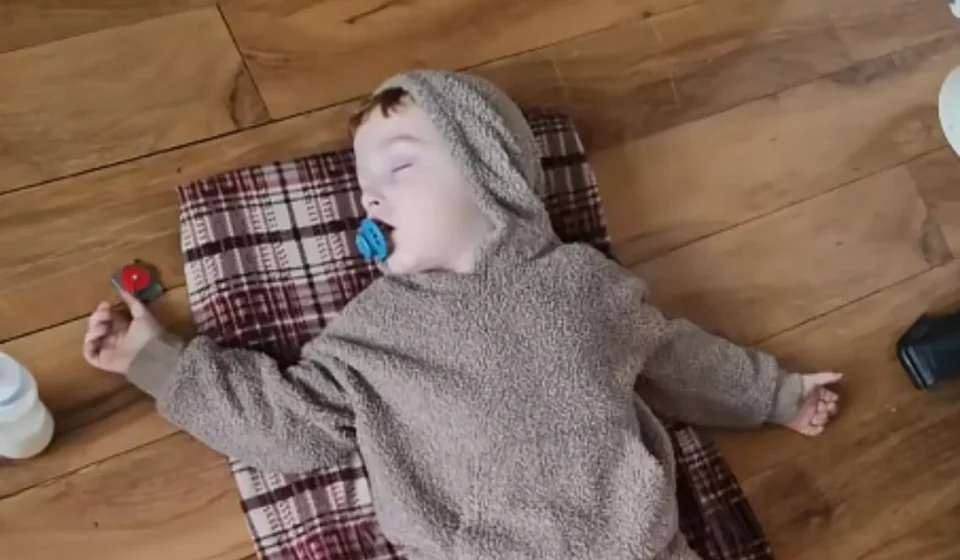

When a 2-year-old British boy seemed constantly exhausted, his mother thought it might be due to a vitamin deficiency.
The reality was worse than she could have imagined.
One morning, Kim Phelps and her partner Arron noticed that their son, Brooklyn, had a swollen mouth and puffy eyes.
Learn more on Family and parenthood

“We of course rushed him to the hospital, expecting it to be some sort of reaction to something, but obviously hoping for some sort of test to see what it might be,” Kim, 30, said. News week.
At the hospital, doctors detected a slight heart murmur, but said they weren’t too concerned and would refer him for further testing.
Brooklyn was given antihistamines and released.
The next morning, Brooklyn woke up with severe dark bruising around his eyes, one worse than the other.
Kim, who is also mom to Aria, 10, and Clark, 8, took him back to the doctor after also noticing bruising on his legs, small pinprick-like marks and swelling around his stomach.
“I told all my concerns to the doctor and he just told me it was the same reaction and they wouldn’t draw blood because they wouldn’t show anything,” she said. “So we went home.”
Less than a week later, Kim became concerned when Brooklyn spent almost an entire day sleeping and barely ate or drank.
Unable to get a doctor’s appointment, she took him to the hospital.
A triage nurse advised taking him to the area’s main hospital for blood tests because of the pinprick-like rash.
“Finally we were getting somewhere,” Kim said. “I was still hoping it was just a deficiency. Of course, I didn’t want to think the worst.”
At the main hospital, Brooklyn was triaged and initially played for a while, but Kim noticed he needed to sit down and rest every few minutes.
“At this point, after Googling his symptoms every day for those weeks, adding extras each day, I began to realize that they were all starting to point to one thing: leukemia.”
About two hours passed as Kim waited alone, while Arron remained convinced that their son was fine and perhaps just needed some vitamins.
She also tried to reassure herself, but couldn’t shake the feeling that something was wrong.
His concern increased when a doctor told him that a more experienced doctor had been called in to review Brooklyn’s blood results.
She sent a message to Arron and asked him to come to the hospital.
The primary doctor examined Brooklyn, asked Kim to review her symptoms, and left to look at her blood work again.
Before Arron arrived, the doctor returned with a nurse and told her that Brooklyn had a high number of abnormal white blood cells, as well as low levels of platelets and hemoglobin.
He then delivered the devastating news that doctors believed Brooklyn had leukemia.
“My whole world felt like it was shattered into a million pieces,” Kim said. “I looked at Brooklyn and it felt like my chest was being stepped on. Imagine a world without him, his innocent little body taken over by this horrible disease.”
When Arron arrived at the hospital, he completely collapsed.
“He kept asking the same questions I was asking: ‘Are you sure? Is he going to die? How long does he have left?'” Kim said. “It was very painful for all of us those first few days.”
Watching Brooklyn undergo test after test made her mother angry because, in her opinion, her earlier concerns had not been taken seriously.
He was exhausted and distraught as doctors performed a chest CT scan and other exams, including tests to check whether the cancer had spread behind his eyes.
Kim couldn’t help but think about what could have happened if Brooklyn’s condition had gotten worse after they had already sought help and been sent home.
She thought the situation should never have gotten to this point. But in the midst of the anger, one thought overshadowed everything else: she wanted her son to be okay.
Brooklyn was diagnosed in February following a bone marrow aspiration and began chemotherapy within a week. He spent six weeks in hospital during the initial phase of treatment, during which his weakened immune system left him vulnerable to serious skin infections.
Despite a rocky start, Brooklyn responded well to the initial five-week onboarding phase and was subsequently placed in the intermediate-low risk category.
Her current regimen includes daily and weekly oral chemotherapy, treatment every four weeks, and five-day courses of steroids, as well as other medications to help prevent infections and manage side effects.
He is expected to undergo around twenty procedures under anesthesia during his treatment, which is expected to continue until March 2028.
“He’s such a brave little boy and he has an army around him,” Kim said. “We have all been through so much, but we are so grateful that he is getting treatment and that our little boy is getting better.”
Gn Health