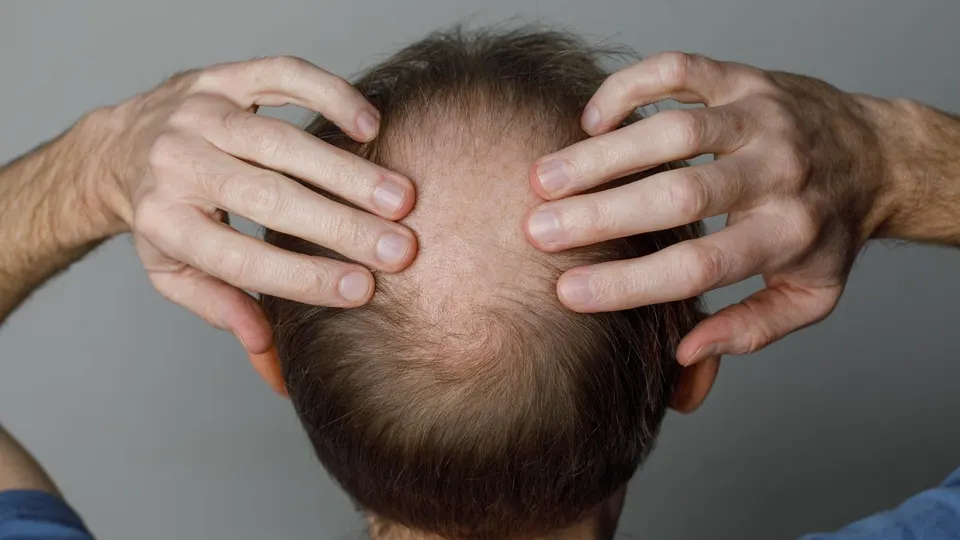


A trait that looks like a conception flaw may be a vestige of the hormones that shaped men in their prime, or it may be a signal in itself.
getty
Hair is one of the defining characteristics of mammals. It keeps us warm, protects skin from the sun, and, on the human scalp, grows longer and more densely than almost anywhere else on the body. So it’s strange that such a large proportion of men lose it. Nearly half of men experience noticeable hair loss by age 50, according to a clinical review published in Endotextand this proportion continues to increase with age.
For a biologist, such a common trait is a puzzle. If losing hair were really expensive, we would expect natural selection to gradually eliminate it. Yet male pattern baldness persists across populations and generations. This suggests that it is either harmless enough to escape selection, linked to something beneficial, or doing its own job.
What actually happens to men’s scalps
The medical name for the condition is androgenetic alopecia. The name refers to its two ingredients: androgens (hormones like testosterone) and genes. The key player is dihydrotestosterone, or DHT, a more potent hormone that the body makes from testosterone.
In genetically susceptible men, scalp follicles on the crown and temples respond to DHT by gradually shrinking, a process called miniaturization. Each growth cycle produces shorter, finer hair until the follicle produces little more than fuzz. Follicles usually do not die immediately. They simply stop producing the thick hair they once did.
Genetics is more complicated than the old folk wisdom that baldness “comes from your mother’s side.” An important gene, which codes for the androgen receptor, is found on the X chromosome, which men inherit from their mothers. But a 2017 study published in PLOS Genetics found that many genes in the genome each contribute a small effect. This is why this disease exists in families without following a simple pattern.
The Androgen Paradox in Men
The same hormones that thin the scalp thicken the beard and body hair. Dermatologists sometimes call this the androgen paradox. Follicles located in different parts of the body react in opposite ways to identical hormonal signals.
This paradox is the best clue to the main evolutionary explanation. Androgens do a lot of work in a young man’s body. They build muscles, deepen the voice, and promote the development of traits related to reproductive competition. Genes that stimulate androgen signaling may be beneficial in early adulthood, even if they come at a cost decades later.
Evolutionary biologists call this antagonistic pleiotropy: a single gene has multiple effects, some helpful early in life and others harmful later. Natural selection weighs more on early benefits than later costs, because traits that help people survive and reproduce during their youth are passed down more reliably. Biologists sometimes describe the final decades of life as falling under a “shadow of selection.” According to this view, baldness is less an adaptation than a side effect that nature has never had good reason to correct.
It also helps that baldness is, from a medical point of view, virtually harmless. Baldness itself does not directly threaten survival or fertility, although some research has linked it to other health problems. A trait with a low cost and late appearance has very little pressure to disappear.
Could baldness be a signal for men?
A second, more speculative idea holds that baldness might have social significance. The idea dates back to a 1996 study published in Ethology and sociobiologywhich proposed that a receding hairline acts as an honest indicator of age and maturity. According to this view, it signals a man who has passed the peak of youth competition, perhaps someone who is seen as wiser, more stable, or less threatening.
There is modest support for the idea that people perceive bald men as older and, in some contexts, more dominant or more socially mature. It is much less clear whether this perception was ever important enough to shape human evolution. The signal hypothesis is generally treated as intriguing but unproven, a possible side story superimposed on the byproduct explanation. This fits into the broader framework of sexual selection, but remains an open question.
Men are not the only ones
Humans are not alone in this, which reinforces the idea that baldness has deep biological roots. Chimpanzees and orangutans may develop forehead thinning as they age. Stump-tailed macaques go bald in a pattern so similar to humans that scientists have used them to study the condition, as shown in a 1988 study published in Dermatology clinics describe.
The prevalence of baldness also varies among human populations. It is generally reported to be more common in men of European ancestry and less common in men of East Asian ancestry. This type of variation is what you would expect from a trait shaped by many genes and the different histories of human populations.
Together, the evidence paints a fairly coherent picture. Male pattern baldness is most likely a byproduct of the androgen biology that shapes men as adults. It persists because it appears late and costs little. Whether this also sends a social message remains debated.
Seen this way, a thinning hairline isn’t so much a dysfunction as it is a compromise. Evolution rarely optimizes a body over its entire lifespan. It builds what works quite well among young people, and the rest of us live with the fine print.
Do you think you understand why evolution has left so many men bald? Find out how much you really know about the forces that shaped the human body with this scientific test: Evolution IQ test
Gn Health