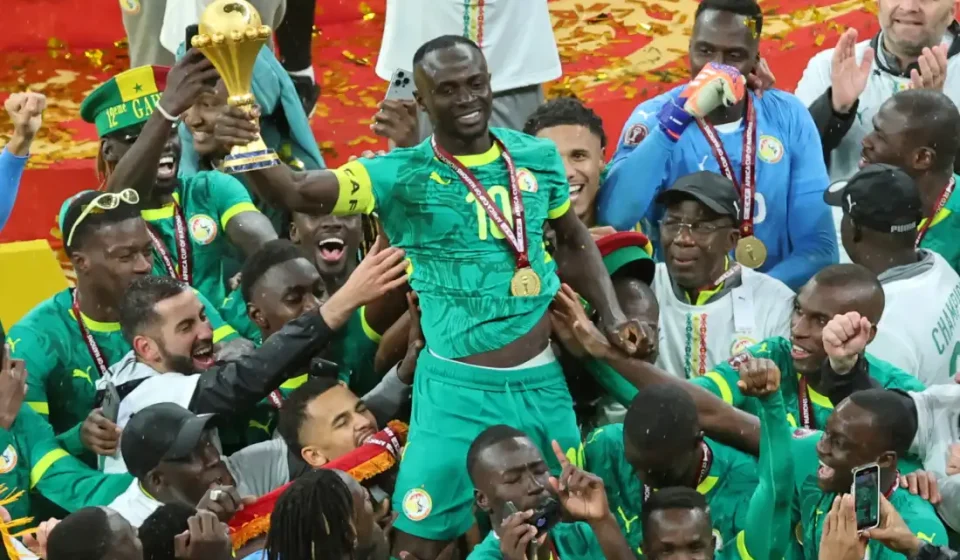

FILE – Senegalese Sadio Mané brandishes the trophy as he celebrates with his teammates his victory in the African Cup of Nations final between Senegal and Morocco in Rabat, Morocco, Sunday January 18, 2026.
Youssef Loulidi/AP
hide caption
Youssef Loulidi/AP
More than ten months after a chaotic and controversial final, Senegal is once again African football champion.
Senegal regained the Africa Cup of Nations title on Tuesday in a legal battle after the Court of Arbitration for Sport overturned an earlier decision that awarded the trophy to Morocco.
Senegal won the African Cup on the pitch in Morocco in January, then lost it in a court case in March because its players left the field in protest in second-half stoppage time.
CAS has now rejected this earlier decision, based on referee Jean-Jacques Ndala’s decision to let the match resume after the protest.
“The Court of Arbitration for Sport has done justice to sport,” said the president of the Senegalese football federation, Abdoulaye Fall, in a statement.
The legal battle may not yet be over after Morocco announced plans to appeal, likely to the Swiss Supreme Court, to challenge the integrity of a top CAS judge.
Tournament regulations state that a team that refuses to play must be considered to have lost the game, but CAS said these rules only apply to cases “when the conduct of a team leads the referee to permanently interrupt the match.”
Ndala “did not commit a legal error” when he resumed play and had “the sole power” to make that decision, CAS said, adding that its three judges were unanimous.
“The panel recognized that the arbitrator had to make a decision in an atmosphere of extreme tension,” the CAS said. “However, these circumstances do not justify characterizing the decision as ‘arbitrary’. On the contrary, the referee’s judgment does not appear to have been affected by factors external to the game.”
Morocco expresses its concerns about the CAS process
The Moroccan football federation has detailed its plans for an appeal against one of the three judges on the CAS panel.
In a statement, the Moroccan federation protested what it described as the court’s failure to address possible integrity concerns, alleging “confirmed communication” between German referee Ulrich Haas and Fall, the Senegalese football president, 48 hours before the decision was handed down.
The director general of the CAS, Matthieu Reeb, admitted to journalists present at the Lausanne court that a Moroccan protest had been received just a few minutes before the verdict was announced.
Reeb said the court’s committee “in charge of contesting motions recognized that there was not sufficient evidence at this stage to postpone notification of the award.”
CAS verdicts can be challenged before the Swiss Supreme Court, also in Lausanne, but only on limited procedural grounds, of which a judge’s integrity could be one.
Haas has been one of the most respected and in-demand CAS judges over the past 20 years, selected by the parties in landmark cases involving Manchester City following a UEFA Champions League ban, the doping case of tennis star Simona Halep and the 2019 African Champions League final.
Patrick Kabou, lawyer for the Senegalese Football Federation, described the alleged communication between Fall and Haas as “unreal”.

Troubles on the pitch and in the stands
Senegal won the final 1-0 after extra time amid chaos on the pitch and violent clashes in the stands. Even the ball boys were involved in scuffles as they tried to tear away the towels that Senegalese goalkeeper Edouard Mendy was using to keep his gloves dry.
The result was overturned two months later following a 3–0 default victory for Morocco by an appeal committee appointed by the Confederation of African Football (CAF).
Senegal beat CAN hosts Morocco after a 15-minute delay in play. At 0-0, the Senegal team left the field to protest the penalty awarded to Morocco in the last minute of regulation time.
Congolese referee Ndala eventually allowed the match to resume, Morocco’s penalty by Real Madrid striker Brahim Diaz – a slow shot known as “Panenka” – was stopped and Senegal won in extra time.
The drama continued through months of legal battles. Senegalese players paraded with the trophy before the match against Peru in March, even though Morocco were recognized as champions at the time.
Both teams entered the World Cup believing themselves to be the rightful champions of Africa.
Football laws versus regulations
Senegal had the laws of the game on its side and Morocco the rules of the tournament.
The laws of football state that referees’ decisions are final. CAS supported this position with its own “field of play” doctrine, according to which a referee’s decisions on the field generally cannot be carried over to the sports field.
“By blowing the whistle for the resumption of play, the referee considered that the conditions for the resumption of the match were met: the two teams were back on the field and both expressed their desire to resume,” indicated the CAS.
In the first court case in March, CAF appeal judges cited the CAN regulation that if a team “refuses to play or leaves the field before the regular end of the match without the permission of the referee, it will be considered a loser and will be permanently eliminated from the current competition.”
CAS judges heard the evidence in a one-day hearing last month and the court promised a verdict by the end of November with a full written decision from its judges setting out the reasons for their decision.
The next men’s CAN will begin in June and will be co-hosted by Kenya, Uganda and Tanzania. Morocco will aim to end a wait for the title which now lasts 50 years.
Senegal football fans celebrate a victory
“Senegal won on the pitch and the court simply confirmed what we all already knew: we are the true champions of Africa,” said Mariama Sidibé, 35, an accountant in Dakar, the capital.
Sidibé said the dispute between Morocco and Senegal must now be a thing of the past.
“With all this behind us, we should focus on what unites us now, and who knows, maybe Morocco can take its revenge on the field during the next CAN this summer,” she said.
“Ultimately, Morocco and Senegal are brothers,” Sidibé added, referring to the close ties the two countries have long shared, based on religion, trade and culture.
Sidi Sylla, a philosophy student at Dakar’s main university, said the court’s decision was “not only a victory for Senegal but for football in general”.
Historic decision
CAS decisions have stripped many athletes of their Olympic medals for doping, but it is rare to overturn the result of a major football competition.
CAS has refused to change the results of the 2019 Asian Cup, rejecting an appeal that the star striker of Qatar’s winning team should not have been eligible for the tournament.
The same year, a lengthy legal battle over the African Champions League final ended with the original winner, Tunisia’s Esperance, taking the title after their Moroccan opponent, Wydad, refused to continue playing.
A notable CAS decision on a team sport title occurred at the 2022 Winter Olympics. A doping case involving Russian figure skater Kamila Valieva, then 15, resulted in her disqualification and the Russian team went from gold to bronze in the team event.
Gn headline