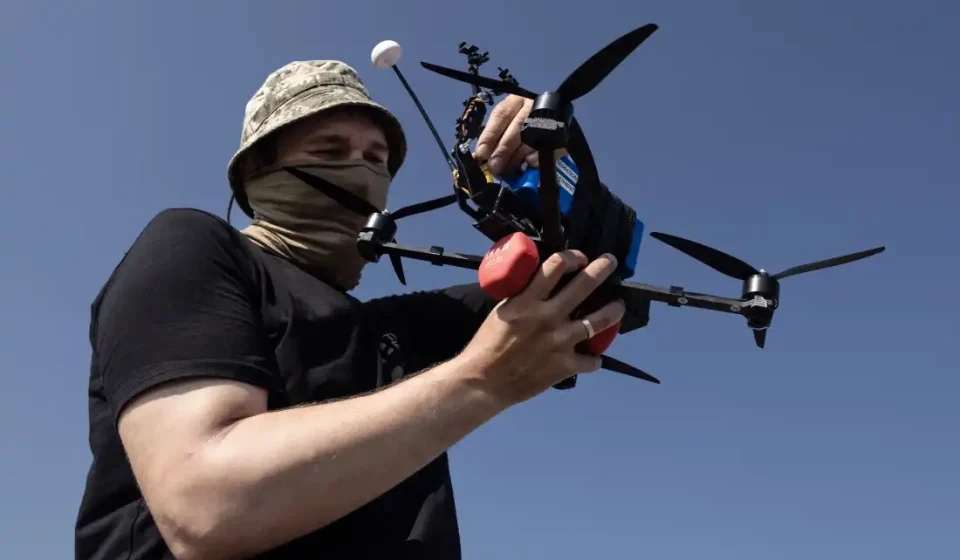
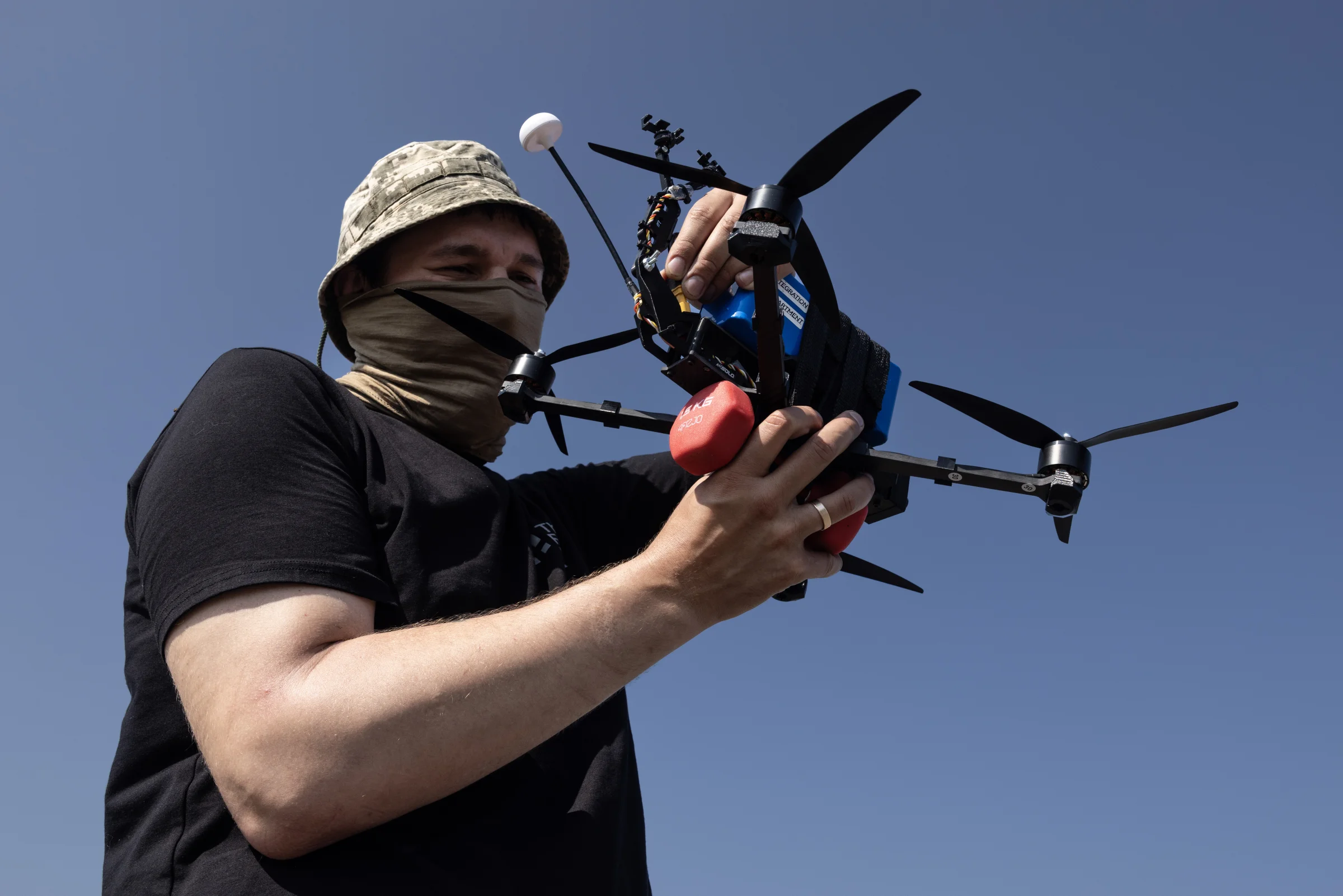
A drone operator with the military call sign Professor operates a Fourth Law Lupynis-10-TFL-1 at a test site in central Ukraine.
Paula Bronstein/for NPR
hide caption
Paula Bronstein/for NPR
kyiv, Ukraine — Like many tech entrepreneurs in Ukraine, Yaroslav Azhnyuk turned his attention to developing drone warfare after Russia’s 2022 invasion.
Drones have transformed the way wars are fought. Azhnyuk says artificial intelligence makes drones faster and more capable.
“When the other side has much greater capabilities, that gives you an asymmetric advantage,” he says. “It can make you 10,000 times more efficient.”
Azhnyuk heads Ukraine-based defense companies The Fourth Law and Odd Systems. They are among the leading companies producing AI-powered drones in Ukraine. Dozens of Ukrainian military units already use their autonomous drone, called Lupynis-10-TFL-1.
Russia is also deploying AI-enabled drones against Ukraine. AI warfare is part of a high-tech arms race that worries many, including Ukrainian President Volodymyr Zelenskyy. He has warned that AI could make decisions on the battlefield as early as next year.
Azhnyuk told NPR he acknowledges concerns about destructive weapons, but said it’s not specific to AI.
“This has been the case with humanity since the invention of fire or steel,” he says. “Any type of tool can be used for better or worse. And ultimately, it’s the human who decides how to use that tool.”
Cameras that “throw explosives”
Azhnyuk is 37 years old, a gregarious computer scientist from a family of scholars and scientists. NPR meets him in a conference room in Kyiv; for security reasons, he asked us not to reveal much else about the location.
He worked for years in Silicon Valley and founded several companies, including Petcubewhich makes smartphone-powered cameras that use artificial intelligence to observe and even entertain animals when they are alone.
“These cameras allow pet owners to monitor their pets when they’re not at home,” he says, “and throw treats at them and shine a laser toy at them. We’ve sold a million of these devices which are very popular in the United States.”
After Russia launched its full-scale war, Azhnyuk, then living in Ukraine, turned his attention to the defense space.
“I said to myself: OK, I have to leave Petcube and do something to protect my country,” he says. “And now we are no longer making cameras that throw candy, but cameras that throw explosives at people who have come to occupy our land.”
The cameras he’s talking about are part of an image recognition system built into first-person view, or FPV, drones.
“We are leaders in the field of autonomous drones and thermal cameras,” he explains.
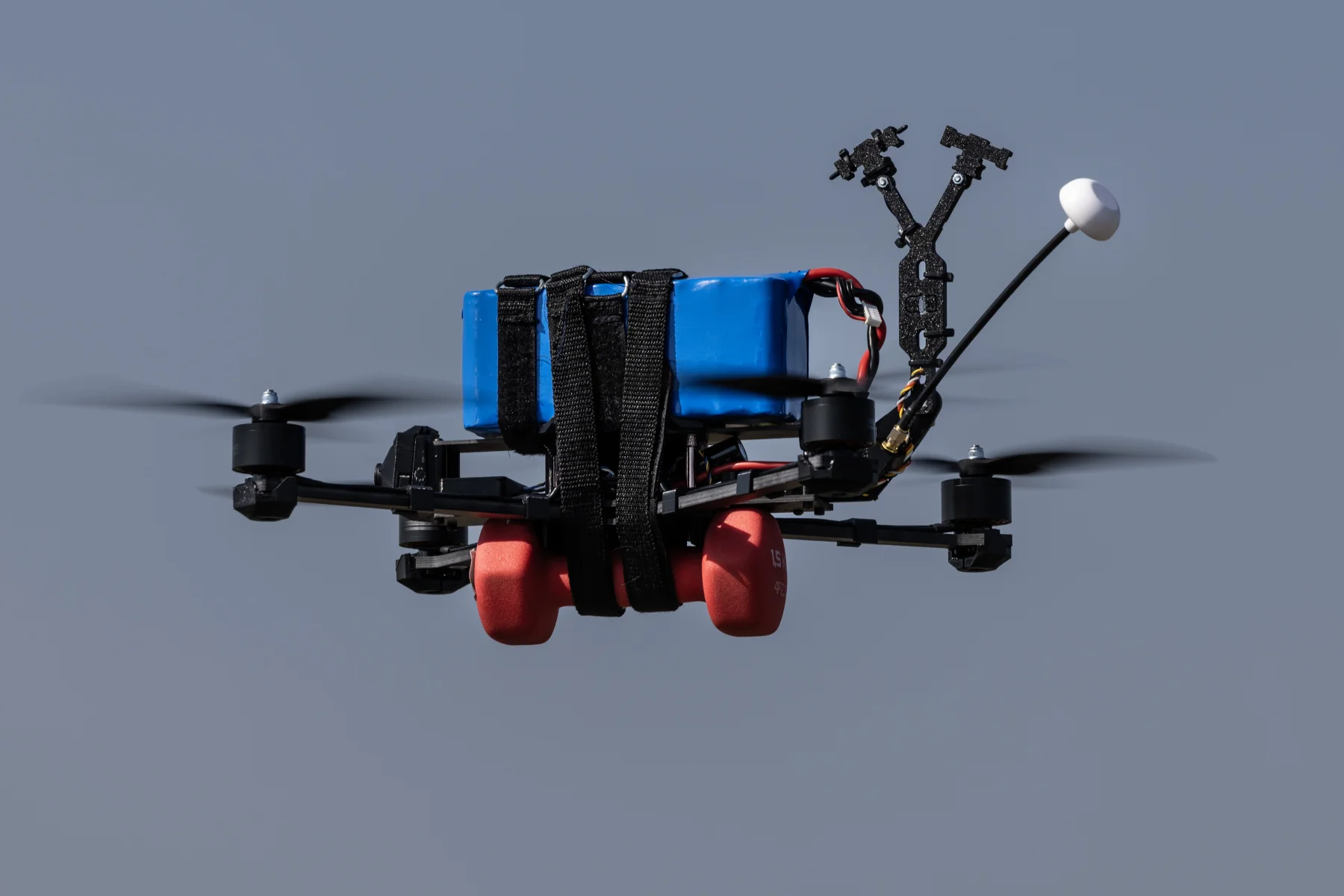
A Lupynis-10-TFL-1 drone is seen in the air at a test site in central Ukraine.
Paula Bronstein for NPR
hide caption
Paula Bronstein for NPR
A drone named after a poet
The Lupynis TFL-1 autonomous drone combines a small, affordable FPV drone with an autonomous terminal guidance unit. This means the drone has an onboard computer and AI technology that takes control for the last 500 meters (or 0.3 miles) of the flight.
“But it’s very different, for example, from the type of AI that’s in the data centers that power Claude,” he says. “Or even the kind of AI that drives your Tesla autonomously.”
Azhnyuk says this AI technology uses simple tools to recognize images and create intelligent software “that then allows you to either navigate autonomously without a human, choose a target autonomously, or fly towards the target autonomously.”
The Fourth Law autonomous drone is named after 20th-century Ukrainian poet and political activist Anatoliy Lupynis, who endured decades of Soviet imprisonment and psychiatric torture. The company named all of its weapons after Ukrainian intellectuals and artists killed or persecuted by the Russians in the last century.
“It’s important for us to help resurrect these people,” Azhnyuk says. “Their ideas are still with us. And now they are fighting back.”
“The drone does everything itself”
Fourth Law teams test Lupynis TFL-1 drones daily. We meet a team in an overgrown field outside Kyiv. They set up a fold-out table near a grove of trees and a hornet’s nest.
A thin man with blond hair stands up from the fold-out table and says that he is the leader of the testing and integration team. It uses the military call sign Stab. The Fourth Law asked NPR not to reveal this location or the identities of those who work there for safety reasons.
Stab shows a drone.
“So here you see our camera, as well as the microcomputer inside this 3D model,” Stab explains. “The whole spirit is there,” he adds with a laugh.
The microcomputer inside the drone runs on a deep learning neural network that uses hours of combat footage to recognize targets.
“Like vehicles, light armored vehicles, tanks and flying objects,” he says.
The drone begins its flight guided by a pilot, who also asked us to use his call sign, Professor. He pilots the drone with a control stick. He selects a target and checks a video monitor. Then he sees a red flash.
“That means it’s locked,” Stab says.
The drone locked on its target: a dilapidated car that an employee was driving on a dirt road. The professor lets go of the control stick. The drone heads towards the car. The microcomputer inside constantly runs algorithms to stay on course.
“You see, the professor doesn’t do anything and the drone does everything itself,” Stab says.
On the battlefield, the drone carried an explosive to hit the car. The test drone does not have one.
Stab says AI drones are useful because they are difficult to jam. He also insists that safeguards are in place so that Fourth Law drones don’t go rogue. Humans choose the target, he says.
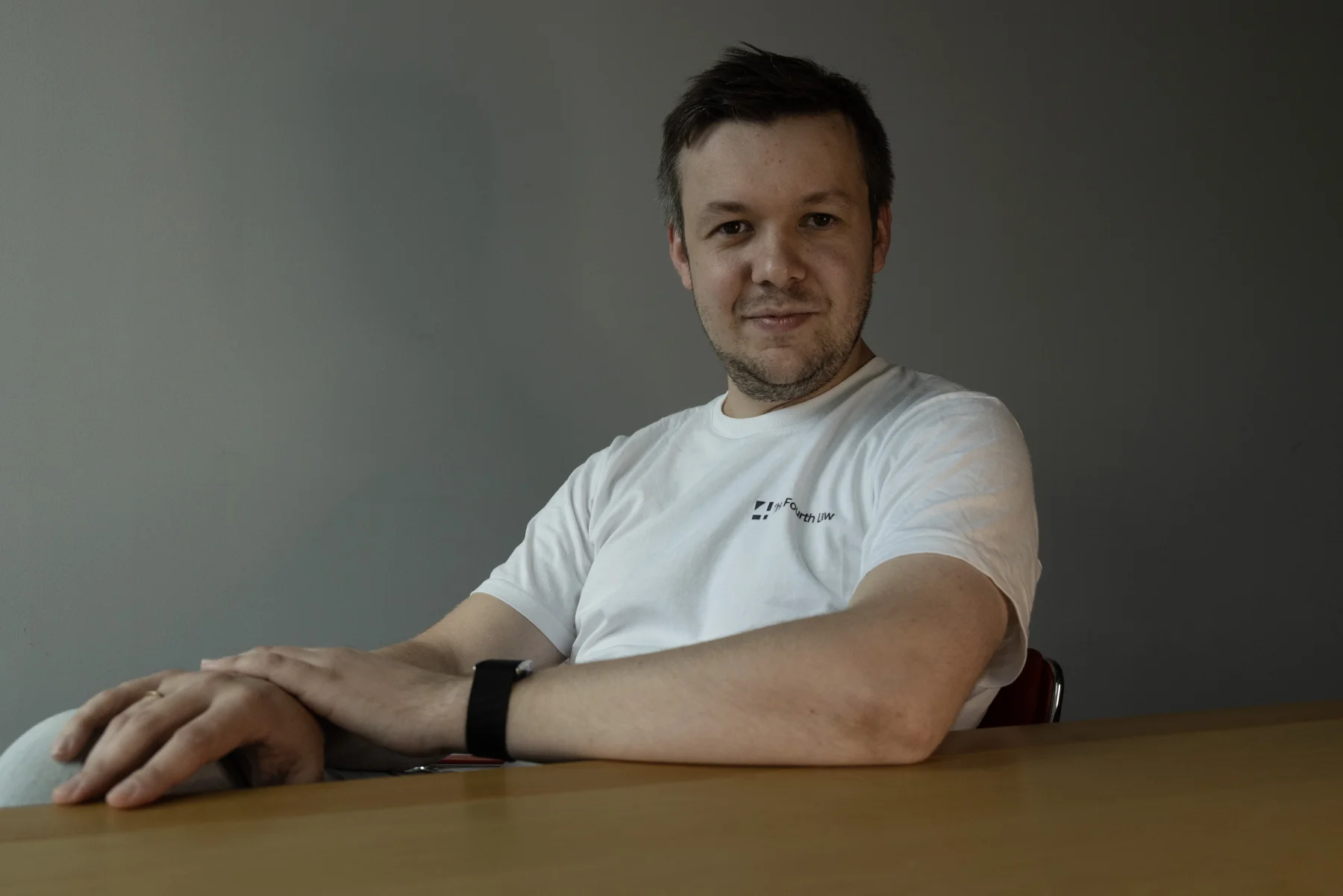
Yaroslav Azhnyuk, founder of AI drone company The Fourth Law, previously worked in Silicon Valley and launched several companies, including one that makes smartphone-powered cameras that use artificial intelligence to monitor and entertain animals when they are alone.
Paula Bronstein/for NPR
hide caption
Paula Bronstein/for NPR
Survival versus AI ethics
Back in the conference room, Azhnyuk says his company’s AI-powered drones are not killer robots.
“We’re very far from a Terminator type scenario, right?” he said. “They’re just some sort of calculator. As if they weren’t any more likely to cause a Terminator uprising than a warehouse full of artillery shells.”
He acknowledges, however, that AI is developing rapidly. “It is not unthinkable,” he says, “to imagine that in a few years there will be drones capable of making their own decisions about whether or not to designate targets.”
It’s the future. For now, he is focused on Ukraine’s current needs.
“Our adversaries are using the exact same technologies, and if they use AI to make decisions in an offensive scenario, and if we refuse to use AI to make decisions in a defensive scenario, we have lost, right?” he said. “Because their systems are capable of making decisions in microseconds and human control takes minutes, hours and sometimes days.”
If Ukraine loses, he said, “we will have no way to discuss the ethics of AI.”
The most important thing, he says, is not to die.
NPR’s Polina Lytvynova contributed to this story from Kyiv.
Gn headline