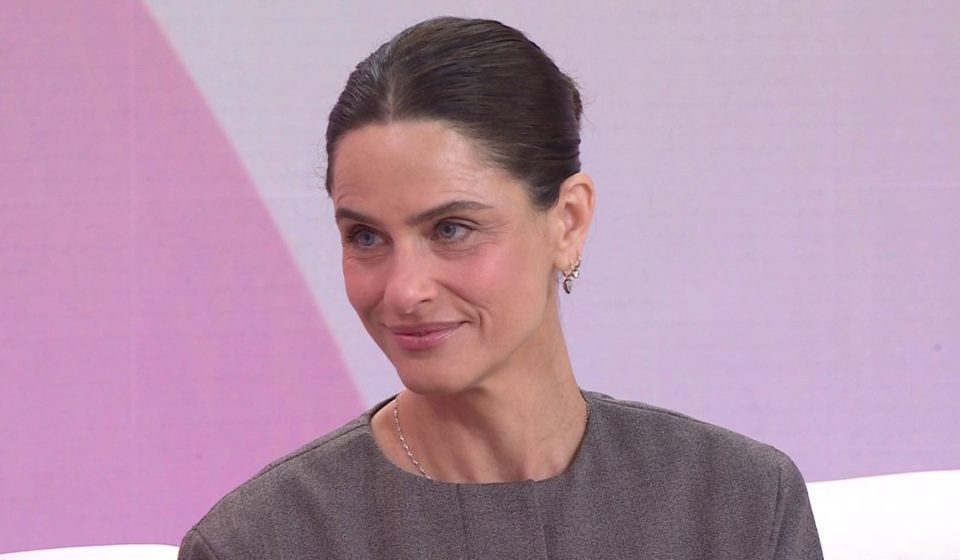
Amanda Peet reveals ‘strange’ first symptom of breast cancer. It wasn’t a lump: EXCLUSIVE

Amanda Peet was diagnosed with breast cancer last fall, but she had a warning sign that something was wrong six months earlier.
The actor revealed the “strange” symptom during an interview with TODAY on Thursday, October 1.
“I was in my closet, probably putting something on and feeling weird — it just didn’t look like normal skin, but it wasn’t the frozen pea that everyone talks about,” Peet, 54, told Savannah Guthrie, referring to what a breast cancer lump can feel like.
“I went in and even had an MRI, and then they sent me back. So I thought I was in good shape, but actually they were monitoring it.”
Six months later, on the Friday before Labor Day in 2025, the actor thought she was going in for a routine exam, when her doctor spotted something concerning on her ultrasound, Peet wrote in an essay for the New Yorker.
She knew something was wrong because her doctor, who was usually very talkative, remained silent. The doctor then took a biopsy and told her she would transport the sample to Cedars-Sinai and hand-deliver it to him on a Friday evening, another worrying clue.
Peet said she will never forget the moment she received her breast cancer diagnosis during a call shortly after.
Although lumps are the most common symptom of breast cancer, skin changes such as lumps, swelling, and redness can also be a warning sign. Skin that feels pitted, like the skin of an orange, is one of the symptoms of breast cancer that a doctor monitors for.
Once diagnosed, Peet recalls facing a “slow leak of information” about treatment options, genetic information and hormone receptor status. “If you’re an anxious person, this is your basic nightmare,” she noted.
The actor was diagnosed with hormone receptor-positive, HER2-negative lobular breast cancer and underwent a lumpectomy and radiation therapy.
Lobular breast cancer accounts for 15% of all new breast cancer diagnoses, according to the National Cancer Institute. Tumors don’t usually form as masses, making them difficult to detect, especially in women with dense breast tissue, he notes. Peet has dense breasts and has been told she needs extra monitoring. She visited a breast surgeon every six months for check-ups, she wrote in her essay.
Her cancer was detected early, at stage 1. “I think about how lucky I was in so many ways,” she said.
Peet previously told Hoda Kotb that she had excellent health insurance, support from friends and family, and a nanny.
“There were a lot of people around me to take care of me, but not everyone has that,” she said. “So I thought about it a lot as well.”
Gn entert