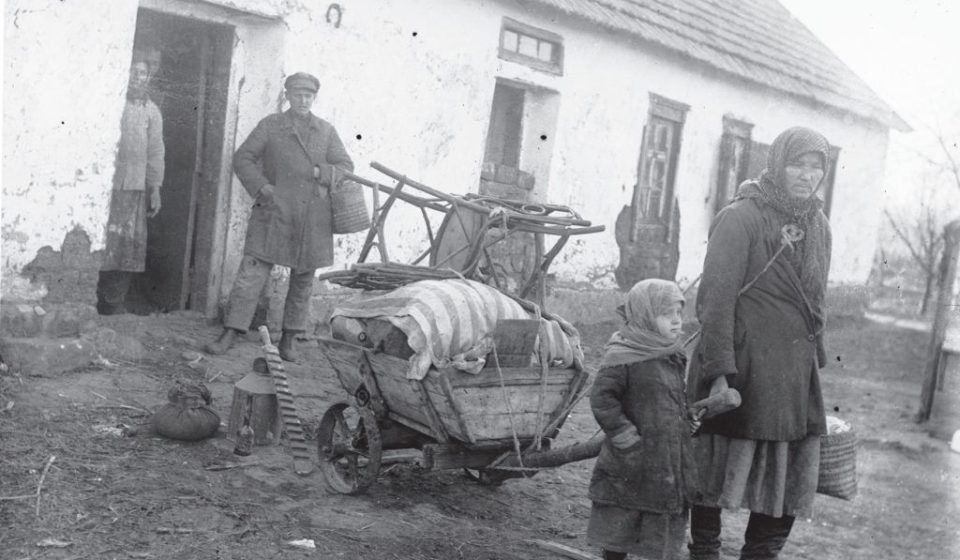
People suffer from starvation during the Holodomor, a famine imposed by Soviet authorities, which left millions dead in Soviet Ukraine in 1932-1933. (Alexander Wienerberger)
One can hardly imagine a more atrocious way to die or a more cruel act than to deliberately and knowingly starve millions of people. Women. Children. Elderly people.
This is what Moscow did to Ukraine almost a century ago for daring to dream of independence.
Today, as evidence mounts of Russia’s eliminationist goals and unspeakable war crimes, many remain cautious around the “G” word. Raphael Lemkin, the very man who coined the term, described Moscow’s attempt to erase the Ukrainian nation in 1932-1933 as the “classic example” of genocide.
Every November, as Americans gather around their Thanksgiving tables, Ukrainians around the world light candles in remembrance of the Holodomor, which claimed the lives of more than one in eight residents of their native and beloved country.
After the collapse of the Tsarist Empire in 1917, Ukraine declared its independence in January 1918.
The Russian Bolsheviks rode the white horse of proletarian emancipation, promising a better world, free from oppression and suffering, pointing the moralizing finger at Western imperialism as the root of all evil. In the same breath, these self-proclaimed liberators asserted Moscow’s right to subdue, oppress and murder anyone they could lay their bloody hands on. Ukrainians included.
By 1922, through war and mass violence, Moscow had reconquered much of its former imperial domain. Yesterday as today, Russia liberates its neighbors by occupying them, saves the lives of its “brothers” by murdering them in cold blood and brings prosperity through plunder and exploitation.
I grew up in Soviet-occupied Ukraine.
At school, we were told about famine through the prism of the so-called “class struggle”. Peasants who resisted collectivization were the enemies of progress. Враги народаor “enemies of the people”, to use Stalin’s expression.

Families who were trying to keep their children from starving, according to my teachers, hoarded grain reserves. It took me years to understand the enormity of the crime.
In 1933, Americans too were fed a perverse version of reality by the very person who was responsible for bringing them the truth.
“You can’t make an omelette without breaking eggs,” joked Walter Duranty, Pulitzer Prize-winning Moscow correspondent for the New York Times. While publicly dismissing reports of mass starvation as a “scary story,” he privately admitted to a British diplomat that Ukraine “had been bled dry.”
Duranty knew Stalin was starving Ukrainians, but he chose to lie.
Americans remember the confrontation with the USSR as a struggle between freedom and tyranny. Good and evil. But how many Americans know that on November 16, 1933, the same year that Moscow carried out genocide against the nation of Ukraine, President Franklin Roosevelt officially recognized the Soviet Union?
At a celebratory banquet at the Waldorf Astoria in New York, Duranty received a standing ovation. The man who didn’t tell the world about mass starvation was applauded at a dinner in America.
Another episode that apostles of American infallibility would rather forget is George HW Bush’s infamous 1991 “Chicken Kyiv” speech, in which an American president warned Ukrainians not to seek independence from Moscow’s suffocating grip.

Three years later, Washington did it again, persuading an independent Ukraine to give up the world’s third-largest nuclear arsenal in exchange for the security guarantees enshrined in the Budapest Memorandum. Ask Ukrainians how much it helps when Russian bombs explode next door and parents carry their children in tiny coffins to the grave.
Nearly a century after the Holodomor, as Washington once again seeks compromise with Moscow at the expense of Ukraine, one wonders what America has learned from this shameful history. Any unacknowledged betrayal is a repeated betrayal.
To understand why Moscow continues to reject any overtures for peace, consider what Ukrainian philosopher Volodymyr Yermolenko calls an imperialism of “imposed sameness.”
In July 2021, Vladimir Putin published an essay proclaiming that Russians and Ukrainians were one people. Seven months later, hundreds of thousands of Russian troops violated the borders of a sovereign neighbor to bring death and destruction to Ukraine for the crime of being Ukrainian.
UN investigators have called Russia’s expulsion and forcible transfer of Ukrainian children crimes against humanity.
In 1933, Moscow’s Chekists, the institutional ancestors of the KGB in which Putin found his calling, ensured that starving Ukrainian peasants remained in their villages to die. They were denied the internal passports needed to travel within the Soviet police state.
In a strange echo of the Holodomor, the residents of Russian-occupied Oleshky were reduced to eating weeds in 2026. It took the intervention of Pope Leo XIV and Melania Trump to secure a humanitarian ceasefire, allowing hundreds of people to escape the starvation to which the Russian invaders had condemned them. In the occupied Kinburn Spit region, around a hundred civilians, most of them elderly, lack food and medicine, their escape being prevented by Russian troops.
In March 2025, Ukraine accepted the US proposal for an unconditional ceasefire. Moscow spent the next twenty months inventing excuses to continue its war.
A Ukrainian nation that survives and thrives outside of Moscow’s orbit calls into question the very principle on which Russian imperialism, and therefore a Moscow-centered state, is based.
The peace Washington seeks depends on the Kremlin’s strength to accept what Stalin sought to extinguish nearly a century ago: the right of Ukrainians to exist as a nation, as free people who will not bow to a mad tsar.

Editor’s note: The views expressed in the opinion section are those of the authors and do not purport to reflect the views of the Kyiv Independent.
Gn world