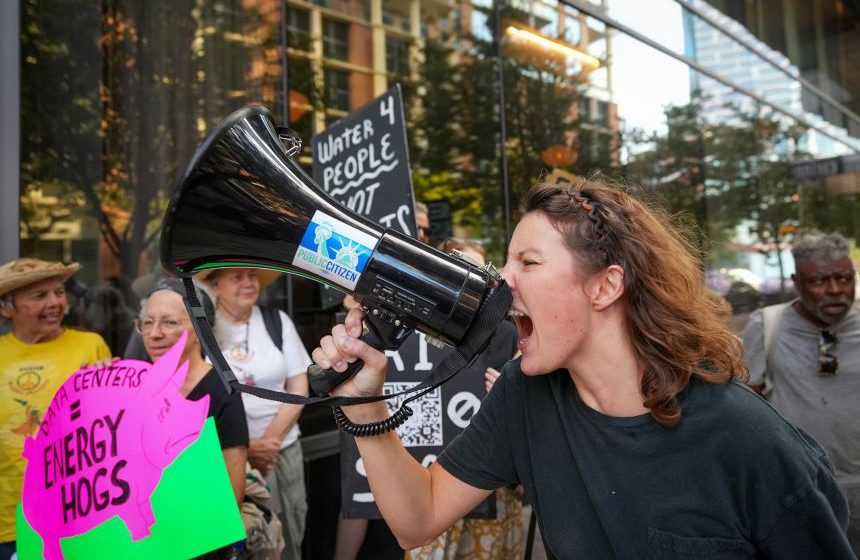
America has received the anti-data center wave it voted for. Here are the economic consequences

A stunning upset in the Texas gubernatorial race and Democratic victories across the country threaten to put the brakes on the biggest spending boom ever recorded in U.S. history.
That could disrupt a key growth engine for the U.S. economy.
In January, according to Goldman Sachs, Democratic-controlled states favoring extending or extending moratoriums on AI construction will account for 45% of planned U.S. data center capacity. A quarter of the planned AI infrastructure construction in the United States is expected to take place in Texas alone.
This does not mean that half of the planned data centers in the United States are suspended. The demand for AI is extraordinary. Donald Trump is still president and he is already waving his veto hat. And Democratic governors couldn’t stop all data centers from being built, even if they wanted to.
But Tuesday’s election nonetheless represents a paradigm shift that could alter the pace and direction of America’s AI spending spree — an investment boom that ING economists estimate has accounted for as much as a quarter of total U.S. economic growth this year.
These economic benefits are already real and support thousands of jobs. And AI has the potential to revolutionize the way we work.
But a slowdown in AI data centers could have significant silver linings. That could dampen rampant growth that has contributed to a rebound in inflation and led to widespread public antipathy toward technology and the data centers that house it. It could also put an end to some questionable business models that have sparked serious skepticism on Wall Street.
Slamming on the brakes could ultimately put AI – and the US economy – on a more sustainable path.

Spending on AI infrastructure is expected to approach $1 trillion a year, every year, for the foreseeable future, according to Stijn Van Nieuwerburgh, an economist at Columbia Business School. As a percentage of U.S. gross domestic product, this would surpass all other investment booms in modern U.S. history – including railroad building.
The outcome of Tuesday’s election could slow this spending, with far-reaching consequences for the thousands of jobs and massive economic development supported by AI.
Democrats won gubernatorial seats in Nevada, Georgia, Ohio and Texas, where candidates campaigned on strengthening data center regulations. The governors-elect’s proposals include ending tax breaks, strengthening climate and electricity restrictions and allowing local governments to impose their own moratoriums on data center construction.

But Texas is the big Kahuna. Wells Fargo estimates that for every 10% reduction in planned data center capacity in Texas, big tech companies will reduce their spending on AI infrastructure by an incredible 1.6% (which is a lot of money when measuring spending in trillions of dollars).
State and local politicians have a lot of jurisdiction and influence over this spending: enough to change the financing of some projects, said Mona Dajani, co-chair of Cooley’s infrastructure, energy and real estate department.
Hundreds of data center developments that are still awaiting permits, utilities or tax incentives could be particularly exposed, Dajani noted. But even ongoing construction projects could be at risk. Texas law grandfathers permits for certain projects, protecting them from future changes to local permitting requirements — but that doesn’t address changes to state permits or electric service guarantees that Gov.-elect Gina Hinojosa may leave behind.

Waiting for approvals could add significant costs for AI companies, Dajani said: Interest, equipment commitments and utility expenses will continue to pile up, even if a project is on ice. At some point, existing projects may cease to be financially viable.
If that happens, AI companies — which have already been scrambling to build data centers quickly enough to meet anticipated demand — may not be able to meet their explosive spending targets.
“This is a rare case where state and local leaders have influence of geopolitical significance,” said Harry Krejsa, director of studies at the Carnegie Mellon Institute for Strategy and Technology.
Data centers are not exclusively a Democratic issue: Americans have shown a bipartisan consensus in favor of putting in place safeguards around the construction of data centers.
Texas Republican Gov. Greg Abbott had already imposed a moratorium on data centers that Hinojosa campaigned to extend until lawmakers established stricter AI regulations.

But Trump has railed against any attempts to hamper AI growth and spending, citing economic and national security — especially in the high-stakes race against China. Many Republican politicians who would have otherwise supported AI regulations, including frameworks for building data centers, have remained silent.
Yet there is evidence that AI development may be following an unsustainable path.
The United States had 5,427 data centers at the end of last year, according to Stanford University’s AI Index report, and AI companies have announced plans for 3,969 new U.S. data centers, according to Aterio, a data center research firm. But only about 800 are under construction, and AI experts have raised doubts about the viability of many of the announced projects.
If Tuesday’s election results trigger a slowdown in investment, that could take some of the weight off the sector.
Example A: CoreWeave, a neo-cloud company that rents IT capacity, recently forecast losses so large that its bond yields soared to 15% – the danger zone. This was particularly worrying because the expected return on investment was only around 9%.
In other words, CoreWeave loses money on every dollar spent to increase its data center capacity.
The deep-pocketed hyperscalers – Amazon, Google, Meta and Microsoft – don’t have this problem. But their actions have come under fire in recent weeks as investors grow impatient with what they see as an unsustainable amount of spending that may not return a profit for years.
“AI is taking a break here,” said Joe Brusuelas, chief economist at RSM US.
Brusuelas expects growth to slow from last quarter’s 3.4% pace to closer to 2.4% if AI slows. This remains solid long-term growth. And the American economy is massive and diverse. Investments that otherwise would have gone to data centers can go elsewhere.
“The situation is slowing down, but that doesn’t mean we’re going to experience a recession,” Brusuelas said.

It also represents an opportunity for AI companies to get smart about the future deployment of their AI data centers – and embark on a more sustainable path.
The patchwork approach to building data centers has resulted in large sums of money going down the toilet on unfeasible projects – collateral damage from massive competition to be first and biggest. Data centers are already facing $200 billion in project delays, according to Mike Mathews, global digital infrastructure practice leader and Marsh risk advisor.
A more rational and politically sensitive approach could generate longer-term benefits for the communities that host data centers and for the AI companies themselves.
There is precedent for this. Over the previous decade, the Googles of the world had been building data centers for the cloud computing revolution, promoting the fact that they would be built sustainably with renewable energy – even before it was profitable to do so. A similar community-based approach could provide AI companies with the compute they need and give them the political and social license to operate their data centers for the long term.
“As the saying goes: if you want to go fast, you go alone; if you want to go far, you go together,” Krejsa said. “If you waste the political license to operate in your country, it will pose an even greater obstacle to remaining competitive with China. »
Gn bussni