
I don’t know how a museum holds real the plants collected by Lewis and Clark in 1806 end up on the chopping block, but it’s 2026, and here we are.
The Philadelphia Academy of Natural Sciences – the oldest natural history museum in the United States, founded in 1812 and open to the public since 1828 – permanently closes its doors on September 30. If you’ve ever taken a child to admire their imposing T. rex skeleton, this Sunday, September 27 is your last chance.
Beyond dinosaurs, there are a lot of things to say goodbye to. Dinosaur Hall alone is home to more than 30 species, including a 42-foot, 7.5-ton T. rex, as well as fossils, dinosaur eggs, and footprints. There’s also a living tropical butterfly garden, wildlife dioramas blending art and science, and a hands-on discovery area where younger visitors can interact with live animals.
The reason for closure is the most usual: money. Tours never fully recovered after COVID and the museum had already reduced its schedule to three days a week. Drexel University, which absorbed the Academy in a merger in 2011 and “manages” its endowment, says closing the museum protects the collections and allows it to “focus resources on the Academy’s enduring scientific assets and research.”
And these assets are truly wild. In the Academy’s herbarium are more than 220 actual plant specimens collected by Meriwether Lewis and William Clark during their 1804-1806 expedition – pressed, recorded and stored since the 1890s, after nearly 80 years forgotten in an attic of the American Philosophical Society. We’re talking about wild rice, tobacco, and other Western scientific firsts still in the works. (I’m a Lewis and Clark nut, so this is pretty devastating.) The collection isn’t thrown away, of course. The museum that surrounds it has just closed its doors to people like you and me.

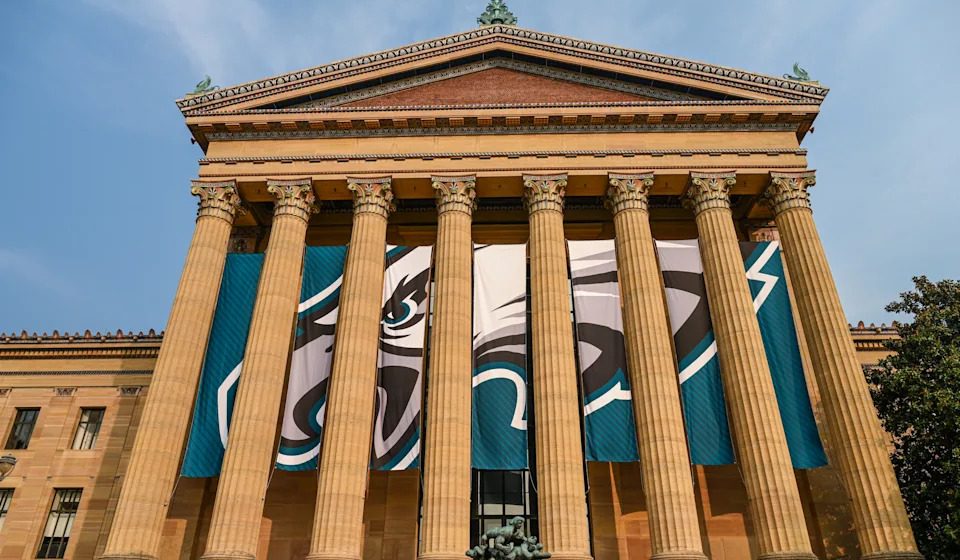
Flag of the Philadelphia Eagles football team between the columns of the Philadelphia Art Museum.
(Olga Kaya via Getty Images)But Philadelphians are fighting
Philadelphians are not taking this easy. City council members gathered at City Hall this month and introduced a resolution — with subpoena power — to investigate how the decision was made, claiming that the Academy never even asked the city for help before announcing the closure (I don’t know about you, but I smell something fishy). Council members are proposing several rescue options: tapping the institution’s endowment through the Orphans’ Court (isn’t that exactly what the endowment is for?), emergency state funding, municipal bonds, or historic preservation tax credits. Philadelphia has done it before: in 2006, the city raised $68 million in 45 days to prevent an Eakins painting from leaving the city.
The question is whether this kind of momentum can save an entire museum rather than a single painting. For now, the dinosaurs — and the 220-year-old plants that survived an attic, a forgotten decade and two centuries of Philadelphia history — have until Sunday. And I don’t know about you, but my heart is breaking a little. Seeing such a concrete example of science and knowledge fall by the wayside is a bit too much at the moment.
Let’s hope that a miracle of brotherly love can save this wonderful place.
If you love travel and nature as much as I do, I wish you could follow me on Yahoo Creators for more articles about our wild world. This shows the Yahoo team what their readers want – and the more brands that support the planet, the better.
Gn usa