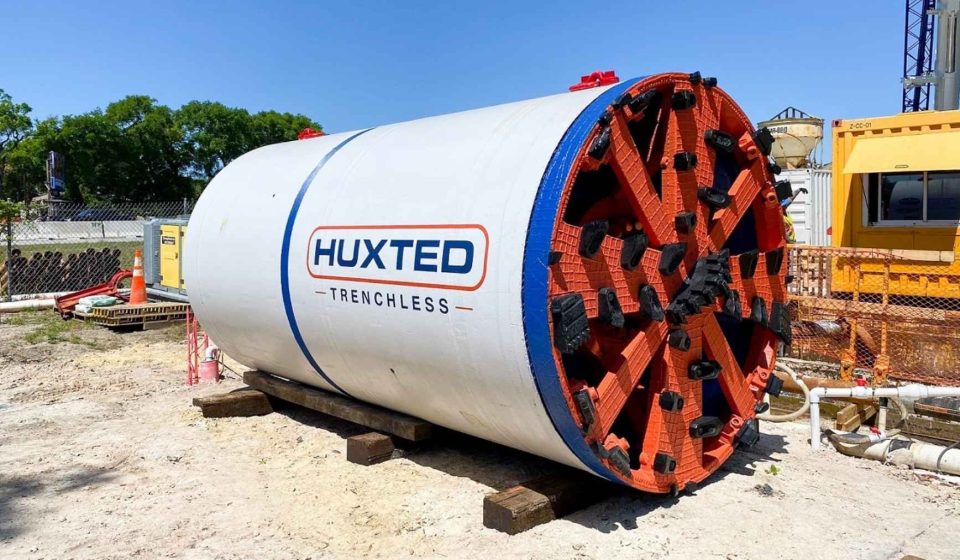
An 8-ton German tunnel boring machine gripped rock so its own cutting wheel couldn’t topple it, cut three 51-inch water intakes under a Georgia reservoir and exited three times through the lake bed for divers to recover, over a 35-foot raised dam to more than triple its storage.

Douglas County, Georgia, has known for more than a decade that its drinking water reservoir is too small. A study told the local water authority that the Dog River Reservoir could not get the county through another drought like the worst in state history. The solution, which is now under construction, involves raising the dam 35 feet and more than tripling the amount of water behind it.
That’s what matters to the county. What interests me is how to extract water from a reservoir that is about to be 35 feet deeper than it is today, because the answer turns out to be an 8 ton German machine that had to hold on to the rock to keep from turning over.
Huxted Trenchless, a microtunneling contractor based in Conroe, Texas, has completed three 51-inch water intake tunnels for the reservoir’s new pump station, according to a Sept. 29 interview with Global Trenchless by its field operations manager, Benny Burton. The machine was a Herrenknecht AVN1000HR, each tunnel was entered in a single pass and the end of each was the lake bottom.
So, what exactly is a microtunnel?
You’ve probably seen the big tunnel boring machines, the ones with names and a crew of a dozen people driving inside under a city. That’s not it. A microtunnel machine is a sealed steel cylinder that no one can enter, and an operator steers it from a cabin at the top of the shaft while a hydraulic ram frame pushes it forward through the ground. Each time the machine advances over a section of pipe, a new section is lowered into the shaft and the entire column is pushed behind it. The cutting head chews the rock up front, the water (or a bentonite slurry) carries the pieces back through pipes, and the machine essentially leaves a finished pipe behind as it goes. So in this case the three “tunnels” are actually three 51 inch pipes that will carry the raw water from the tank to the pumps.
Herrenknecht’s own description of the AVN1000HR gives you an idea of what’s going on up front. The HR stands for hard rock, and compared to the standard version, it has a stronger main bearing rated at about 250,000 pounds of contact force, a drive that spins the cutting wheel up to 17 times per minute, and a 177-horsepower motor that spins it. The wheel itself carries tungsten carbide tipped cutting discs rather than the scraping teeth you would use in clay.
What is his weight? Herrenknecht’s spec sheet for the AVN1000 series lists an outer diameter of 1,295 millimeters, which is where the 51 inches come from, a shield just under 10 feet long, and the heaviest part at 7,600 kilograms, or about 8.4 tons. The hard rock version carries that beefier bearing and drive, so I’d guess a bit more than that, but Huxted hasn’t released weights for his particular machine.
Why does a boring machine have to remember anything?
Here one thing you need to know about rotating a cutting head against hard rock is that the rock pushes back.
You know the feeling when a large drill bit gets caught in a piece of wood: the bit stops and the drill tries to turn your wrist instead. A microtunnel machine has the same problem, just with a cutting wheel more than four feet in diameter and several tons of steel behind it. The harder the rock and the more torque you put into the wheel, the more the body of the machine wants to turn in the opposite direction. Roll a few degrees and your steering, laser target, and slurry lines all end up pointing somewhere they shouldn’t.
Global Trenchless reports that because of the extra torque generated by driving hard rocks, this machine carries clamps located behind the rear box, the section that follows the cutting shield, to keep the whole thing from tipping over. The grippers are essentially hydraulic pads that press outward against the tunnel wall. The body leans against the rock it has just cut, the wheel continues to turn and the torque has a direction that is not that of the machine.
It’s frankly a pretty elegant solution to a problem that most people would never think of in a tunnel boring machine. Large open-faced hard rock TBMs also use grippers, but there they also do the pushing. Here, the thrust comes from the cylinders in the shaft, and the clamps are only there to stop the rotation.
The exit was the bottom of a lake
An intake tunnel has a tricky requirement that a sewer or utility crossing does not have. It has to end up in the water.
Which means the machine cannot enter a tidy receiving well on the other side. It crosses the lake bed, the tank spills into the tunnel and someone has to go get the machine. Huxted says they installed two bulkheads to deal with this problem, which are essentially two watertight barriers that prevent the flooded tunnel from flooding the launch shaft where the lifting frame and people are located. Divers then took care of recovering the machine from the reservoir.
We’ve seen this move before. An Oklahoma driller came out of the bottom of Kaw Lake on the Enid water intake, and the recovery produced some of the strangest photos ever produced by municipal water systems. Dog River’s job is the same trick three times, in rock, with a machine that must have held up.
What Huxted didn’t say was how long each journey took or how deep the tunnels were. The general contractor, a joint venture of Clark Water and Reeves Young, lists on Clark’s project page that the scope of the water intake is four microtunnels totaling nearly 550 linear feet, which equates to just under 140 feet each. Huxted says three. So either a fourth workout is still to come, or one of the four isn’t an admission, and I can’t tell you which one based on what’s been published.
What the three tunnels feed
The conduits lead to a new intake and pumping station that will house two 2,500-horsepower vertical turbine pumps. The new dam and spillway raise the water surface from an elevation of 760 feet to 795 feet, and the Douglasville-Douglas County Water and Sewer Authority says storage increases from 1.9 billion gallons to 6.5 billion.
Intake tunnels
3 x 51 in
Drilled in a single pass by a Herrenknecht AVN1000HR, heaviest part approximately 8.4 tonnes according to the manufacturer’s technical sheet.
Dam increase
35 feet
The water surface increases from an elevation of 760 feet to 795 feet.
Storage
1.9 to 6.5 billion gallons
More than triple the water behind the dam, according to the water authority.
TARGET
Completion
2029
Two 2,500 hp vertical turbine pumps in the new collection and pumping station.
The reservoir itself provides the county’s primary source of drinking water. Initially, it provided about 16 million gallons per day, then it was expanded to 23 million, and the authority says that daily figure remains unchanged. The extra 4.6 billion gallons are there to maintain that same amount of water during a dry year, which is apparently what this study says the old lake couldn’t do.
The price depends a little on who you ask. The authority estimated it at about $390 million at its groundbreaking ceremony, the Douglas County Sentinel used $400 million, and Global Trenchless is now talking about $440 million. Each of these projects makes it the largest public infrastructure project ever built in Douglas County, and the authority closed the Dog River Recreation Complex last year because the new water level would put the boat ramp and picnic area well underwater.
Clark says the entire expansion is expected to be completed in 2029, and water authority Executive Director Gil Shearouse said the goal is to have a completed and filled reservoir by the end of this year.
Gn bussni