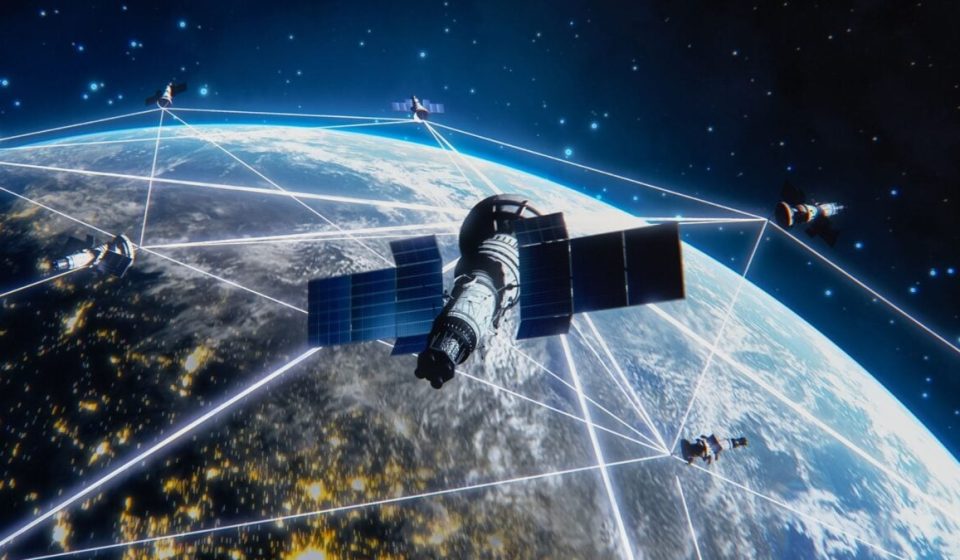
Satellite operators typically send commands as digital packets over the radio, but a group of amateur radio operators tried something a little more conversational: They spoke the command into a microphone. Specifically, they verbally ordered a satellite orbiting Earth to launch Lossmarking what appears to be the first time a voice instruction has been successfully sent and executed by a satellite.
The Oslo-based group sent a voice command to the European Space Agency’s OPS-SAT PRETTY, an experimental cubesat launching in 2023. The message was simple: “PRETTY PLAY DOOM.” Sure enough, the satellite detected the command and launched the 1993 first-person shooter video game. It even transmitted a postcard image of the moment, according to Tanagra Space, which develops machine learning aboard spacecraft.
While the experiment makes for a fun demonstration, it could also lead to more practical applications for satellite communications. The ability to recognize and respond to voice commands could eventually pave the way for more responsive satellites that can listen for distress calls or emergency signals and respond accordingly.
Just say the word
Satellites normally receive commands from Earth via radio frequency signals transmitted by ground stations. The process is called remote control and works a little differently than just talking to a device.
Satellite operators use specialized software to create digital commands, such as an instruction to adjust the orientation of the spacecraft. A ground station then uses a high-gain antenna to transmit these commands to the satellite as coded radio signals. An onboard radio receiver picks up the signal and the spacecraft’s computer decodes the digital instructions before carrying out the request.
According to Tanagra Space, the July 27 experiment marked the first time a satellite recognized and executed a voice command itself. Amateur radio operators tested the system twice that day. During the morning session, they transmitted a synthesized voice message in a continuous loop. Later in the evening, they went further, with an operator speaking directly into a microphone to give the order.
Both times, OPS-SAT PRETTY was able to capture the radio signal, recover the voice from the noise, and transcribe it with a speech-to-text AI model. The satellite then detected the command and acted autonomously.
A satellite that listens
ESA’s OPS-SAT PRETTY satellite is equipped with a processing pipeline designed to recognize voice commands, allowing it to process incoming audio and recognize spoken words.
The team behind the experiment believes that voice-activated satellites could have different uses in the future. “There may be an application there in terms of capturing (distress calls) on a global scale and acting immediately, instead of waiting for the Coast Guard or another vessel to respond,” Georges Labrèche, principal investigator of the project and founder of Tanagra Space, told SpaceNews. “Maybe this could be turned into a service where all of a sudden you can point into the air, call Mayday, and then a network of satellites is able to relay that immediately.”
This functionality could also be used for space observations. “When you do astronomical observations, like looking at gamma-ray bursts or black hole collisions, you’re looking for signals that have very specific patterns,” Labrèche said. “So maybe there will be a near future where, instead of training a model to recognize a human voice, we will train a model to recognize these astronomical events directly on board the satellite, so we can detect them more immediately.”
Gn tech