An Egyptian farmer discovered ‘an unusual stone’. This led archaeologists to discover pieces of statues of an ancient king.

Cairo — Egyptian farmer Khaled al-Shahat was working on his land when he came across something he had never seen before. This unusual pink rock has led archaeologists to dig up pieces of statues to King Ramses IIwho ruled Egypt from 1279 BC to 1213 BC
“I was working on my land on Friday when I came across an unusual stone,” al-Shahat told CBS News. “I informed the relevant authorities and they came to examine it.”
The stone turned out to be an ancient block of pink granite measuring about 1.3 meters long (about 4.26 feet) and bearing two royal titles of Ramses II: “Nesw-Bity” (king of Upper and Lower Egypt) and “Sa-Ra” (Son of Ra, the sun god), the Ministry of Tourism and Antiquities said.
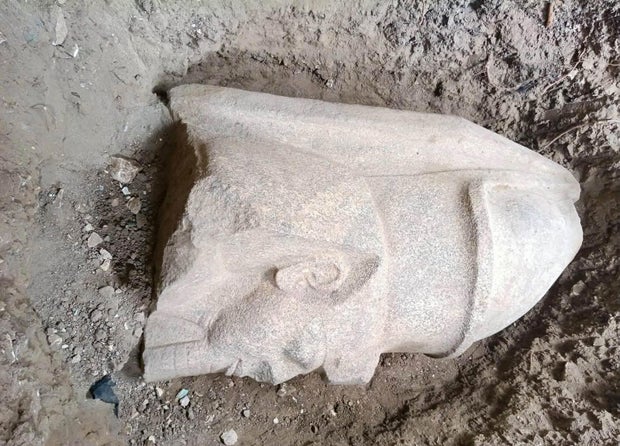
Archaeologists began excavations and discovered near the block a colossal head of a statue of Ramses II, measuring approximately 1.6 meters high (about 5.25 feet). The king is depicted wearing the double crown, symbol of the unification of Upper and Lower Egypt around 3100 BC.
Egyptian Ministry of Tourism and Antiquities 
On Wednesday, Minister of Tourism and Antiquities Chérif Fathy visited al-Shahat’s hometown in Al Gharbia Governorate in the Nile Delta to pay his respects.
The minister presented al-Shahat and his wife with certificates of appreciation and granted them a trip to Saudi Arabia to perform the Umrah pilgrimage in recognition of his honesty and responsible conduct for not keeping the discovery to himself.
Egyptian Ministry of Tourism and Antiquities 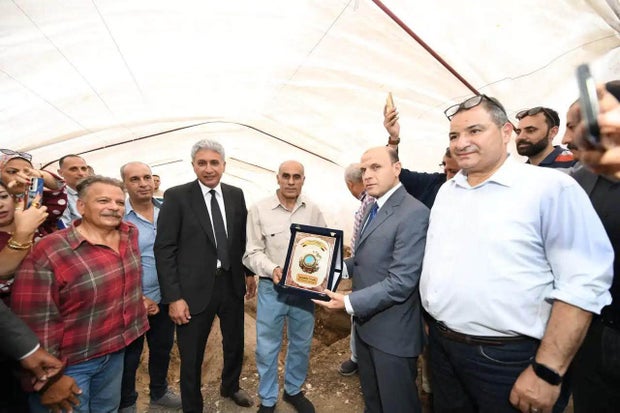
“The minister insisted that the citizen be honored in his village, on his own land, as well as within his family and fellow citizens, in recognition of his honesty, his conscience and his sense of responsibility,” the ministry said in a statement.
Archaeologists also unearthed the remains of the upper part of the statue’s rear pillar, bearing Ramesses II’s official royal title, or Horus name: Hor Ka Nakht Mery Maat.
The size of the head suggests the complete statue was about 28 feet tall, according to archaeologists.
“I was surprised and happy when they discovered more antiquities,” al-Shahat told CBS News. “They told me it could change the history of the area.”
Egyptian Ministry of Tourism and Antiquities 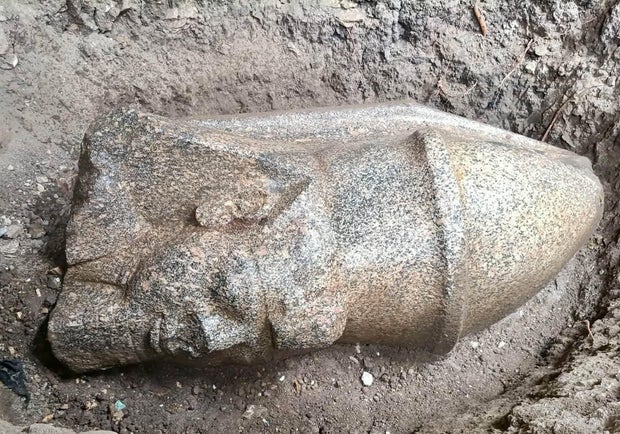
Most of a second royal statue, also believed to represent Ramesses II, has been discovered. Measuring approximately 2.4 meters long (approximately 7.87 feet), it is missing its legs and base, as well as part of the upper part of its royal nth headdress. Its head has clearly visible and well-preserved facial features that resemble those of the first statue, the ministry said.
Excavations and archaeological studies continue in the lands of al-Shahat to learn more about the statues, the history of the region and its architectural evolution in ancient Egypt.
Gn world