
Andrew Garfield has found the Norman Bates of Silicon Valley and he could win an Oscar for it.
The Academy gave “Psycho” (1960) four nominations at the 33rd Academy Awards, and none of them were for the motel clerk with the stuffed birds. Alfred Hitchcock earned his fifth and final nomination for Best Director. Janet Leigh, whose Marion Crane doesn’t make it out of the first half of the film, was nominated for supporting actress. Anthony Perkins, who made Norman Bates the most sympathetic monster the movies have ever produced, didn’t get a nod for what many consider one of the greatest performances in movie history (the American Film Institute ranked Norman as the second-best villain in movie history, behind only Hannibal Lecter).
And now, 66 years later, you can see the ghost of Perkins’ work in the horror classic, watching Andrew Garfield perform the same trick as OpenAI co-founder and CEO Sam Altman in Luca Guadagnino’s dark comedy-drama, “Artificial,” which premiered at the New York Film Festival to enthusiastic reception. Hopefully this time, voters will give Garfield a better result than Perkins.
“Artificial” tells the true story of the five days in November 2023 when OpenAI’s board fired its CEO, saw more than 700 employees threaten to walk out, and gave him his job back. Guadagnino and screenwriter Simon Rich make a compelling, often very funny, argument that these five days were humanity’s last real chance to rein in artificial intelligence, and that chance was traded for money and the bruised egos of a few tech bros who were never said no. It also feels like a wake-up call to all of us as we use AI more, and words like “super intelligence” become commonplace in our modern societies.
But apocalyptic feelings aside, we have a real Oscar contender on our hands. This is Guadagnino’s best film since “Call Me by Your Name,” and Garfield, alongside his main co-star Yura Borisov, delivers top-notch acting work on every level.

“Artificial”
Courtesy of NYFF
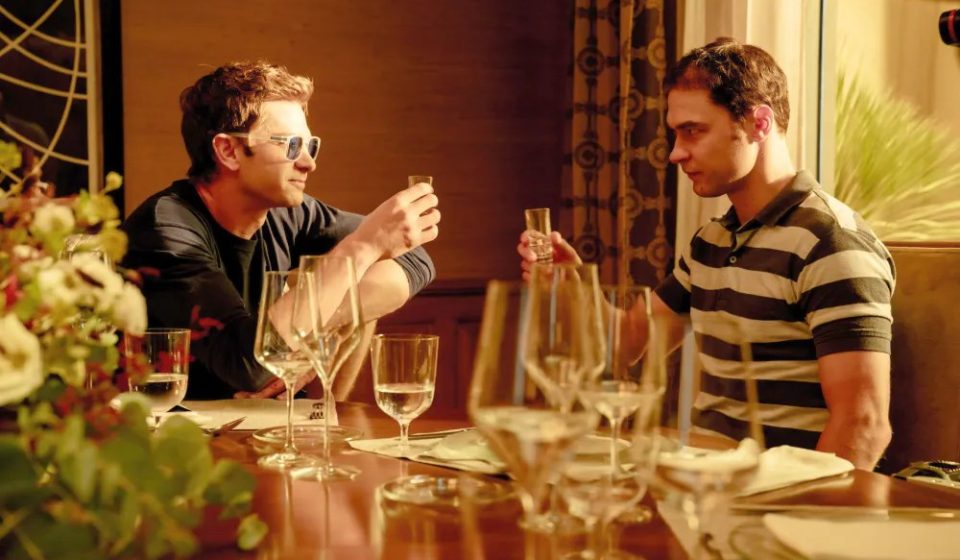
To be clear, no one is accusing Altman of keeping his mother in the fruit cellar (at least not today). The comparison is about the craft and the way Garfield approaches the character. Perkins understands that Norman only works if the audience likes him: he stutters, fusses with sandwiches, and chews candy corn while chatting with a private detective. Garfield builds his Altman the same way. Sitting almost constantly crossing applesauce, his voice remains soft, as his eyes widen and he listens intently, as if he’s completely obsessed with the human being in front of him. Until, suddenly, the life drains from his eyes, sometimes for barely a second, and returns before anyone in the scene notices. But the public does. And that’s when you realize that the movie has given you all the clues you need to recognize the monster you’ve been spending time with, and it’s revealed during the end credits.
While an easy and apt comparison is that it’s more of a spiritual sequel to “The Social Network” (2010) than “The Social Reckoning” itself, the structure Guadagnino and Rich construct is perhaps also a bit closer to “Psycho.” The first act of Hitchcock’s film is about Marion, before drawing the shower curtain. “Artificial” entrusts its point of view to Ilya Sutskever, the computer scientist of Soviet origin Borissov plays a man who sees the cliff in front of him. Altman does not venture into this part until a decade after the story begins. Both films are designed to cause audiences to misjudge who really matters in the story. That’s why Neon, like Variety reported exclusively, features Borisov as lead and Garfield as support for awards season.
Borisov, Oscar nominee for “Anora” (2024), delivers an impeccably strong turn. Perhaps we weren’t expecting the unknown revelation of Sean Baker’s Best Picture winner to come back so strongly so soon. Yet there he stands, empowering and stoic, with a turn of phrase reminiscent of someone like Mark Ruffalo in “Spotlight.” He is one of the film’s greatest strengths and deserves a place in the ever-crowded Best Actor field. The talented ensemble around Borisov and Garfield helps, including Cooper Hoffman as Greg Brockman, the loud and obnoxious board chair and Oscar nominee Monica Barbaro (“A Complete Unknown”) as Mira Murati, the CTO who sees the company’s pitfalls coming.
Andrew Garfield in “Artificial”
Neon
The supporting actor category has always had a soft spot for a villain with charm and a sharp blade hidden behind him. Javier Bardem (“No Country for Old Men”), Heath Ledger (“The Dark Knight”) and Christoph Waltz (“Inglourious Basterds”) have won supporting actor statues in three consecutive ceremonies. In recent ceremonies, Robert Downey Jr. won for “Oppenheimer” as Lewis Strauss, a real-life power broker whose wounded pride helps bring down the film’s hero, and last year, Sean Penn scored his third career win for playing a white supremacist in Paul Thomas Anderson’s “One Battle After Another.” The Oscars love themselves as an entertaining villain.
And then there’s the resume Garfield has assembled as a two-time Best Actor nominee (“Hacksaw Ridge” and “Tick, Tick…Boom!”) without any wins. Not to mention his snub for “The Social Network” which earned him a Golden Globe while Eduardo Saverin, the co-founder, withdrew from Facebook, before the Academy sent him his work. The late story remains for all to see.
What will help the buzz around Garfield and the film itself is that Altman is alive and well, still in the headlines and behind the product that some Academy members may have used to write thank-you notes. Many voters will flinch at a film that highlights an industry that Hollywood is bargaining with, as seen when Amazon MGM dropped the film in June, months after its parent company invested $50 billion in OpenAI. Given how good Guadagnino is, it’s hard to argue that this decision was anything other than political. Neon, who won best picture with “Parasite” and “Anora,” grabbed the opportunity with open arms. This could be one of Neon’s best films this year, which they’ll have to juggle with Palme d’Or winner “Fjord” and fellow Cannes premieres “All of a Sudden,” “Clarissa” and “Paper Tiger.”
“Psycho” ends with Perkins smiling and, interestingly, “Artificial” ends with Garfield’s. Let’s see if this expression is repeated on the stage of the Dolby Theater.
“Artificial” will then screen at the BFI London Film Festival before releasing in select theaters on Christmas Day, followed by an expansion in January.
Gn entert