
There’s a lot of mystery surrounding the finances of major AI labs, and as Anthropic gets closer to its IPO, we’re starting to get some answers. In particular, the company is finally revealing more about the economics of compute and how much of Anthropic’s skyrocketing revenue is being lost to compute costs.
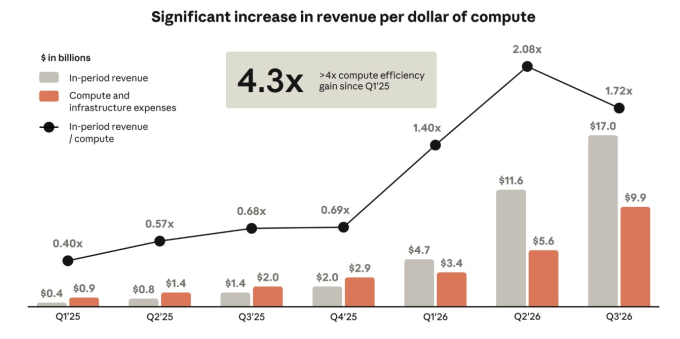
In a new filing released Monday, Anthropic released data that shows these calculation margins are deteriorating. The filing was an update to the S-1 released last week – but where the financial information in that filing only covered through June 30 of this year, the new data expanded to disclose results for an additional quarter, through September 30. Overall, Anthropic had a good quarter: revenue reached $17 billion, up from $11.5 billion in the previous quarter, suggesting sustainable growth. But operating loss has increased at the same time, largely due to rising computing costs.
Looking at the calculation margins makes the situation even worse. In the new quarter, computing accounted for 58% of the company’s revenue, up from 48% in the previous quarter. At a time when the company could convince IPO investors by showing improving margins, the situation is deteriorating.
A chart in the filing shows this even more clearly, tracking the company’s revenue for every dollar spent on computing. Since the start of 2025, it has been growing steadily, peaking at just over 2x in the last quarter and then falling back to 1.72x.

Many indications suggest that this shift in computational margins is more of an incident than a long-term problem, but it nevertheless teaches us important things about running a large laboratory. In trying to keep up with demand, Anthropic’s compute bill ballooned to $10 billion for the quarter, including, as the filing notes, “$5.0 billion of compute under short-term commitments, which currently costs significantly more than comparable compute purchased under our multi-year commitments.” » Basically, demand was growing so quickly that Anthropic had to scramble to do the math, which meant paying higher rates.
Some of these transactions have already been made public. Anthropic pays SpaceX $1.25 billion a month for computing, along with multibillion-dollar deals with Nscale, Akamai and Volta. In industry parlance, these are neoclouds rather than hyperscalers – smaller companies that offer more flexible compute offerings at higher prices.
Anthropic’s margins deteriorated in the third quarter due to deals like these, and there’s no sign they’ll be able to move on from them any time soon. As the new filing says: “We expect compute and infrastructure spending to increase in absolute dollars and remain our largest operating expense for the foreseeable future as additional committed compute becomes available to us under multi-year agreements with CSPs and as we continue to invest in additional compute.”
Anthropic is always trying to reduce its computational costs. In particular, the company talks a lot about its efforts to build its own computational base under a project it calls “Anthropic Direct.” But with demand growing so quickly, these efforts won’t be able to keep pace, and neoclouds will continue to be the best option they have.
In a sense, these are champagne problems. As long as revenues are growing at nearly 50% per quarter, few investors will worry about high computing costs – and as soon as demand slows, investors could take comfort in a much sunnier computing picture. But it reminds us how much AI labs still rely on building trillions of dollars’ worth of infrastructure — and how vulnerable they are to hiccups in that process. It’s easy to imagine that data center construction will slow over the next year if bond markets become nervous or local opposition intensifies. There’s not much Anthropic can do to address either of these risks, and either would make an IT situation even more complicated.
In the meantime, the future of Anthropic and other labs will be at the mercy of computational prices.
When you purchase through links in our articles, we may earn a small commission. This does not affect our editorial independence.
Gn bussni