Apex neural rendering challenges NVIDIA DLSS with up to 2.4x faster frame generation, 62% lower VRAM usage, and broad GPU support

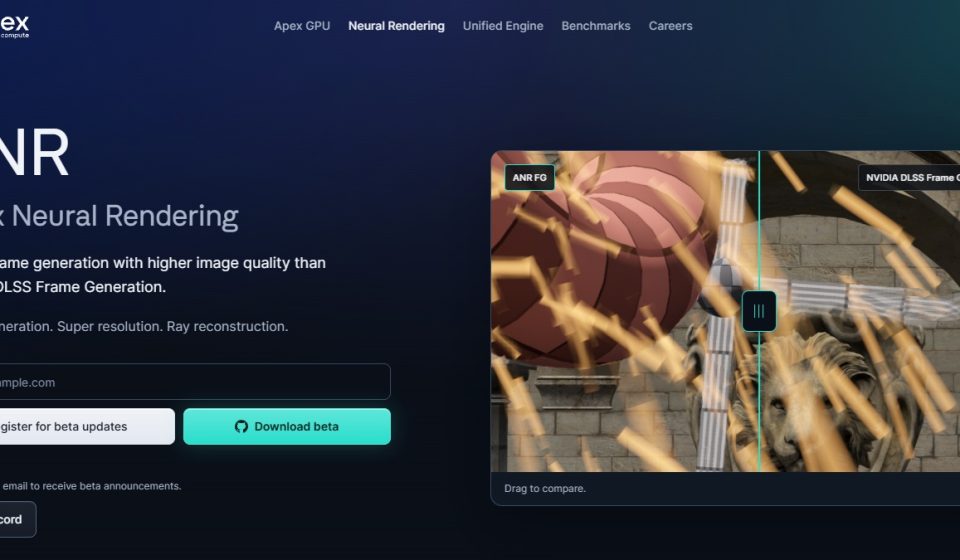
NVIDIA DLSS might have a promising new competitor. Apex Compute has introduced Apex Neural Rendering (ANR), a cross-platform neural rendering suite that is said to deliver up to 2.4x faster image generation, higher image quality, and significantly lower GPU memory consumption than NVIDIA technology. Better yet, players can already try it for themselves – or at least its (Multi) Frame Generation component, which is currently available in beta.
Announced by an official X thread, the ANR consists of three components: Image generation (FG), super resolution (SR) and ray reconstruction (RR). Frame Generation is currently available in betawhile its scaling and ray reconstruction models remain in development.

One of the most exciting features of ANR is its exceptionally broad compatibility, encompassing considerably older hardware that does not officially support NVIDIA DLSS (Multi) frame generation:
- Nvidia: GeForce GTX 16 and RTX 20/30/40/50 series
- AMD: Radeon RX 5000/6000/7000/9000 series and Steam Deck
- Intel: Arc Series A and Series B
Beta version supports Windows 10/11 alongside Linux And SteamOS through Proton. Apple silicon is also supported via a separate native Metal test kit for MacOS 26 and more recent.
Performance looks promising, at least according to Apex Compute’s internal benchmarks. On a GeForce RTX 5090 at 3840×2160, ANR FG requires 1.01 milliseconds per image generated in 2X modecompared to 1.26ms for generating NVIDIA DLSS frames. In 4X modethe numbers drop to 0.61ms And 0.82msrespectively.
GPU memory consumption is another claimed benefit, with ANR only requiring 214 MB versus 562 MB for NVIDIA in 4K, which is a reduction of around 62%. The weights of its neural network are also remarkably compact, occupying simply 0.17 MB.

Although Apex claims up to 2.4x faster frame generation in some tests, its published RTX 5090 measurements suggest more modest improvements in processing time. These results relate to the cost of generating additional frames rather than equivalent increases in actual gaming FPS..
Image quality is another major selling point. Apex’s interactive comparisons demonstrate improvements in challenging scenarios involving particles, moving objects, water, vegetation and deocclusion artifacts.


The company also released The Last of Us Part II Remastered And Hogwarts Legacy video showcases. Internal sound CGVQM-5, ColorVideoVDP, and PSNR quality metrics consistently favor ANR over NVIDIA DLSS FG, although independent testing is still needed.


Interested players can download the latest ANR Frame Generation Beta from GitHub. Installation uses OptiScalerwith separate packages for games that already have it installed and those that don’t. Users extract the files, run the installer in the game’s executable directory, and enable (multi)frame generation via the game’s graphics settings..
The last FG V.B14 outputpublished on November 12also addresses a Windows compatibility issue that prevented some games from launching with older versions. Visual C++ execution times.

Apex also released an interesting utility called nr-recordwhich allows users to capture image generation inputs and play them back through concurrent implementations for direct comparisons of image quality.
An important caveat is that The implementation of ANR (multi) frame generation is not yet open sourceits developers promising to release the source code later. Inasmuch as experimental beta version, Compatibility issues and visual artifacts should also be expected.
Nonetheless, ANR represents an intriguing development for gamers looking for alternatives to proprietary (multi)-frame generation implementations, especially those running older graphics cards. As we’ve previously reported, unofficial efforts to bring advanced DLSS (multi) frame generation capabilities to older RTX hardware have already made substantial progress.
Information source: Apex calculation on

About the author: Sebastian Castellanos is a data scientist by education and training. He is also deeply passionate about PC gaming hardware and software. He recently started writing technical articles and guides on Wccftech about PC hardware, gaming and mods.
Follow Wccftech on Google to get more of our news coverage in your feeds.
Gn tech