October 29, 2026, 2:59 p.m. ET
A simple exercise that requires no equipment and can be done at home can help people maintain lower blood pressure, even if they can’t exercise several times a week, according to a new study.
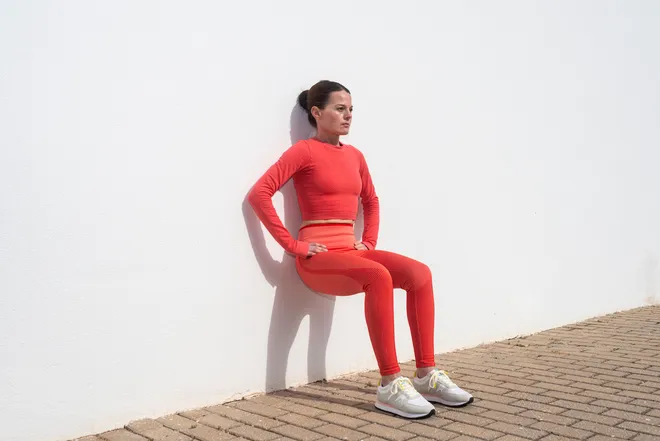
The exercise is a wall squat, which involves leaning against a wall and lowering your body into a seated position while maintaining the pose. Research suggests that this type of exercise can provide cardiovascular benefits without requiring prolonged training.
A study published in BMJ Open Sport & Exercise Medicine examined whether people could maintain improvements in their blood pressure by doing wall squats less frequently. Researchers found that exercising once or twice a week preserved some short-term benefits, although three weekly sessions produced greater reductions.
Here’s what to know about the results and how the exercise routine worked.

How did the study take place?
The researchers studied 100 adults with an average age of 37.4 years. Participants had systolic blood pressure measurements between 120 and 140 mmHg and did not regularly participate in structured exercise programs. None had been diagnosed with hypertension.
During the first four weeks, exercise group participants performed four wall squat holds per session, resting for two minutes between holds. They performed the routine three times a week.
For the next four weeks, participants continued to exercise three times a week, reduced their sessions to twice or once a week, or stopped exercising.

Exercising once a week helped maintain improvements
After the first four weeks, the exercise groups showed improvements in their blood pressure compared to the control group.
At the end of the eight-week study, participants who exercised once or twice a week maintained significant reductions in systolic blood pressure, the pressure in the arteries when the heart contracts.
Those who continued to exercise three times a week saw the greatest reduction, with systolic blood pressure dropping an average of 13.73 mmHg since the study began.
The twice-a-week group saw an average reduction of 6.95 mmHg, while the once-a-week group saw a reduction of 6.56 mmHg.
Neither the once-a-week nor the twice-weekly group maintained a statistically significant improvement in diastolic blood pressure, which measures the pressure in the arteries between heartbeats.
Participants who stopped exercising lost their previous improvements. At the end of the study, their blood pressure values were no longer significantly different from those of the control group.
What is isometric exercise?
Wall squats are a form of isometric exercise, which involves contracting muscles while maintaining a position rather than moving the body repeatedly. Planks and grip exercises are other examples.
Previous research has linked isometric exercise to lower blood pressure. The latest findings suggest that even people who cannot maintain a frequent workout schedule may be able to preserve some benefits by continuing to exercise.
However, the study’s maintenance period lasted only four weeks. Further research is needed to determine whether less frequent exercise can maintain improvements over months or years.
People with high blood pressure should consult a healthcare professional about an appropriate exercise routine. Wall squats should not replace prescribed medications or other recommended treatments, the researchers noted.
Reporter Anthony Thompson can be reached at ajthompson@usatodayco.com or on X @athompsonUSAT.
Gn Health