MIDDLETOWN, Iowa (AP) — The U.S. military intentionally detonated the nation’s entire stockpile of lead azide, a chemical used to make explosivessaying early signs Wednesday indicated the controlled detonation in Iowa did not allow any toxic dust to spread to nearby homes and farms.
The plan for the detonation was announced just days in advance, with officials saying the barrels had degraded and were in danger of exploding uncontrollably as the weather cooled. The sudden announcement trigger concerns on the potential impacts on health and the environment, as well as on the frustration linked to the lack of information.
Officials called it a success. The five tons of lead azide were successfully destroyed at the Iowa Army Ammunition Plant in Middletown, Maj. Gen. Eric Shirley, who led the military operation, said at a news conference.
U.S. Environmental Protection Agency air monitors reported no lead in the air around the plant.
The risk to surrounding communities has been “reduced as close to zero as humanly possible,” Shirley said.
However, government agencies plan to conduct more tests in the days and weeks to come. Independent researchers also plan to conduct extensive environmental testing of water sources, farms, homes and playgrounds. Lead is a heavy metal dangerous at all levels and particularly dangerous for children and pregnant women.

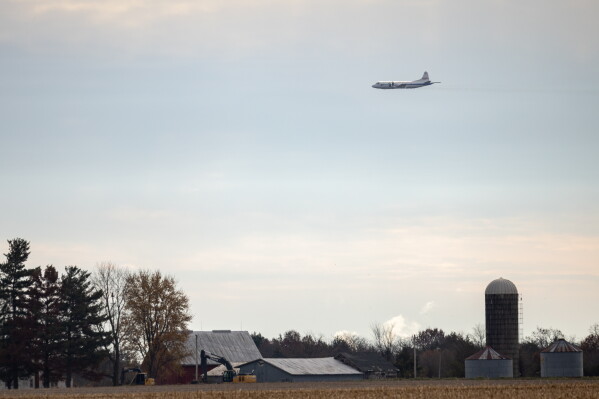
A NASA research aircraft circles the area after the U.S. Army detonated a stockpile of lead azide at its Iowa Army Ammunition Plant in Middletown, Iowa, Wednesday, Nov. 25, 2026. (AP Photo/Austin Johnson)
License for this photo
The smoke after the explosions cleared within minutes
An Associated Press reporter watched and filmed the explosions, along with several bystanders parked on the side of a road less than a mile (and upwind) from the site. After two loud bangs around 9 a.m. local time, a pair of wispy white plumes rolled high into the air before quickly dissipating.
The military attributed the smoke to foam sprayed during the explosion to settle the dust.
Passersby laughed and joked about the magnitude of the explosion and the smoke. No one wore a mask or eye protection.
Burlington resident Tim Brandt said he wanted to feel the ground shake, but the bang reminded him of the noisemakers that crack when thrown to the ground.
“It was nothing,” he told the AP. “It seems that the government has instilled fear in many people for nothing. »
It remains unclear whether the plume contained toxic lead. The wind was expected to carry the plume southwest toward neighboring Missouri and away from Burlington, a city of just under 25,000 people along the Mississippi River.
President Donald Trump posted on social media that initial reports showed the military’s “mitigation efforts have far exceeded expectations.”
Acting Secretary of the Army Adam Telle and the Republican governors of Iowa and Missouri also said it appeared to be a success and that the explosion was well contained.
A locked gate secures the south entrance to the Iowa Army Ammunition Plant in Augusta, Iowa, Tuesday, Nov. 24, 2026. (AP Photo/Austin Johnson)
License for this photo
Safety concerns and weather conditions delayed detonation
Government officials encouraged residents within a 5-mile radius of the site to evacuate.
Schools that were not yet closed for the upcoming Thanksgiving holiday canceled classes, and a gas station near the site of the detonation posted a note on the front door saying they would be open again once it was safe. Some residents sealed their windows and doors as a precaution.
The explosion was initially planned for last Friday. The army changed the detonation date three times amid public backlash and to allow more time for safety measures and tailwinds, according to court documents.
“Inaction is no longer an option,” Shirley said.
The army took steps to quell the plume
The military installed additional “blast barriers” around the two bunkers where the 68 barrels of lead azide exploded. The materials were surrounded by two-story-high concrete and sand barriers.
Ballistic gels, foams and more than 100,000 gallons (380,000 liters) of water were intended to absorb the lead dust.
Video of the site released by the military before the detonation showed a bunker surrounded by an earthen berm and sand-filled blocks.
Colin Wellenkamp, executive director of the Mississippi River Cities and Towns Initiative, told the AP that the military’s actions appear to have limited the dispersal of lead.
“Our water treatment facilities on the Mississippi River and the Missouri River in particular will be tested periodically, starting every few hours,” he said, “just to make sure there are no detectable spikes.”
The decades-old lead azide was crystallizing, risking spontaneous detonation
The stockpile was brought to Iowa from bases across the country in 2009, according to Robert Cekada, director of the Bureau of Alcohol, Tobacco, Firearms and Explosives. The lead azide was stored in case the military needed to use it again.
During an inspection in March, munitions plant personnel found that the chemicals had partially crystallized, making them sensitive to friction and cold temperatures and creating a risk of spontaneous detonation.
The military asked experts to develop a plan and they found that alternatives such as heat treatment and neutralization of the contents of the barrels were not as safe as a controlled detonation.
A crowd gathers to watch the planned explosion of a lead azide stockpile in Middletown, Iowa, Wednesday, Nov. 25, 2026. (AP Photo/Ty ONeil) Photo taken with a cell phone.
License for this photo
Court gives final approval despite reluctance from environmental groups
Environmental groups sued to stop the project, but a court decision Monday get the detonation back on track. A federal appeals court found that the U.S. Environmental Protection Agency adequately incorporated safeguards to minimize the dispersal of lead dust.
Some residents said the timing could have been better, given it was the day before Thanksgiving, but they agreed the problem needed to be addressed now. Others worry about the impact on water, farms, animals and their own homes.
“I don’t think the lead danger will go away anytime soon,” said Lucy Giehl, who lives nearby in West Burlington. “It seems like someone could have thought this through a little earlier before it came to this.”
___ Seewer reported from Toledo, Ohio, and Bauer from Madison, Wisconsin. Associated Press writers Susan Montoya Bryan in Albuquerque, New Mexico; Dave Collins in Hartford, Conn.; Jessica Hill in Las Vegas; and Chris Weber in Los Angeles contributed to this report.
Gn headline