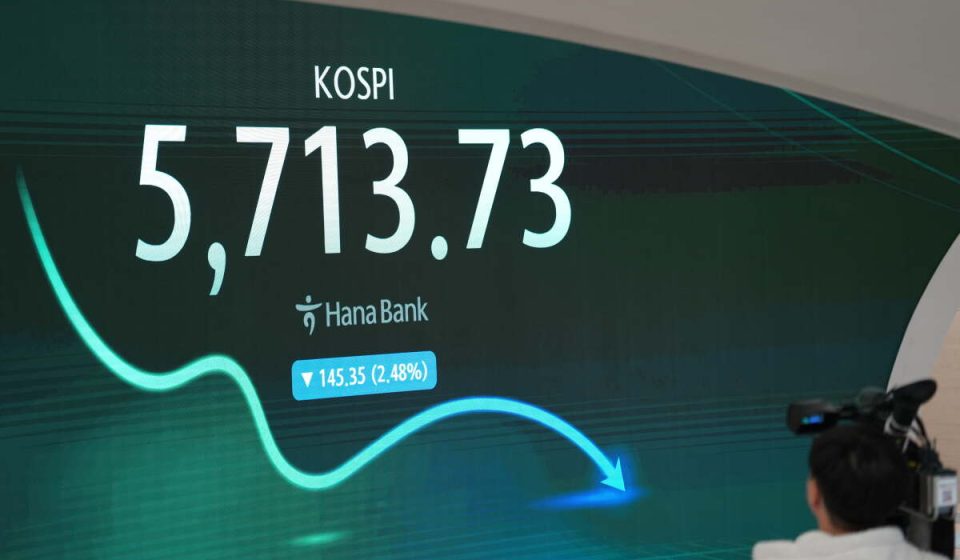
HONG KONG (AP) — Stocks in Asia were mixed Tuesday as markets like South Korea and Taiwan, heavily weighted in technology stocks, fell to their lowest levels in three months following a selloff on Wall Street.
US futures fell slightly and oil prices rose.
South Korea’s benchmark Kospi index fell 4% to close at 5,626.08. Memory chip maker SK Hynix fell 5.7% and Samsung Electronics fell 4%, giving up Monday’s gains.
Tokyo markets were closed for a public holiday.
In Hong Kong, the Hang Seng added 0.4% to 23,474.98.
The Shanghai Composite index fell 1.4% to 3,588.50, close to its lowest level in more than a year. The gains resulting from the market support measures announced on Monday were short-lived.
Australia’s S&P/ASX 200 index rose 0.3% to close at 8,880.50. The Reserve Bank of Australia raised its benchmark interest rate by a quarter of a percentage point to 4.85%, the highest cash rate since it was 5.25% in December 2008.
This is the fifth rate hike this year.
Reserve Bank Governor Michele Bullock said in a statement that inflation remained widespread.
“This partly reflects rising prices for fuel and other raw materials affected by the conflict in the Middle East,” the statement said. “AI-related investments are driving rapid growth in the prices of technology-related goods, and inflation for many goods and services remains high,” the report said.
Taiwan’s Taiex slipped 3.8%. Taiwan Semiconductor Manufacturing Corp. fell 1.9% and chip designer Mediatek plunged 7.6%.
India’s Sensex rose 1.1%.
On Monday, the S&P 500 fell 0.5%, erasing a 1.1% gain earlier in the day. The Dow Jones Industrial Average rose 0.4%, while the Nasdaq composite fell 1.1%.
The mixed performance of the indexes occurred even as the majority of S&P 500 stocks rose. They benefited from a recent drop of 7.6% in the price of a barrel of Brent, which closed at $104.77. This is the latest yo-yo move for oil prices due to uncertainty over when the war with Iran will end, allowing the global industry to return to normal.
The price of the most actively traded contract on the Brent market hovered between $70 and $120 per barrel just before the war with Iran began, and it quickly reversed course.
The same goes for stocks in the artificial intelligence sector, which have been reeling for months amid criticism that they have soared too high and are in a bubble. There is growing concern that the hundreds of billions of dollars that big tech companies are investing in AI data centers are not generating enough productivity and profits to make the investments worth it.
THE latest Alphabet earnings reports and other big tech companies have also shown how AI can impact their own businesses. Google’s parent company burned through more cash in the most recent quarter, measured by what’s called free cash flow. announced slower than expected growth in its research activity.
Alphabet initially rose 2.6% on Monday, but ended with a 0.3% loss. Nvidia went from an initial gain of 2.6% to a decline of 1.3%. Such fluctuations carried the rest of the market with them.
Still, nearly seven out of 10 stocks in the S&P 500 index rose.
Expectations are high for all kinds of companies to continue generating strong profit gains as the American economy continues to groweven with high inflation And interest rate. That helped propel the S&P 500 to its all-time high last month.
A report released Monday said the U.S. manufacturing sector improved last month more than economists expected. Additionally, a measure of inflation in the Institute for Supply Management survey showed prices rising at a slower pace.
In other trading Tuesday, the price of Brent crude, the international standard, rose 1 percent to $105.85 a barrel. Benchmark U.S. crude oil rose 1.1% to $97.48 a barrel.
The US dollar fell to 157.84 Japanese yen from 157.95 yen. The euro rose from $1.1188 to $1.1198. ___
Rod McGuirk in Melbourne, Australia, contributed to this report.
Gn bussni