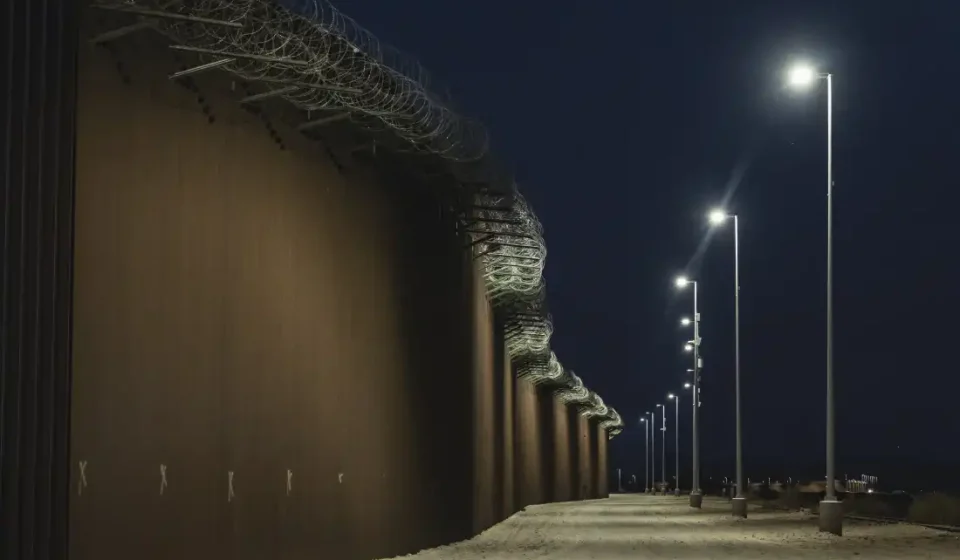

A view of the border wall on the U.S.-Mexico border near Somerton, Arizona, on October 18.
Olivier Touron/AFP via Getty Images
hide caption
Olivier Touron/AFP via Getty Images
For nearly two years, the Trump administration has banned asylum applications at the U.S.-Mexico border, canceled thousands of pending asylum applications, and overhauled the immigration court system with mass layoffs. Critics say that, combined, these measures have effectively closed a once-vital route for those fleeing persecution or danger.
The U.S. Supreme Court will soon consider whether the president can circumvent Congress and existing federal immigration law and unilaterally suspend access to asylum protections.
The legal challenge to the presidential ban, which took effect hours after President Trump took office, is the latest legal case against the administration’s seismic immigration policy shifts to be taken up by the high court. Critics say these policy changes have deprived asylum seekers of their basic due process rights and transformed the immigration court system into a deportation arm of Immigration and Customs Enforcement (ICE).
In legal filings, the Trump administration has insisted that the proclamation is a necessary protection against an “invasion” along the southern border and what the president and conservative critics have long called an abuse of the system by “bogus” asylum seekers. Since its implementation, the chaotic crush of people crossing the border into the United States has collapsed. U.S. Border Patrol apprehensions have fallen this year to their lowest level in the agency’s history. The agency recorded fewer than 99,000 apprehensions at the Southwest border in fiscal 2026, a 95% decline from more than 1.8 million a year under President Biden, according to U.S. Customs and Border Protection data.
“The difference between an average month under Trump and an average month under Biden is just staggering,” Simon Hankinson, a senior fellow at the Heritage Foundation’s Center for Border and Immigration Security, a conservative think tank with close ties to Trump, told NPR. And if the Supreme Court overturned the ban, “it would be disastrous,” he added.
Hankinson says most people arriving at the southern border are not eligible for asylum. “And even if they did, they’ve already crossed into Mexico, which is a safe third country where they could seek asylum, especially if they’re coming from Venezuela or Afghanistan. So you have a population that overwhelmingly will not qualify for asylum under U.S. law. They’re here because they want to find a job,” he said.
But, critics say, all of the measures taken by the administration have reduced access to asylum to nothing.
Despite the return of calm along the southern border, the president’s argument for banning asylum was rejected by two lower federal courts. courts. However, it has largely remained in place as the case is mired in court battles.
In December, the Supreme Court will review the administration’s strategy of expelling immigrants to third countries that have agreed to adjudicate asylum claims, even though some of those countries face allegations of human rights violations and cannot guarantee that the person seeking asylum will not be returned to their home country.
The administration faces a third legal battle that could end its attempt to indefinitely detain thousands of people in deportation proceedings.
If the predominantly conservative court rules in favor of immigrant advocates in the lawsuits, advocates say, the rulings could finally break the stranglehold the Trump administration has placed on asylum approvals, which are at their lowest levels in decades. National asylum denial rates climbed to 94% in June, compared to about 50% in 2024 — the last full year of the Biden administration. That’s according to TRAC, a Syracuse University research project that tracks data on immigration judges.
“The president does not have the right to unilaterally ignore protections granted by Congress to those fleeing danger,” said Lee Gelernt, senior counsel and deputy director of the Immigrant Rights Project at the American Civil Liberties Union, one of the groups spearheading the challenge to the asylum ban. “The courts are right to reject this unprecedented power grab that would put countless lives at risk. We look forward to making our case before the Supreme Court.”
Lawyers for migrants seeking asylum hope to win their case at the High Court. For many of Madhavi Narayanan’s clients, this could save lives. An immigration attorney with Los Angeles-based Human Rights First, she currently represents immigrants who, before Trump’s second term, would have received what she calls “slam dunk” asylum applications.
One of them is an Ethiopian in his thirties named ZG, who arrived in the United States via Mexico in February 2025 after enduring numerous tortures in his native country. Narayanan asked NPR to use only ZG because he fears retaliation from the Ethiopian government. After traveling to the southern border, ZG was taken into custody and immediately filed an asylum application.
Narayanan said ZG is a member of an indigenous group in Ethiopia that is part of an ongoing armed conflict in that country, which human rights organizations say risks committing more atrocities against civilians. And Narayanan, who has worked on the case for nine months, said she had produced documents and letters to support her torture allegations.
“At any other time, this would have been a very simple matter,” she said, adding that “there is a wide range of human rights reports explaining that people in this precise situation would be at high risk” of violence and death if they were to return to Ethiopia.
But instead of an immigration hearing, ZG received a deportation order this month. in Uganda, a country he has never set foot in and which does not recognize the military violence in Ethiopia as war.

An undocumented immigrant prepares to be deported aboard an Immigration and Customs Enforcement deportation flight to El Salvador on December 8, 2010.
John Moore/Getty Images
hide caption
John Moore/Getty Images
In an effort to curb asylum applications and alleviate the crushing backlog of U.S. Citizenship and Immigration Services cases, the Trump administration is urging ICE attorneys to terminate asylum applications by convincing immigration judges that an application is incomplete or that a person cannot substantiate their claims. The administration could also argue what it did in ZG’s case: that he could seek asylum in a third country.
It has proven to be a highly successful strategy for the Department of Homeland Security (DHS), which has so far canceled thousands of pending cases.
Narayanan said experiences like ZG’s reflect how Trump’s changes to immigration courts have all but eliminated due process rights, including evidentiary hearings, paving the way for summary deportations. They also show how the new guidelines are designed to limit judge autonomy. Narrating the events of the motion to terminate ZG’s claim, Narayanan said the immigration judge told the court his hands were tied.
“He basically said to me, ‘OK, I hear everything you said, but I’ve read this case and I’m not allowed to think about it,'” Narayanan recalled.
According to the Executive Office for Immigration Review, nearly 60 policy memoranda have been issued so far under the second Trump administration — a sharp increase from the 30 immigration court-related memoranda issued during Biden’s four-year term.
The administration has also been aggressive in its push to overhaul the immigration court, purging more than a hundred experienced immigration judges. Jennifer Peyton, a former deputy chief immigration judge in Chicago, told NPR that immigration courts across the country have become unrecognizable.
“Everything is different now,” said Peyton, who was fired via email in July 2025 after more than nine years on the bench.
In Trump’s first year back in office, nearly 40 percent of immigration judges were fired or resigned. Nearly all have been replaced by what the administration calls “deportation judges,” who critics say are ideologically aligned with the president’s immigration agenda and eager to rubber stamp asylum denials and expedited deportation orders. This change, along with previous appointments by Trump, have reshaped the immigration bench. Today, more than half of immigration judges are Trump appointees.
Among these new immigration judges, very few have experience working on behalf of migrants. About two-thirds of them come from the field of homeland security or military law, according to an essay published in THE Yale Law Journal by Geoffrey Heeren, professor of immigration law and policy at the University of Idaho. He wrote that “only about eleven of the new (immigration judges) have clear prior experience in immigrant advocacy, and of those, only one does not also have experience in DHS or military law.”
In her previous role, Peyton was part of the Department of Justice’s immigration judge recruitment and training team. She now practices immigration law and represents asylum seekers and appears before the same judges she helped train. In those cases, Peyton said, she feels a little more comfortable because she knows the quality of training they received. But when she pleads before unfamiliar recruits, she says, she is often dismayed.
“There’s no doubt in my mind, when I have the misfortune of appearing before them, that they don’t know that much about immigration law and they don’t care that they don’t have the training that we put them through so rigorously when I was on that team,” Peyton said.
She added: “The vast majority have not been taught the process of evaluating a case, but rather the shortcuts to ensure that these procedural hurdles arise, to ensure that non-citizens are deprived of their due process.”
Gn headline