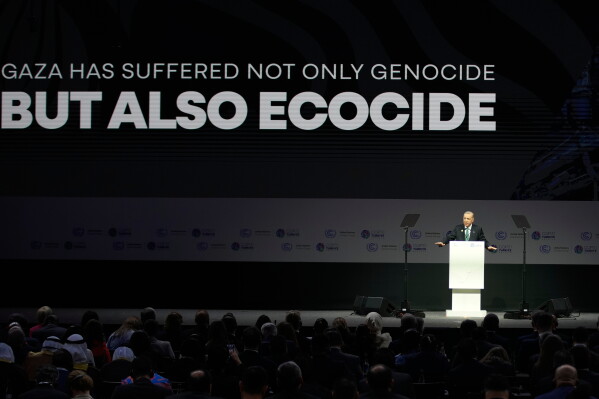
Turkish President Recep Tayyip Erdogan on Wednesday called on the world to recognize the environmental impacts of Israel-Hamas War in Gaza and called on the Israeli government to provide more aid for access to Palestinian territory.
Erdogan spoke at UN Climate Summitknown as COP31, in Antalya, Türkiye.
“What happened in Gaza is not only genocide, but it is also ecocide,” Erdogan said to applause from world leaders and other climate envoys.
A U.N.-backed group of independent experts concluded last year that Israel had committed genocide in Gaza. Israel vehemently denies the allegations and has accused the panel of anti-Semitism.
“Centuries-old olive trees have been cut down. The soil and water have been polluted in Gaza, and Gaza’s towns have been turned into huge piles of rubble,” Erdogan said. “With the destruction of Gaza’s infrastructure, compounded by torrential rains and flooding, tens of thousands of tents and shelters have been flooded. »

Turkish President Recep Tayyip Erdogan speaks during the UN COP31 climate summit, Wednesday, Nov. 11, 2026, in Antalya, Turkey. (AP Photo/Khalil Hamra)
License for this photo
The Israeli Foreign Ministry responded in a post on X, accusing Erdogan of “using an international forum to promote his campaign of anti-Israeli lies” and of supporting Hamas. Israel launched its Gaza campaign following attacks by Hamas-led militants in southern Israel on October 7, 2023. The militants killed around 1,200 people and took 251 hostages.
“Those who truly care about Gaza should demand that Hamas disarm so that reconstruction can begin,” the statement said. Israel was not invited to COP31.
Israel’s retaliatory offensive has killed more than 74,000 people, according to local health authorities, and destroyed much of Gaza. The Health Ministry, part of the Hamas-led government in Gaza, does not distinguish between civilians and fighters, but says women and children account for almost half of the deaths.
Erdogan has been an outspoken critic of Israel, while Israeli Prime Minister Benjamin Netanyahu called Erdogan an anti-Semitic “tyrant.”
“The latest country to become a major spreader of anti-Semitic lies is Turkey,” Netanyahu said in September during a speech to the UN General Assembly.
Displaced Palestinians walk through a rain-soaked tent camp following heavy rains in Deir al-Balah in the central Gaza Strip, Saturday, November 7, 2026. (AP Photo/Abdel Kareem Hana)
License for this photo
In recent days, heavy rains and subsequent flooding have destroyed many of the tents and makeshift shelters in which Palestinian residents now live. At least four people were killed earlier this week when a sand embankment collapsed onto their shelter. The rain too left a lot displaced people without food, drinking water and a dry place to sleep.
Humanitarian aid is flowing into the country, but imports remain well below levels before the start of the war between Israel and Hamas – and many items remain blocked by Israel.
A 2025 Report by the United Nations Environment Program also highlighted the devastating reality of Gaza’s environment since the start of the war.
Remote sensing assessments showed that by May 2025, more than 97% of tree crops, 82% of annual crops, 95% of scrub and 89% of grasslands and fallows had been damaged, according to the UNEP report.
“For now, our families only have 3 percent of the cultivated land to use, and that’s assuming it’s distributed among 2 million Palestinians” in the Gaza Strip, said Mohammed Usrof, co-founder and executive director of the Palestinian Institute for Climate Strategy.
“Failing to talk about these losses undermines Palestinians’ food supply, their livelihoods and their ability to stay on their land,” Usrof said.
Palestinians walk through a tent camp housing displaced people amid buildings destroyed by Israeli strikes during the Israel-Hamas war in Gaza City, Sunday, November 8, 2026. (AP Photo/Jehad Alshrafi)
License for this photo
The territory’s capacity to dispose of waste, treat sewage and provide drinking water has been virtually decimated by three years of war. This has worsened difficult living conditions and increased health risks for hundreds of thousands of people deprived of adequate shelter, food and medicine, humanitarian groups say.
The conflict has “virtually eliminated” the livelihoods of Gaza’s fishermen, the report says, highlighting how marine ecosystems have been contaminated by munitions, sewage and solid waste.
“For Gaza residents, this means very limited access to clean water, greater exposure to water-borne diseases and toxic substances, worsening food insecurity and the loss of livelihoods dependent on agriculture and fishing,” Ghiwa Nakat, executive director of Greenpeace MENA, told the Associated Press.
Nakat also warned that Gaza’s environment could take years to recover.
“The environmental damage will not stop with the end of the war,” Nakat said. “Contamination of soil and groundwater, destruction of ecosystems and collapse of critical environmental infrastructure could harm public health, food security and livelihoods for generations, threatening the resilience of communities and their ability to recover. »
World leaders began formal negotiations at COP31 this week, seeking agreement on concrete steps to curb global warming after a year of deadly floods, heat waves and other climate-related disasters.
More than 70 world leaders and senior government officials will speak at the summit, although some key leaders will be absent, including the heads of state of the United States, China and India.
___
Victoria Milko reported from Islamabad.
___
Associated Press climate and environmental coverage receives financial support from several private foundations. AP is solely responsible for all content. Find AP standards to work with philanthropies, a list of supporters and funded coverage areas on AP.org.
Gn world