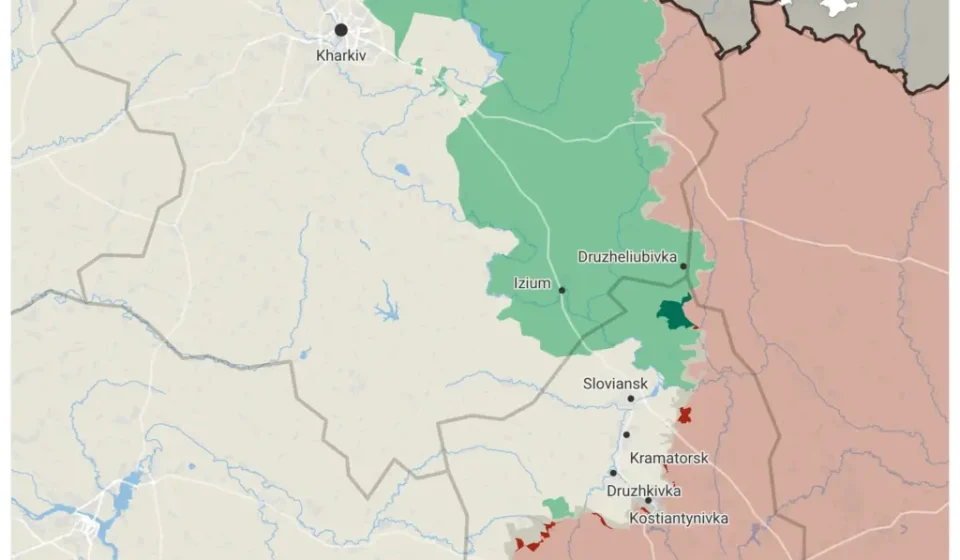
Attack of the robots: Ukraine sent 28 armed ground robots, including eight equipped to explode, on Russian lines. Russian drones stopped them this time

- A recent fully robotic Ukrainian ground attack involved as many as 28 armed unmanned ground vehicles.
- It appears the assault failed, but that’s not what matters
- What matters is that new fully robotic attacks are coming
Fully robotic amphibious landings, aerial assaults, engineering and refueling operations are increasingly common in Russia’s broader war against Ukraine, now in its 57th month. They are particularly common on the Ukrainian side, as kyiv races to bolster its manpower-starved armed forces with unmanned systems of all kinds.
However, a recent fully robotic attack carried out by the Ukrainian 3rd Assault Brigade on or just before October 30 stood out. This is the largest confirmed attack by unmanned ground vehicles so far in the wider war: as many as 28 UGVs of all kinds crossed the gray zone near the village of Druzheliubivka in Kharkiv Oblast in northern Ukraine.

It appears the Russians spotted the assault from afar and quickly defeated it, primarily by sending in explosive drones viewed from a first-person perspective. But this could be a temporary victory. UGVs are cheap, some costing a few tens of thousands of dollars, and Ukraine is building many of them. Former Ukrainian Defense Minister Mykhailo Fedorov claimed that Ukraine would acquire 25,000 UGVs in the first six months of 2026 alone. The figure for the rest of the year will likely be as high, if not higher.
These 28 Ukrainian UGVs may not have succeeded in breaking through the Russian positions. The next 28 could succeed.
The fully robotic daytime ground assault, which took place approximately two years after the first ever fully robotic ground assault and four months after the first fully robotic amphibious landing and aerial assault (all carried out by the Ukrainians), would have involved eight self-exploding UGVs plus 20 other UGVs equipped with handheld weapons: 18 with pairs of single-shot grenade launchers and two with automatic grenade launchers firing more numerous but smaller shells.
The Russians released a video montage depicting FPV attacks on approaching Ukrainian UGVs. Whether any of the Ukrainian robots got close enough to the Russian positions to engage directly is not apparent from the video.
The Ukrainian plan appears to have failed. But that doesn’t mean it wasn’t a wise plan. Examples abound of recent, but smaller, fully robotic or robot-led ground operations. Aerial drones and ground robots paved the way for Ukraine’s 3rd Army Corps’ successful counteroffensive, Operation Vivaldi, which ejected two Russian field armies from a critical sector of Donetsk Oblast in northern eastern Ukraine beginning in March.
For Operation Vivaldi, the 3rd Army Corps deployed ground mine clearance robots and BTR-60 remotely controlled armored personnel carriers transformed into powerful rolling bombs. Even more dramatically, the corps and its supporting drone units staged fully robotic aerial assaults. Heavy octocopter bomber drones carried armed UGVs across the gray zone and dropped them just in front of or just behind the Russian positions.

A valuable workforce
The robotic operations of Operation Vivaldi succeeded where the recent assault of 28-UGV apparently failed. Occasional defeats hide frequent victories. Either way, Ukrainian forces are banking on robots because they have no other choice. Short of tens of thousands of trained infantry, Ukraine’s ground forces are struggling to fully staff their 150 line brigades.
Robots are the obvious solution. “Fighting against a much greater power, Ukraine, throughout the war, had to take advantage of technology to be able to fight back and take the fight to Russia,” war correspondent David Kirichenko told Euromaidan Press.
But replacing humans with robots is easier said than done. The robot itself is only the visible part of a complex system. Radio networks and other systems connecting robots to their remote operators are just as important as the robots themselves.

Each control system used by Ukrainians has advantages and disadvantages. Wireless systems, including satellite, line-of-sight and mesh radios, are subject to Russian jamming and, in the case of Starlink and Starshield, also subject to throttling by billionaire Elon Musk’s SpaceX. It is possible to connect a UGV to its operator via a spool of optical fiber several kilometers long, but the fiber tends to get caught in trees and rocks and break.
Given the fragility of a system, the Ukrainians have learned to install several control systems on each UGV. Backups for backups. When we see 28 armed robots launching into battle, it’s not the machines that are impressive. The control systems are what matters most.
It is Ukraine’s mastery of these command systems that guarantees the multiplication of fully robotic assaults.
Gn world