
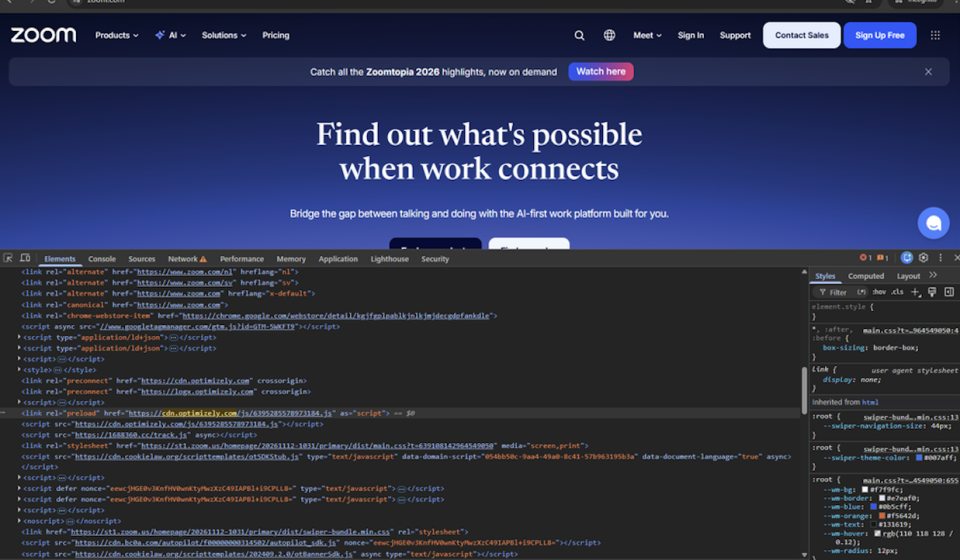
At least 178 top web destinations have unwittingly served a variety of malware exploits against visitors in the past 24 hours thanks to a security vulnerability involving Optimallya company that helps websites personalize user experience and test new features. Experts say the incident, which saw data-stealing malware silently injected into sites like BBC, CNN, Equifax, Ledger And Zoomhas been exacerbated by the fact that few popular websites have strict rules on third-party content sources.

The Zoom.com homepage loading the malicious JavaScript file from Optimizely. Image: blog.report-uri.com. Click to enlarge.
According to a blog post from the security company Report URIOn November 16, malicious JavaScript code was delivered to visitors of 178 organizations via the Optimizely platform. Report from a URI researcher Scott Helme wrote that the payload delivered by the malicious Javascript was reconstructed 26 times over the course of the day, dropping a versatile malware kit capable of stealing payment card data, cookies and screenshots, and swapping all cryptocurrency payment addresses for those of the attacker.
Helme noted that the affected websites also served as custom exploit code to attack known vulnerabilities in older Apple iPhone and iPad devices. Known by names such as “Dark Sword” And “La Coruña“, these are zero-click exploit kits that chain together half a dozen security vulnerabilities to take full control of obsolete devices and extract data.
“The important lesson here is that reliable JavaScript does not always remain trustworthy,” Helme wrote. “A website can be compromised by a third-party dependency without its own code or infrastructure ever being breached. »
Contacted for comment, Optimizely said that on November 16, 2026, it “identified a security incident in which an unauthorized party exploited a vulnerability in the Optimizely experiment to add malicious JavaScript to certain customer projects.”
“We acted quickly to contain the incident and fully remediated the identified vulnerability,” read a written statement shared by Optimizely. “These measures included blocking access to the vulnerable path, deploying a patch, removing injected code from affected projects, terminating active sessions, revoking tokens, and resetting access to affected user accounts. We have also implemented additional protections to prevent the transmission of malicious code into Cloudflare. Although the incident has been fully resolved, we are working with third-party experts on a further investigation.”
Many leading web properties no longer fully display content unless visitors agree to let often dozens of third parties serve JavaScript, a powerful web scripting language that enables interactive content. JavaScript code runs on the user’s device and can read information displayed in the user’s browser and even change the appearance or content of a website.
One of the reasons why JavaScript is so widely used is that it allows for fairly precise browser fingerprinting and other ways of tracking visitors and clicks. According to HTTP Archive’s Web Almanac 2025, the median homepage loads at least 22 JavaScript files. But as the incident with Optimizely shows, a compromise on a third-party vendor’s website can quickly escalate into a supply chain attack on downstream websites that end up serving visitors with spoofed and malicious JavaScript files.
Zach Edwards is a researcher at Infoblox and co-founder of the ad tracking service Decipher the ads. Edwards said Optimizely is a vendor that often collects data outside of opt-in flows, with their JavaScript snippets embedded as close to the top of the page as possible to ensure it’s one of the first things to display, which is important since the product is primarily designed for A/B testing.
“So for the product to work as intended, this code is configured to immediately trigger loading on the page and not restrict rendering behind a consent dialog,” he said. “This means that this supply chain attack did not require any clicks or consents to trigger – most affected clients would immediately deliver the payload as soon as someone loaded the page, further increasing the chances of this type of JavaScript snippet being compromised.”
Websites can minimize the risks of a breach at a third-party content provider escalating into a supply chain attack by taking full advantage of “content security policies” or CSPs, which specify which domain names are allowed to serve third-party content. But Edwards said that most websites — except perhaps the largest e-commerce, social media and financial platforms — either don’t even bother with CSPs, or else tend to leave them too permissive for marketing reasons.
“With literally every website that integrates third-party JavaScript resources, if you don’t have a content security policy, if one of those partners is compromised, new domains can be injected into your website via JavaScript and won’t be stopped,” he said. “We are in the age of JavaScript attacks on the supply chain and yet almost no one is talking about why content security policies were invented and how they are a large part of the solution for operators, even if it is not always easy to deploy them initially.”
To what extent have CSPs been deployed on websites affected by the Optimizely attack? According to the URI in the report, 68 of the sites had no CSP, while 50 of them had a CSP that still allowed the malware payload. And data theft. The company found that only 24 of the affected sites (15%) had CSPs that blocked the malicious payload entirely.

Image: blog.report-uri.com.
The overall deployment of CSPs on the web’s busiest sites is slightly lower – around 10% – according to the Helme site. robot.ninjawhich scans millions of top websites daily for security issues. Helme said he hoped this incident would encourage more sites to adopt effective CSPs, noting that it could have been much worse: according to URI Report estimates, the perpetrators of this malicious attack only managed to steal about $7,500 in virtual currency from affected users, as well as an unknown number of payment card records.
Helme said he often compares the current lack of CSP to the Wild West.
“Organizations are running all this code, but they don’t know what it does,” Helme said in an interview with KrebsOnSecurity. “That’s why we continue to see such large-scale breaches in places (where) there are no controls or rules in place over the code that we run, so it was sort of inevitable. Once an attacker gets to the point of running code on your site, the question is what do they want to do with it and can they write the script to do it. Now with AI, that’s no longer an issue.”
Internet users can control what JavaScript elements are allowed to run on web pages using simple script blocking plugins like NoScript. But these tools have historically only been effective for security and privacy enthusiasts who are willing to sift through dozens of JavaScript requests on each new website.
Fortunately, modern ad blocking software can easily block most third-party JavaScript requests. Ten years ago, the standard security advice for end users was to install antivirus and enable a firewall. Nowadays, your ad/script blocker East your firewall. We explored several options and approaches to blocking ads in our August 2026 article, Who Is Following You?
Gn bussni