

Luxury watchmaker Audemars Piguet says its sales and engagement are breaking records after its risky and eye-catching Royal Pop and Swatch collaboration earlier this year, according to the company’s CEO.
Audemars Piguet teamed up with Swatch in May to launch a line of brightly colored watches attached to cords and priced at $400 each. The Royal Pop collaboration sparked a frenzy of interest on social media, with Swatch posting on Instagram a request for customers to “not rush into our stores”. The furor sparked a debate in the luxury industry over whether Audemars Piguet, whose ultra-rare watches sell for more than $30,000, had devalued the brand and demeaned a revered member of the “Holy Trinity” of Swiss watchmakers, which includes Patek Philippe and Vacheron Constantin.
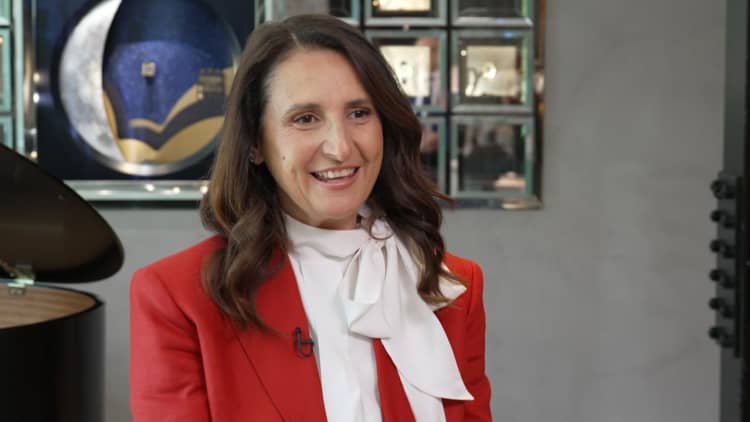
Still, Audemars Piguet CEO Ilaria Resta said sales and interest in the brand have soared. The launch generated more than 20 billion mentions and conversations on social media, she said. Millions of young consumers have suddenly become immersed in the workings of mechanical watches and watchmaking. Even the biggest Audemars Piguet collectors were calling to request their own Royal Pop.
“We’ve had a record month every month since Royal Pop launched,” Resta said. “Our website is down. We visit our stores continuously. By simply highlighting an object and a mechanical movement, we suddenly discover the world of Audemars Piguet.”
The company’s success has become a case study for Switzerland’s struggling $50 billion watch industry and the luxury economy as a whole. While the high-end Swiss watch industry is booming, business and profits for the entire sector are in decline.
The number of Swiss watches exported around the world has more than halved since 2011, and total sales fell 1.7% last year, according to a report from Morgan Stanley and LuxeConsult. While there are about 450 Swiss watch brands, the top four – Rolex, Patek Philippe, Audemars Piguet and Richard Mille – now account for about half of the industry’s sales and about 76% of profits, according to the report.
The top of the market has become so rarefied that it has become inaccessible even to wealthy watch enthusiasts. Audemars Piguet only makes 53,000 watches per year, compared to more than a million produced by Rolex, according to Morgan Stanley. Audemars Piguet’s coveted Royal Oak models typically start at $30,000, with the most complicated models selling for over $200,000. Waiting lists are long for those lucky enough to purchase them. Used hotspots typically sell for 30% or more above retail because supply is very scarce.
Resta said Swiss watch brands that follow the old model – relying on their history, older clientele and elitist marketing – are facing extinction.
“Either you dare or you die,” she said.
Ilaria Resta, CEO of Audemars Piguet.
Jason Alden | Bloomberg | Getty Images
She describes her new strategy as “radical opening”. The objective is to open the prestigious world of Swiss watchmaking to a wider and younger audience. Alongside the Royal Pop collection, Audemars Piguet is also rolling out AP Labs, ephemeral experiences that immerse visitors in the world of mechanical watchmaking. Visitors can play watch-themed games, learn about movements and complications, see watchmakers at work, and even try their hand at attaching tiny watch components.
No watches are sold at AP Labs, Resta said. The objective is solely education, as well as the recruitment of new watchmakers for an industry in perpetual shortage of qualified craftsmen.
“It’s a category born and fueled by love, passion and understanding,” Resta said. “If you don’t understand watchmaking, you will never appreciate a mechanical watch. You will always default to the simplest and cheapest way to tell time. Telling time is the last reason you buy a mechanical watch. You buy it because you understand the mechanical invention behind it, you appreciate the movement, you appreciate the aesthetic and meaning of an object that is meant to last forever.”
Audemars Piguet “Royal Pop” Collaboration with Swatch
Courtesy of: Swatch
As one of the few luxury watchmakers still privately owned and family-owned, Audemars Piguet does not publish any sales figures or profits. Resta said the company saw organic sales growth of 10% in 2025, mainly driven by more complex and expensive watches. She said 2026 will “break that record even more.”
Audemars Piguet is donating all profits from the Royal Pop collaboration to finance an initiative dedicated to the training and education of watchmakers.
But alongside its successes, Audemars Piguet is also facing new industrial pressures. The United States has imposed a series of tariffs on Swiss goods over the past year, bringing the current tariff rate to 12.5%. Expensive Swiss watches were particularly hard hit. Swiss watch exports to the United States fell 19% in August, despite global growth of 9%, according to the Federation of the Swiss Watch Industry.
Although wealthy watch buyers can easily afford the extra tax, some prefer to wait until tariffs are lifted or lowered to make purchases or deliveries, according to industry analysts. Prices of materials used for luxury watches, particularly gold, have also skyrocketed, increasing production costs. The Swiss franc has strengthened against many currencies over the past year, particularly the U.S. dollar, reducing revenue for Swiss companies selling abroad.
The combination of customs duties, material prices and currencies has reduced the margins of Swiss watchmakers. Some companies are passing on rising costs to their customers by raising prices by double digits. Resta said AP chose not to pass on tariff costs and only impose small price increases to partially offset rising material prices.
“I manage all of these headwinds in a way that doesn’t penalize our customers,” Resta said. “What I’m looking for is not annual profits. I’m fortunate to be at the head of a private company that has a very long time horizon. You want to preserve the relationship with the customer, but you also want to preserve the fair value of the product you offer.”
Resta said tough times are precisely when businesses need to innovate the most. AP is creating a new state-of-the-art service center in Raleigh, North Carolina, to repair and maintain watches, even as other watchmakers shrink their footprints.
“I always say that if you change your strategy because you’re going through a crisis, that means you’ve done a lazy job working on your strategy,” Resta said. “Strategies must be foolproof in the event of a crisis.”
A bright spot for demand is technological wealth, with many new AI millionaires and billionaires starting to collect luxury watches. Silicon Valley executives and founders are seeking hobbies and experiences that are decidedly anti-tech, from wilderness hikes and remote fly fishing to buying classic cars and mechanical watches.
“These are two worlds that should theoretically be in opposition,” Resta said. “The worlds of analog and digital, of the hyperconnected and the disconnected, are blending.”
Gn bussni