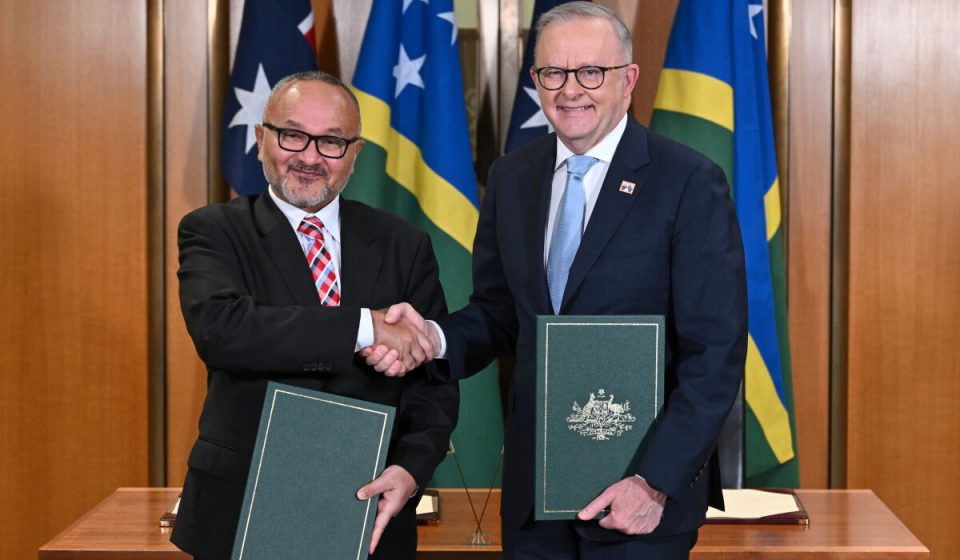
MELBOURNE, Australia (AP) — Solomon Islands rejected secret 4-year-old defense agreement with China which has raised fears of a Chinese naval presence in this South Pacific country and declared on Wednesday, during the signing of a treaty with Australia, that it would never allow a foreign military base on its soil.
The Solomon Islands lie on the sea route between the United States and Australia, from where American General Douglas MacArthur commanded the Pacific campaign during World War II. U.S. allies fought crucial battles against Japanese forces on the islands during the war, and the country that today has a population of less than 900,000 remains a strategically imperative territory in the United States’ fight against China for global influence.
The Prime Minister of the Islands Matthew Wale and his Australian counterpart Antoine Albanais signed the bilateral security agreement following reports that the Solomons would end its defense treaty with China next year.
The new treaty confirms Australia’s place as the Solomon Islands’ “principal security partner” and stipulates that “there will be no foreign military or security bases” on the small country located 2,000 kilometers (1,200 miles) northeast of Australia, the two prime ministers said in a statement.
The agreement is the latest bilateral security agreement Australia has entered into with its Pacific neighbors since Beijing signed a deal. treated with the previous Solomons government in 2022 raising fears that the Chinese navy would build a base in the South Pacific.
Since Albanese’s government was first elected in late 2022, Australia, a staunch US ally, has attempted to keep Chinese influence away from the region through bilateral security agreements with countries such as Fiji, Tuvalu And Vanuatu.
Australia has entered into a security pact with Papua New Guinea in 2024, which promised Australia’s nearest neighbor A$600 million ($396 million) over a decade to include a rugby league team in Australia’s domestic competition.
Wale neither confirmed nor denied media reports that his government had told Beijing that the security agreement with China, which provided Chinese police trainers to Honiara, the capital of the Solomons, would not be renewed when it expires after five years in early 2027.
“Unfortunately, there is a non-disclosure clause in the treaty with China,” Wale told reporters at a news conference with Albanese at the Australian Parliament. “So I can’t talk about it. We have ongoing discussions with China.”
“As you know, the Solomon Islands have been a source of uncertainty and doubt in the region for several years. Those days are over. Gone. We don’t want to go back there again,” he added.
In Beijing, Foreign Ministry spokesman Guo Jiakun did not directly answer a reporter’s question about whether the Solomons had said it would end the Chinese security pact.
“China always follows the principle of mutual respect and equality in developing its relations with the Solomon Islands,” Guo said on Tuesday. “There is no element of geopolitical rivalry or bloc confrontation in the cooperation between China and the Pacific island countries, including the Solomon Islands.”
Albanese said the new bilateral treaty has elevated bilateral relations to a “level never seen before and never been stronger.”
The treaty goes beyond security. Australia has agreed to also invest in infrastructure, education, renewable energy and sport in the Solomons.
Oliver Nobetau, director of the Pacific Islands program at the Lowy Institute, a Sydney think tank, described the treaty as important and well-suited to Solomon Islands priorities.
“It demonstrates that Australia is listening to what the Pacific partners want,” Nobetau told Australian Broadcasting Corp.
Gn world