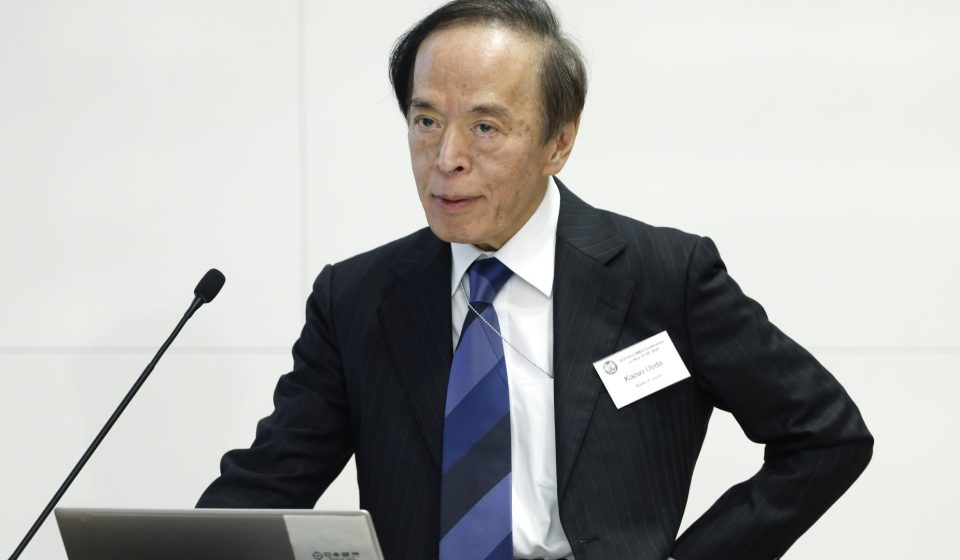

Kazuo Ueda, Governor of the Bank of Japan (BOJ), speaks during a conference hosted by the bank’s Institute for Monetary and Economic Studies in Tokyo, Japan, Tuesday, May 27, 2025.
Kiyoshi Ota | Bloomberg | Getty Images
The Bank of Japan is expected to keep its key rate unchanged at 1.25% at the end of its two-day meeting on Friday, according to a CNBC survey, with the possibility of an increase very present in the coming months.
The 16 people surveyed expect the BoJ to stay put, given that the bank last month raised rates to their highest level in 31 years. All respondents said they expected the BoJ to lay the groundwork for a rate hike in December or January next year, as domestic inflation and wages continue to rise.
Macroeconomic factors support the BoJ’s further policy tightening, said Homin Lee, macroeconomic strategist at Lombard Odier. “But there may not be sufficient consensus within the policy council for successive rate hikes given the fragility of the domestic bond market,” he added.
Sosuke Nakamura, an economist at Citi Research, said he saw no clear signs that inflation was accelerating to a degree that would justify back-to-back rate hikes.
Japan’s core inflation, excluding fresh produce, rose 2.1% in September from a year earlier, hitting its highest level this year as a weak yen raises import costs and rising energy costs feed through into higher prices, even as government subsidies absorb rising energy costs for consumers.
Inflation-adjusted wages in Japan rose for the eighth consecutive month in August, up 1.5% from a year earlier, according to the most recent government data, also indicating potential inflation driven by wage growth.
Finance Minister Satsuki Katayama reportedly told lawmakers last week that Japan was “on the cusp of a period of sustained inflation driven by rising wages,” while acknowledging that rising import costs were also pushing up prices.
The BOJ is expected to declare that its 2% “core inflation” target has been met at this meeting, according to reports from Reuters and the Japan Times.
Yen and yields
Ryutaro Kimura, senior fixed income strategist at BNP Paribas Asset Management, said he was waiting to see if the BOJ changed its wording on inflation in the monetary policy statement this week from “core CPI inflation is approaching 2 percent” to “has reached 2 percent.”
As for the yen, nine respondents expect it to trade between 157 and 158 against the greenback over the next month. Respondents’ outlook for the three-month yen target was more dispersed, ranging from 150 to 160.
“The BoJ’s normalization, rising domestic yields and changing institutional flows should gradually narrow the yield gap and bring capital back to Japan,” said Masahiko Loo, senior fixed income strategist at State Street Investment Management. But he added: “High US yields should prevent a linear rise in the yen. »
The yen strengthened against the dollar and yields on Japanese government bonds fell last week due to safe-haven demand amid a selloff in AI stocks – a reversal from earlier this month, when Prime Minister Sanae Takaichi’s spending plans and a global bond sell-off put pressure on those assets.
Nine respondents said they expected the yield on benchmark 10-year JGBs to be between 3% and 3.1% by the end of the year, up from the current 2.809%. Seven respondents said they expected the 30-year JGB yield to rise to 4.1% from 3.829% on Tuesday.
The forecast comes as analysts expect the BoJ to resume tightening after a planned pause in October.
Takuji Aida, Credit Agricole’s chief Japan economist, said the next rate hike would likely come in January, when the BOJ is expected to release its quarterly outlook report that assesses economic activity and prices.
Thirteen respondents said they expected a final rate, or the level at which the BoJ should stop its tightening cycle, between 1.75% and 2% by mid-2027.
Macroeconomic data shows the policy rate is closer to the neutral level of 2%, the BoJ’s inflation target, said Masato Koike, senior economist at SOMPO Institute Plus. But “given the state of the Japanese economy and the need to avoid excessive downward pressure on growth, I expect the BOJ to stop raising rates around 1.75%,” Koike said.
The CNBC survey was conducted from October 14 to 26 among 16 economists and analysts.
— CNBC’s Lim Hui Jie and Sri Jegarajah contributed to this report.
Gn bussni