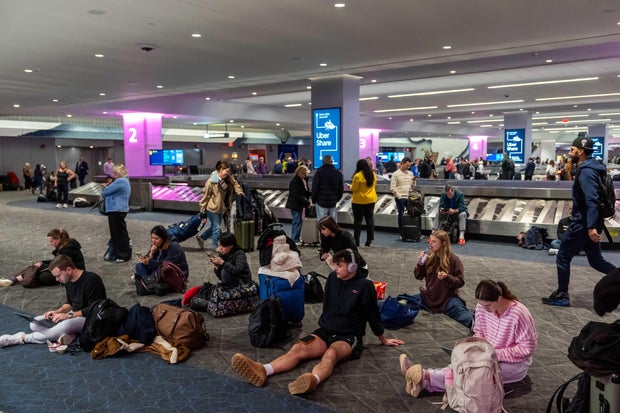
Before the airline collapse, federal transportation officials received years of questions and warnings, records show.

Government watchdogs have been warning for years of the risk of technical failures involving decrepit air transportation systems like the one that grounded all planes across the country on Fridayaccording to federal audits and previous congressional testimony.
Audits found billions of dollars spent on uncompetitive and delay-plagued contracts amid repeated technology failures. Transportation Secretary Sean Duffy said the mistake that led to Friday’s five o’clock stoppage can be traced back to a router that was supposed to be replaced in 2006.
“We’re investigating it right now,” Duffy said Sunday on CBS News. “Face the Nation with Margaret Brennan.” “It goes back decades.”
L3Harris is a company responsible for the aging telecommunications infrastructure over the past quarter century.
The Federal Aviation Administration has invested billions of dollars in the company’s contracts since 2020. A 2024 audit by the Office of Inspector General found that since the original contract was awarded in 2002, the FAA has made 10 “improperly authorized” extensions (as well as one that was appropriate), adding 57 months and $1.5 billion in expenses.
The inspector general warned that the FAA “may repeatedly use these noncompetitive extensions for convenience and administrative ease,” adding that it “risks paying more than the Agency should pay and receiving less than the highest quality results.”
Adam Gray/Getty Images 
These concerns from government watchdogs date back two decades. Just four years after Harris Corporation, now part of L3Harris, won the contract in 2002 to modernize and operate the FAA’s telecommunications infrastructure, an audit warned that the program was falling behind schedule. A follow-up report released in 2008 identified ongoing concerns about reliability issues disrupting air traffic control operations.
A year later, in 2009, more than 800 flights were delayed following a telecommunications outage. The DOT IG investigated the incident and found that the FAA failed to adequately supervise Harris Corporation and also failed to develop sufficient safeguards to oversee privately operated systems, despite the increasing shift of services to the private sector to reduce costs.
Despite these problems, the FAA awarded Harris another $291 million contract in 2012 to update its outdated voice communications equipment for air traffic control. The project was ultimately halted in 2018, after repeated delays and technical problems, with $160 million spent on the unsuccessful program.
Duffy acknowledged at a news conference after last week’s outage that the government couldn’t immediately move away from L3Harris, saying it was “stuck with L3Harris” until a new system could be built.
“A lot of our contractors, a lot of our partners, are taking our money and giving us really poor service,” Duffy said, while questioning whether the outage was caused by contractor error or faulty equipment.
Eric Soskin, inspector general of transportation under the Biden administration, told CBS News that some FAA equipment is now so old that a replacement parts manufacturer has been out of business for more than a decade.
“When you have systems as old as we currently have in place, the knowledge of how they work…may even have been lost through retirements or memory,” he said. “If only we had managed to fully deploy next-generation technologies ten years ago, I bet whatever the cause, this wouldn’t have happened.”
But a September report from the Office of Inspector General also warned that upgrading too quickly could also lead to disruption.
Adam Gray/Getty Images 
L3Harris did not immediately respond to CBS News’ request for comment regarding the inspector general’s criticism, but said in a statement Saturday that the company was working “in close coordination with the FAA” and had completed 70 percent of the transition from old copper lines to fiber cables for the Agency’s communications.
“We support the FAA in its investigation to understand the conditions that led to the grounding of our nation’s air transportation on November 13,” the statement said. “L3Harris takes seriously the nationwide ground shutdown and its impact on travelers, airlines and air traffic operations.”
Even as L3Harris faced scrutiny over its performance, the company spent millions trying to influence federal policy, including seeking additional funds to modernize the infrastructure it has operated for more than two decades.
It has paid $23.9 million to lobbyists since 2020, including $2.51 million this year, according to Senate records. The revelations show that she annually lobbied Congress for funding to modernize the FAA. L3Harris also lobbied the FAA directly.
Ballard Partners, which has close ties to the White House, has at times been among the lobbying firms it has retained. Other companies employed lobbyists who previously worked on congressional appropriations committees that play an important role in decisions on FAA funding, records show.
Last April, L3Harris wrote a letter urging congressional leaders on the House Transportation and Infrastructure Committee to advance an air traffic control modernization proposal that initially called for $15 billion in federal spending.
Two of the lawmakers addressed in the letter had previously received campaign contributions from the company’s political action committee, including Rep. Sam Graves, a Republican from Missouri, whose campaign received $10,000 in the 2021-2022 election cycle, and Democrat Rick Larsen, of Washington, whose campaign received $5,000 in the 2023-2024 cycle.
Four days after sending the letter, Graves publicly unveiled the committee’s proposal to provide billions of additional dollars for air traffic control modernization. Congress ultimately approved $12.5 billion for FAA modernization as part of President Trump’s One Big Beautiful Bill Act, including $4.75 billion for telecommunications upgrades.
Graves and Larsen did not respond to requests for comment from CBS News.
In testimony before the House Appropriations Committee last March, Deputy Inspector General Mitch Behm cited a repeated pattern in 50 audits of cost increases and schedule overruns, placing much of the blame on the failure to define design decisions and the lack of a clear plan.
Other government watchdogs have also denounced the collapse of air communications infrastructure.
In 2024, the Government Accountability Office deemed 51 of the FAA’s 138 air traffic systems unsustainable, citing outdated features and missing replacement parts, and another 54 potentially unsustainable.
The Transportation Department says it is using its $12.5 billion wisely, including replacing handwritten paper systems with electronic systems in 25 control towers, upgrading five facilities away from the use of floppy disks and upgrading 469 tower radios, but it says the funds are allocated narrowly by Congress with little flexibility to choose what it spends.
Soskin told CBS News that Friday’s outage “confirms the importance of continuing technology upgrades,” but added that “the FAA and DOT need to carefully oversee these projects and ensure they have high-performing, reliable, properly purchased systems so that they represent good value for taxpayers.”
“The transfer must be handled carefully,” the former inspector general said. “It may be that some disruptions like this are unavoidable, in which case the FAA and other leaders need to do a good job explaining to travelers why they are happening and why the end result is worth it.”
Gn usa