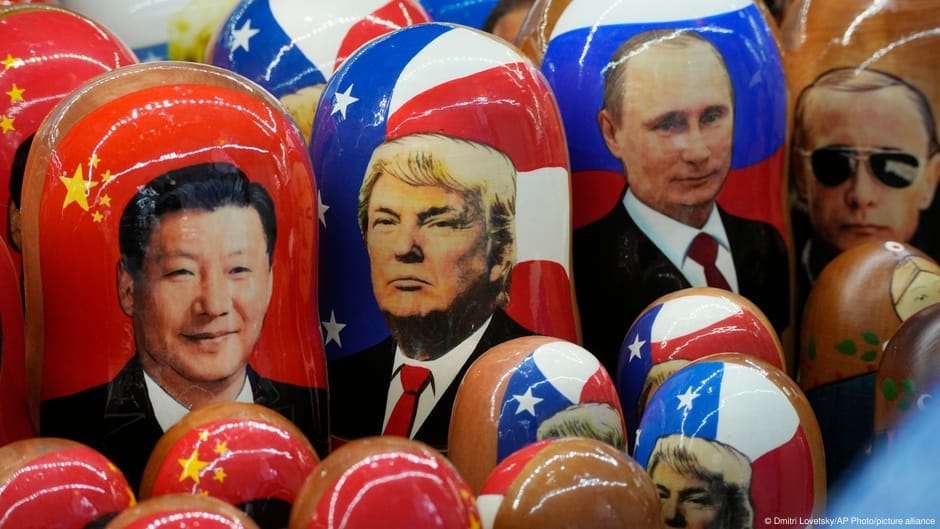
An unprecedented meeting between the leaders of China, Russia and the United States could take place this week on the sidelines of the Asia-Pacific Economic Cooperation (APEC) summit at China’s technology hub in Shenzhen.
China has not yet confirmed that the meeting will take place. However, a Chinese Foreign Ministry official recently told reporters that Beijing was “in communication” with relevant parties. In Moscow, a Kremlin representative said “coordination” work was underway.
The clearest indication of a possible summit came from US President Donald Trump last weekend. Speaking to reporters at a Florida airport, Trump said he “thought” one of the planned APEC meetings would be with Russian President Vladimir Putin and Chinese President Xi Jinping.
Is the world ready for a “new Yalta”?
Despite no official confirmation from Beijing, Moscow or Washington, media outlets have already referred to the possible trilateral summit as “the new Yalta”, invoking the optics of the United States, the United Kingdom and the Soviet Union coming together at the end of World War II and deciding the new balance of geopolitical power in the Crimean resort town.
At the same time, no one seems to really know what the three leaders would talk about if China agreed to host the trilateral APEC summit.
In his brief remarks to reporters Sunday, Trump avoided mentioning Russia’s war in Ukraine when asked about the possibility of a meeting, bringing up only “Iran” and “denuclearization” as possible topics of discussion.
China’s Foreign Ministry reported “no information” when asked earlier this week about the potential content of the negotiations.
End of the campaign to isolate Putin?
A three-way meeting with a photo opportunity would be a major diplomatic victory for Russian President Putin. Since launching the full-scale invasion of Ukraine in February 2022, the Kremlin leader has faced years of diplomatic boycott from kyiv’s allies, including the United States under Trump’s predecessor Joe Biden.
Putin first floated the idea of a trilateral summit last month during a call with Trump. THE The Wall Street Journal reported that Putin wanted the meeting to discuss ending his war in Ukraine.
For the United States, having the president stand alongside the leaders of America’s main rivals could be a bad image, even though Trump has already appeared to personally greet both leaders with a red carpet at different points in his second term.
As host, China finds itself in an even more delicate position. Even though Russia and China are largely aligned on many issues, Beijing does not want to be explicitly linked to Russia’s war in Ukraine and undermine China’s efforts to present itself as a long-term force for global stability.
EU fears being excluded from Ukraine talks
The Chinese government is also working to rebalance economic ties with the EU. European powers would likely bristle at a China-hosted summit discussing the war in Ukraine without kyiv or Brussels present at the table.
“China is clearly concerned about a possible trilateral meeting with the United States and Russia, and although Beijing has changed its position from silence to admitting that the three powers are in contact, the vagueness of these statements appears deliberate,” Alicja Bachulska, an Asian policy researcher at the European Council on Foreign Relations (ECFR), told DW.
“Beijing is aware of the potential negative optics of the ‘Yalta 2.0’ framework, even if this historical comparison is inaccurate and does not reflect current geopolitical dynamics,” Bachulska said.
She notes that the trilateral meeting could “trigger a further escalation in the already deteriorated relations between China and the EU” if Ukraine was discussed without Europeans in the room.
For China, there is also little to gain in terms of optics. Images of Xi alongside Trump, the leader of Beijing’s main rival, and Putin, Beijing’s partner in its opposition to the United States, could present an awkward look.
“Even if the meeting only results in a photo shoot, it could still seriously erode China’s image,” Bachulska added.
Beijing and Moscow stick to a “limitless” partnership
Putin and Xi have met around 40 times since the Chinese president came to power in 2012.
The two neighboring countries became particularly close after declaring a “no-holds-barred” partnership agreement in early 2022. The move was announced by Xi and Putin on the sidelines of the Beijing Winter Olympics, just weeks before the full-scale invasion of Ukraine.
Current ties between Russia and China are deeper than they have been in decades.
At the heart of the axis between the two nations is a long-term strategy aimed at containing American power while fostering an alternative world order that Moscow and Beijing can use for their own ends.
China helps Russia on the sidelines
Throughout the war in Ukraine, which is nearing the end of its fifth year with no solution in sight, Beijing has quietly provided Russia with a crucial market for its energy exports, while supplying it with so-called “dual-use” technologies and goods.
Although China did not explicitly supply weapons to Russia, its exports included high-tech components that could be used for modern weapons systems like drones.
Officially, Beijing maintains its neutrality in the war in Ukraine and has refused to take responsibility for its outcome.
“China is more interested in global governance reform that reflects its preferences and red lines while maintaining a collegial appearance,” Aurelio Insisa, a senior analyst at the Berlin-based Mercator Institute for China Studies (MERICS), told DW.
Even if China agrees to host the meeting, it will likely avoid presenting it as three major powers making decisions for the rest of the world, according to Insisa.
“Adhering to the ‘G3’ narrative would damage its image as a champion of the Global South and developing countries. It is also worth noting that Beijing has shown no interest in engaging in the only pressing issue that could realistically be addressed in such a trilateral format: nuclear disarmament,” he added.
What are the real limits of the China-Russia axis?
In a report released in August, the U.S.-China Economic and Security Review Commission (USCC) described China as a “decisive enabler” of Russia’s war in Ukraine.
Beijing “converts dependence on Moscow into lasting military, technological, economic and geopolitical advantages while avoiding the obligations of a formal alliance,” according to the American body.
However, the commission also noted that there were limits to Beijing’s strategic support, and that intelligence and security concerns remained a constraint on deeper cooperation. The report highlights that the relationship is more of a strategic alignment than an alliance, with deep mistrust persisting in some key areas.
Russian defense companies, for example, have accused Chinese companies of stealing intellectual property. Beijing, for its part, is concerned about growing strategic relations between Russia and North Korea, which have reduced Pyongyang’s dependence on China.
China and Russia also differ on nuclear doctrine. While Beijing has long maintained a “no first use” policy, Moscow uses the nuclear threat as part of its strategy.
China enjoys ‘privileged perspective’ on Ukraine war
But for now, the benefits of alignment remain.
MERICS analyst Insisa believes that cooperation between Russia and China will largely continue through this year, including providing energy to Russia and potentially transferring military technologies in the “few remaining areas where it maintains an advantage.”
“China, in turn, will continue to supply dual-use technologies, purchase Russian energy, provide Moscow with some diplomatic cover and, most importantly, offer channels to circumvent Western sanctions,” he added.
Notably, China will also benefit from a “privileged vantage point” on how the battlefield in Ukraine is evolving when it comes to land warfare.
“Strategic mistrust between the two sides, particularly Russia’s concerns over its economic dependence on China, will continue to limit the scope of their cooperation,” Insisa said.
Gn world