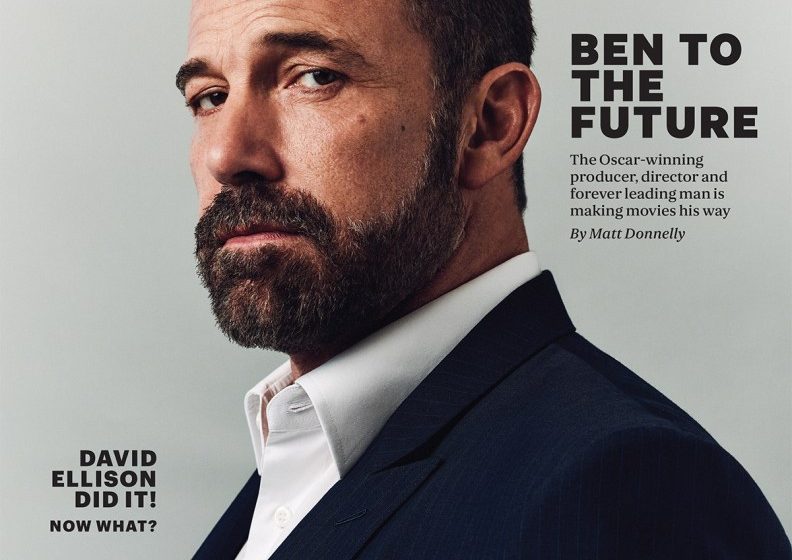

In the offices of Artists Equity, the full-service content company founded four years ago by Ben Affleck and Matt Damon, Batman is the gatekeeper.
As you step out of the red-carpeted elevator in an elegant West Hollywood skyscraper, the superhero replica greets you with a menacing look. Affleck played the Caped Crusader in four films between 2016 and 2023. Opposite Batman stands a mannequin dressed in the orange NASA suit worn by Damon in the 2015 hit “The Martian.”
The exhibition is an effective media hype tool, like a version of Jennifer Hudson’s “spiritual tunnel” but for brothers, because we are entering a space rarely open to the press. Spanning two floors with stunning views of the hills, the office doubles as a memorabilia museum that chronicles the adventures of Hollywood’s childhood best friends. Outside Affleck’s office, there’s a credenza housing the Oscars he and Damon won for writing “Good Will Hunting,” the 1997 film that catapulted them to stardom. (Affleck won a second Oscar for producing the winning film “Argo,” in which he also starred and directed.) Elsewhere, there’s evidence that nearly 30 years later, they’re still enjoying the fruits of those early successes: A miniature version of a Trojan horse from Damon’s recent blockbuster “The Odyssey” and the Batcycle that Affleck rode in the less-appreciated “The Flash” are also on display.

Matt Sayles for Variety
Affleck, at 54, wants to make it clear that this whole enterprise isn’t just a Matt-and-Ben shrine. “The danger is that it seems like building a monument to yourself – it’s not,” Affleck says. “I’m in an interesting line of work where you accumulate these physical tokens, and that’s all that’s left. You spend all this time on a movie, work so hard, and all you get is a little plastic DVD. I always wonder what happens to that thing. Most people put it in a warehouse in Simi Valley.”
The films commemorated throughout the office — in Affleck’s suite there’s also the rubber nun mask he wore as a thief in “The Town” and a Tommy gun from “Live by Night” — have little in common other than the talent of Affleck and Damon. Yet they bring back not only memories and hard work, but also a model that Artists Equity hopes to reshape.
After all, Affleck will soon add a memento from “Animals,” the upcoming kidnapping thriller he directed and in which he stars alongside Kerry Washington, Steven Yeun and Gillian Anderson. This was not achieved in the traditional studio system, but through the partnership between Artists Equity and Netflix – a first-time deal to produce and distribute films for streaming. That arrangement made Affleck and Damon’s humble boutique the primary outside producer of the company’s original films, including their on-screen reunion, “The Rip,” which arrived on the platform in January. (Netflix also acquired InterPositive, Affleck’s AI startup, in July for nearly $590 million in cash.)
For all of Artists Equity’s good faith, little is known about its inner workings. In 2022, well into the streaming revolution that has upended the show business economy, Affleck and Damon formed AE with RedBird Capital baron Gerry Cardinale (a backer in David Ellison’s acquisition of both Paramount companies). And Discovery Warner Bros). “Matt wants to win Oscars and Ben wants to make money. Together they are the perfect person,” Cardinale said.
The company’s promise is to give creatives greater access to profits, almost in real time. The company shares all streaming revenue with exceptional talent – including writers, directors, actors and producers – in addition to traditional fees. He also negotiated performance-based bonuses with Netflix that pay the entire crew on a given film.
What does this model mean – in itself and for the future of the company? For the first time, Affleck lifts the veil to Variety to explain Artists Equity’s proprietary model, which he hopes other companies will adopt.
By revealing these details, Affleck says he’s worried about putting press on what he and Damon have built. Who can blame him? The spoils of Affleck and Damon’s on-screen achievements documented in these rooms have had their ups and downs. Affleck’s life as captured by the celebrity press — including a romantic reunion with Jennifer Lopez and another breakup in 2024 — has often placed him in a role he wouldn’t have chosen to play.
But that may just be behind it: Affleck has a business to grow and an industry to evolve. Here, he discusses the beauty of a mundane routine and how Artists Equity helped him find balance within himself.
It’s an extremely uncertain time for the industry, but there’s an undeniable revival this year at the box office. Is theater back?
The income is almost back. Let’s see what happens with “Dune: Part Three” and “Avengers: Doomsday.” I still think we’re going to be short on attendance. Premium formats create a delta, which responds to a particularity of this phenomenon: uniform pricing. There is a ticket price. I remember thinking at the time, “They charge the same amount to see ‘Armageddon’ and ‘Chasing Amy,'” even though we filmed one in Kevin Smith’s backyard and the other at NASA. I don’t think theater will ever get back to where it was when it was the only way to see something. That’s why “Gone with the Wind,” I think, remains, I think, the best-selling movie in history. This is also the reason why it is more difficult to become a star now.
Why then?
There are fewer people that everyone has heard of. When you were in a movie in the 80s or 90s, a studio invested a lot of money to market you as an actor. We all benefited from it. We had the feeling that we could give fame to certain people. People ask: where are the stars now? Obviously you have Tom Holland, Jacob Elordi, Zendaya. Lots of them. But there are fewer that everyone in America has heard of. I remember when I was a kid reading Premiere magazine about what makes a star. It’s about getting the audience to show up. “Cocktail” and “Sleeping With the Enemy” sold easily because Tom Cruise and Julia Roberts are big stars capable of selling a big movie. But what if a movie is just okay?
Matt Sayles for Variety
Artists Equity has been in existence for four years. Elevator pitching provides greater access to benefits for creatives. You haven’t really explained how this works so far. For what?
I spent a lot of my life doing that. Promoting (my work) feels more and more like a minefield. It’s like, “Don’t say something stupid that’s going to haunt you forever.” » Before, I had more fun; this is a little less the case now. I’ve been a little reluctant to talk about (Artists Equity) because I don’t want the perception of what we do to be just me and Matt. We are consciously trying to achieve something greater.
But I was wrong not to be proactive. With the arrival of Animals, there is context around our partnerships with Netflix and Sony and the performance-based pay system we are working on. We have had success. People received bonuses. The history of this company is full of promises of participation that ultimately do not come true. You read it in Varietytrue or apocryphal stories, where people say: “We made this movie, it made $200 million at the box office and I didn’t make any money. »
How does this company address this?
It took years to institutionalize this. Look at the work stoppages that occurred during the Hollywood labor strikes three years ago. A lot of that had to do with streaming and how people were paid. We’ve worked to facilitate conversations about this, and Netflix has ultimately agreed to share information about what’s successful on its platform. It is in their interest to create a united motivation with the people they work with.
You’re talking about changing deal structures that date back to the 1940s. I imagine having two movie stars in a room asking you, that gives you and Matt Damon some leverage?
Part of it is about enjoying it. It’s present, but it’s not something you can rely on on a daily basis. This is not a business where you get a warrant and a gold watch. The phone no longer rings for all of us. (Fame) helps build momentum.
It’s impossible to say “Let’s adopt something new”: people have spent years navigating the existing system. Matt and I started this model with “Air” at Amazon, and “The Rip” at Netflix is another good example. We asked them to try it our way. We seek to compensate old-school talent – directors, writers, actors, producers – as if they were investors in a film. It starts from the clear and obvious principle that these parties are remunerated exactly as equity financiers would be. Not in some sort of mysterious, separate bonus pool away from where the income comes in.
I understand the studio’s point of view. Historically, they live in a position where (talent) is treated as a cost. They are paid in advance; they are not investors. But we are trying to create a model that can be widely adopted. To that end, we just closed a deal to launch Artists Equity Independent Pictures, an independent film fund that I’m really excited about. It’s specifically for next generation filmmakers. Another part of our mission with (this model) is to maintain Los Angeles as an important hub for cinema.
How?
Wanting to be here. I am divorced, I…
Gn entert