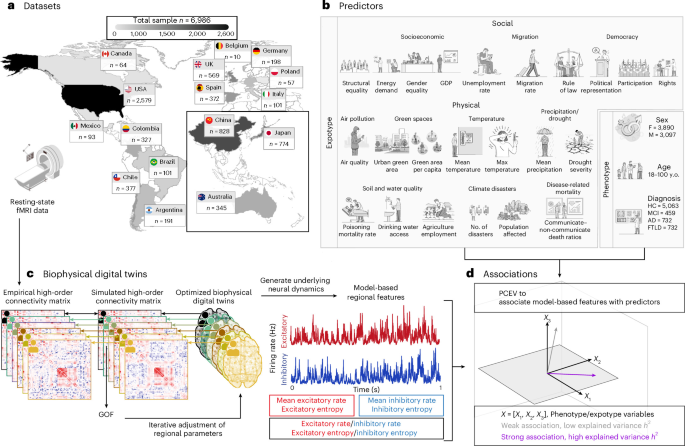
Ibanez, A. et al. Computational models of whole-body exposure for comprehensive and precise brain health. Nat. Common. 1611078 https://doi.org/10.1038/s41467-025-67448-3 (2025).
Ibanez, A., Kringelbach, ML & Deco, G. A synergistic turning point in the cognitive neuroscience of brain diseases. Cogn. Trends Sci. 28319-338 https://doi.org/10.1016/j.tics.2023.12.006 (2024).
Patow, G., Martin, I., Sanz Perl, Y., Kringelbach, ML & Deco, G. Whole-brain modeling: an essential tool for understanding brain dynamics. Nat. Rev. Primer Methods 41–2 https://doi.org/10.1038/s43586-024-00336-0 (2024).
Genon, S., Ibanez, A., Tahmasian, M. & Eickhoff, S. Linking extype to brain-behavior phenotype: towards a holistic vision. Nat. Reverend Neurosci. 27513-524 https://doi.org/10.1038/s41583-026-01049-x (2026).
Xu, L. et al. Seasonal variations in functional connectivity of the human brain. Sci. representative 1316898 https://doi.org/10.1038/s41598-023-43152-4 (2023).
Tian, X. et al. Spontaneous regional brain dynamics contribute to generalizable brain-behavior associations. Nat. Hmm. Behavior. 10384-402 https://doi.org/10.1038/s41562-025-02332-0 (2026).
Luppi, AI et al. Dynamic models for assessing structure-function relationships in network neuroscience. Nat. Reverend Neurosci. 23767-768 https://doi.org/10.1038/s41583-022-00646-w (2022).
Shine, JM et al. Computational models link cellular mechanisms of neuromodulation to large-scale neuronal dynamics. Nat. Neuroscience. 24765-776 https://doi.org/10.1038/s41593-021-00824-6 (2021).
Coronel-Oliveros, C. et al. Diversity-sensitive brain clocks linked to biophysical mechanisms of aging and dementia. Nat. Ment. Health 31214-1229 https://doi.org/10.1038/s44220-025-00502-7 (2025).
Moguilner, S. et al. Biophysical models applied to dementia patients reveal links between geographic origin, gender, disease duration and loss of neuronal inhibition. Alzheimer Res. There. 1679 https://doi.org/10.1186/s13195-024-01449-0 (2024).
Udeh-Momoh, CT et al. Resilience and brain health in global populations. Nat. Med. 312518-2531 https://doi.org/10.1038/s41591-025-03846-w (2025).
Coronel-Oliveros, C. et al. Viscous dynamics associated with hypoexcitation and structural disintegration in neurodegeneration via whole-brain generative modeling. Alzheimer’s dementia. 203228-3250 https://doi.org/10.1002/alz.13788 (2024).
Ranasinghe, KG et al. Altered parameters of excitatory and inhibitory neuronal subpopulations are clearly associated with tau and amyloid in Alzheimer’s disease. eLife 11e77850 (2022).
Saberi, A. et al. Adolescent maturation of the cortical excitation-inhibition ratio based on individualized modeling of the biophysical network. Sci. Av. 11eadr8164 https://doi.org/10.1126/sciadv.adr8164 (2025).
Sánchez-Rodriguez, LM et al. Personalized whole-brain neural mass models reveal combined hyperexcitable Aβ and tau influences in Alzheimer’s disease. Common. Biol. 7528 https://doi.org/10.1038/s42003-024-06217-2 (2024).
Hernandez, H. & Ibanez, A. Expotype-phenotype resilience and multimodal aging clocks. Clin. Trans. Med. 16e70558 https://doi.org/10.1002/ctm2.70558 (2026).
Berman, MG, Kardan, O., Kotabe, HP, Nusbaum, HC & London, SE The promise of environmental neuroscience. Nat. Hmm. Behavior. 3414-417 https://doi.org/10.1038/s41562-019-0577-7 (2019).
Legaz, A. et al. Exposure of brain aging in 34 countries. Nat. Med. 321838-1851 https://doi.org/10.1038/s41591-026-04302-z (2026).
Wang, HE et al. Virtual brains: from fundamental neuroscience to clinical use. Natl Sci. Round. 11nwae079 https://doi.org/10.1093/nsr/nwae079 (2024).
Moguilner, S. et al. Brain clocks capture diversity and disparities in aging and dementia across geographically diverse populations. Nat. Med. 303646-3657 (2024).
Ibanez, A. et al. Neuroecological links of the exposome and One Health. Neuron 1121905-1910 https://doi.org/10.1016/j.neuron.2024.04.016 (2024).
Ibanez, A. & Santamaria-Garcia, H. Rethinking risk factors for global dementia prevention. The Lancet 408787-789 https://doi.org/10.1016/s0140-6736(26)01440-6 (2026).
Mindlin, I. et al. The impact of homeostatic inhibitory plasticity in a generative biophysical model. Network. Neuroscience. 1–65 https://doi.org/10.1162/NETN.a.611 (2026).
Hellyer, PJ, Jachs, B., Clopath, C. & Leech, R. Local inhibitory plasticity adjusts macroscopic brain dynamics and allows the emergence of functional brain networks. NeuroImage 12485-95 https://doi.org/10.1016/j.neuroimage.2015.08.069 (2016).
Hernández, H. et al. The exhibition of healthy and accelerated aging in 40 countries. Nat. Med. 313089-3100 https://doi.org/10.1038/s41591-025-03808-2 (2025).
Turgeon, M. et al. Principal component of explained variance: An efficient and optimal data dimension reduction framework for association studies. Stat. Methods Med. Res. 271331-1350 https://doi.org/10.1177/0962280216660128 (2018).
Herzog, R. et al. Neuronal mass modeling for the general public: democratizing access to whole-brain biophysical modeling with FastDMF. Network. Neuroscience. 81590-1612 https://doi.org/10.1162/netn_a_00410 (2024).
Chen, L., Li, X., Tjia, M. & Thapliyal, S. Homeostatic plasticity and excitation-inhibition balance: the good, the bad and the ugly. Curr. Notice. Neurobiol. 75102553 https://doi.org/10.1016/j.conb.2022.102553 (2022).
Rosas, FE, Mediano, PAM, Gastpar, M. & Jensen, HJ Quantifying high-order interdependencies via multivariate extensions of mutual information. Phys. Rev. E 100032305 https://doi.org/10.1103/PhysRevE.100.032305 (2019).
Gatica, M. et al. High-order interdependencies in the aging brain. Brain connection. 11734-744 https://doi.org/10.1089/brain.2020.0982 (2021).
Verdi, S., Marquand, AF, Schott, JM & Cole, JH Beyond the average patient: how neuroimaging models can address the heterogeneity of dementia. Brain 1442946-2953 https://doi.org/10.1093/brain/awab165 (2021).
Migeot, J. et al. Social exposome and brain health consequences of dementia in Latin America. Nat. Common. 168196 https://doi.org/10.1038/s41467-025-63277-6 (2025).
Robinson, H. et al. The effect of the “exposome” on developmental brain health and cognitive outcomes. Neuropsychopharmacology 51169-184 https://doi.org/10.1038/s41386-025-02180-6 (2026).
Mahdipour, M. et al. Exposome-wide models predict brain health during aging. Nat. Common. 173409 https://doi.org/10.1038/s41467-026-71271-9 (2026).
Stefanovski, L. et al. Linking molecular pathways and large-scale computational modeling to evaluate candidate pathological mechanisms and pharmacodynamics of Alzheimer’s disease. In front. Calculate. Neuroscience. 1354 https://doi.org/10.3389/fncom.2019.00054 (2019).
Gn Health