
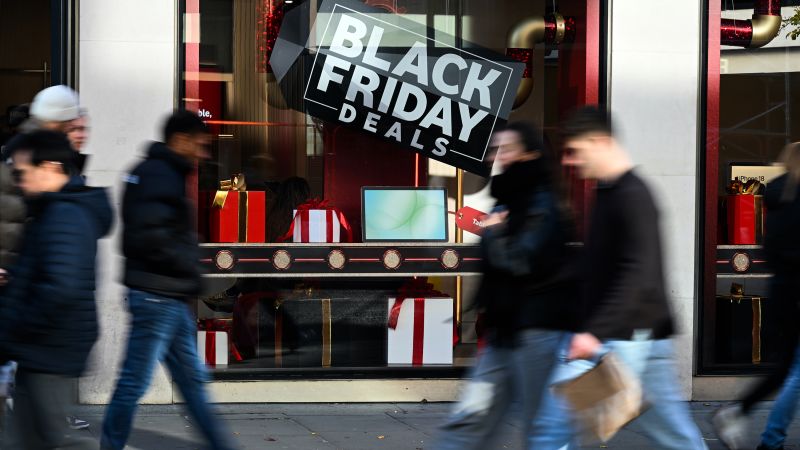
Consumers shopped more on Black Friday this year despite inflationary pressures, with U.S. retail spending up nearly 6% year over year, according to a Mastercard SendingPulse analysis.
Much of that increase was focused on electronics and software, with consumer spending in those areas surging in mid-November — the same time “Grand Theft Auto VI” was released and generated nearly $4 billion in sales. Spending in this tech category increased 7.9% year over year on Black Friday.
“Black Friday showed an adaptable consumer who remains willing to spend while considering where, when and how to do it,” Michelle Meyer, chief economist at the Mastercard Economics Institute, said in a press release.
Spending on clothing increased 4.4% year-over-year, according to Mastercard, while spending on jewelry increased 4.6%. The Mastercard report, which is not adjusted for inflation, measures in-store and online sales excluding gasoline and automobiles.
U.S. wallets have been weighed down by rising gasoline prices since the start of the Iran war, as well as more expensive groceries — including Thanksgiving dinner — while the Federal Reserve’s preferred inflation gauge is nearly double the Fed’s 2% target. While many consumers are looking for ways to budget, they are also proving to be resilient spenders looking for value.
The National Retail Federation had estimated that nearly 183 million people would shop over Thanksgiving weekend, up from nearly 187 million last year.
“Shoppers are looking for deals and retailers are offering great-value gifts while creating special experiences that continue the Thanksgiving weekend shopping tradition,” said Allison Zeller, NRF vice president of industry and consumer affairs, in a Nov. 19 press release.
Despite bad weather and hundreds of thousands of Americans losing power, in-store spending increased 3.8% on Black Friday, the highest since 2022, according to Mastercard.
Global online spending reached nearly $83 billion on Black Friday, according to Salesforce data. Brands using Shopify generated $7.6 billion in Black Friday sales, according to the e-commerce platform, up 21% from last year.
Americans are also increasingly turning to artificial intelligence tools to guide their spending. More than half of consumers surveyed by the NRF said they plan to use AI, including for brainstorming, budgeting and product recommendations.
Big tech companies, like Meta, OpenAI, and Amazon, are fighting for consumer attention with their AI agents. Meta’s Muse, which racked up 10 million downloads in the United States in its first 40 days, boasts of its ability to help buyers. And Amazon rolled out Alexa for Shopping as an AI assistant earlier this month.
Buyers who use agents also spend more online, according to Salesforce. Shoppers who used an AI agent spent an average of $209, or 48% more per order than those who did not.
Online spending reached $13.1 billion on Black Friday, an 11.1% increase from last year, and is expected to reach $15.1 billion on Cyber Monday, according to Adobe Analytics.
While last-minute shopping is expected to increase for Cyber Monday, Mastercard’s Meyer expects a “typical moderation” after Black Friday until a Christmas resurgence in the final weeks of December.
“Activity is expected to pick up around shipping times, followed by a final in-store push as shoppers check the final items off their lists,” Meyer said.
Gn bussni