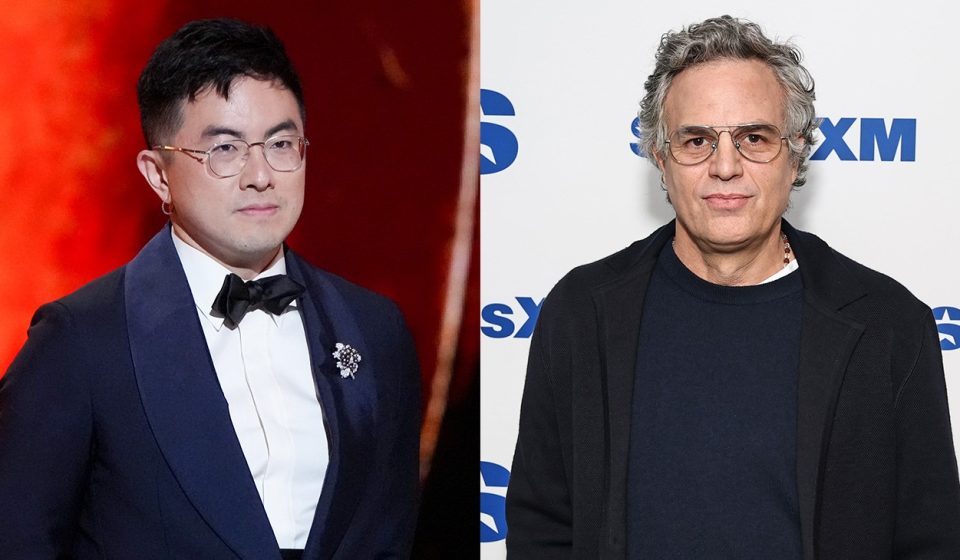
Bowen Yang insists he didn’t know “Zio” was an anti-Semitic slur.
In a resurfaced clip of his Bodybuilders podcast, the comedian muttered the term under his breath at the mention of Regina Spektor, the Jewish American singer-songwriter. Yang was responding to a guest, another alleged mastermind named Edy Modica, who said Spektor was “a little Israel, a hard core.” Spektor, who was born in the Soviet Union and immigrated to the United States as a child refugee, has openly defended the Jewish state since the Hamas massacre of October 7, 2023, and, given her personal history, is well aware of left-wing anti-Semitism. When protesters interrupted one of his concerts last year by shouting “Free Palestine,” a visibly frustrated Spektor announced to the crowd: “The only reason I speak English is because I came here to escape this shit.” »
“Zio,” short for “Zionist,” was popularized by former KKK grand wizard David Duke when he was going through a phase of respectability and needed a way to attack Jews without naming them as such. In her apology, Yang seemed genuinely shocked to hear this. “I want to sincerely apologize for using a word on the podcast without knowing its anti-Semitic history,” he wrote on Instagram. “Particularly upsetting to realize that I have adopted language popularized by far-right movements whose rhetoric we should be wary of and against which we should act. »
We should take Yang at his word: he didn’t know the anti-Semitic etymology of “Zio.” Why would he do it? The progressive cultural spaces in which Yang lives are so deeply anti-Semitic that people readily hurl racist slurs propagated by men in white hoods. Does anyone really believe that Bowen Yang knows the first thing about the Israeli-Palestinian conflict? Like everyone else in his social milieu, which dominates large swaths of the entertainment world, he acquires his progressive worldview – in which vicious hatred of Israel is at the center – by osmosis. If there is one subject that unites the extreme left and the extreme right in this country, it is the Jewish question.
Yang seemed more distraught by the far-right origins of “Sio” than by the community the word intends to harm: Zionists, that is, all those who believe in Israel’s right to exist, that is, the vast majority of the world’s Jews. In the minds of Yang and others of his ilk, progressives cannot be anti-Semitic, just as they cannot be anti-black, anti-women, anti-gay, or anti-anyone. For them, intolerance is exclusively a right-wing phenomenon. Yang is not an anti-Semite, you see, he is just an “anti-Zionist.” We know this because he ended his apology with the indispensable “Free Palestine,” no expression of contrition for Jewish pain being complete today without a nod to the movement that wants to eliminate the world’s only Jewish state.
Unfortunately, Yang wasn’t the only celebrity to make an anti-Semitic speech last week. Like Yang, who owes his career to a Jew (Lorne Michaels), Mark Ruffalo became a very wealthy man playing a comic book character created by one of them (Stan Lee). That didn’t stop him from questioning the loyalty of the country’s highest Jewish official. “Israel is just one issue among a multitude of reasons why Van Hollen is the right leader for our times,” Ruffalo tweeted in a message explaining his support for Maryland Sen. Chris Van Hollen becoming Senate Majority Leader over Chuck Schumer. “We need justice, we need leadership that follows the will of the people and not entrenched religious beliefs and loyalties. »
In other words, Schumer cannot be trusted in a position of political leadership because he is a Jew who cares about Israel, a class of Americans whose “loyalty” is suspect. Ruffalo subjects no other ethnic group to this scrutiny except Jews. According to him, Schumer is less American than someone who has “Van” in his last name. Again, this is the sort of thing Gregory Peck’s character might have encountered in Agreement between men will come out of the mouth of a prominent Hollywood liberal in 2026. At least David Duke has the courage to be outspoken in his anti-Semitism.
William Goldman’s famous maxim about Hollywood – “no one knows anything” – applies just as much, if not more, to its residents’ understanding of politics. This is surprising to me, after the popularity of Team America: World PoliceRicky Gervais’ numerous appearances at award shows and Kamala Harris’ presidential campaign, that celebrities still have the nerve to voice their opinions on something other than the movies and gaming platform they’re paid to run. Does nepo baby Hannah Einbinder realize how ridiculous she sounds, declaiming “never again for anyone” at a gay rights event in support of an Islamist political movement that murders gay people and uses rape as a weapon of war? Just like we don’t ask plumbers to brush our teeth, we shouldn’t rely on people who claim to make a living to inform our political views.
That anti-Semitism is so prevalent in certain sectors of Hollywood—that stars can so casually invoke old prejudices against Jews and not have to worry about their careers as they certainly would if they slandered any other minority—reveals two things about the entertainment industry. First: even if Hollywood was built largely by Jews (which the Academy Museum should be encouraged to acknowledge), it is certainly not controlled by them. And second: in its understanding of prejudice, anti-Semitism is taken less seriously than other forms of bigotry.
The tale of two Academy Awards illustrates just how far Hollywood has fallen in this regard. In 1978, actress Vanessa Redgrave won an Oscar for her role in Juliebased on a book by Stalinist writer Lillian Hellman. Outside the Dorothy Chandler Pavilion were members of the extremist Jewish Defense League protesting Redgrave for his advocacy of the Palestinian cause. In accepting his award, Redgrave condemned the “Zionist thugs” outside, “whose behavior is an insult to the stature of Jews everywhere and to their great and heroic record in the fight against fascism and oppression.” Good Jews, according to Redgrave, are those who fight his political battles. The wicked support Israel.
Redgrave was rightly booed. But the real blow came when director and screenwriter Paddy Chayefsky then took the stage to present an award. A true veteran of the war against fascism and vocal opponent of the Hollywood blacklist, Chayefsky had the good faith to censure Redgrave for attempting to hijack the evening. “I’m tired of seeing people exploit the opportunity of the Oscars to spread their own political propaganda,” he said, a phrase that could be uttered at every Oscar ceremony. “I would like to suggest to Miss Redgrave that the fact that she won an Oscar is not a pivotal moment in history, does not require proclamation and that a simple thank you would have sufficed.”
Fast forward to 2024, when director Jonathan Glazer accepted the Academy Award for Best International Film, The area of interest. After thanking the Auschwitz-Birkenau National Museum, Glazer and his two Jewish co-producers behind him said, “In this moment, we stand here as men who refute our Jewishness and the Holocaust hijacked by an occupation that led to conflict for so many innocents.” » These dirty Jews who are exploiting the Holocaust to perpetrate their own genocide.
But this time, Glazer was applauded for his appalling remarks. And when Steven Spielberg, director of Schindler’s Listfounder of the Shoah Foundation and one of the most powerful men in Hollywood, took the stage later that evening, saying nothing.
There are many ways to measure Hollywood’s decline. Poor quality of films. The decline in theater attendance. The rise of content inspired by algorithms. Here’s another: the depreciation and marginalization of people whose creativity has helped make them the envy of the world.
James Kirchick is the author of Secret City: The Hidden History of Gay Washington.
Gn entert