BREAKING: Vanderbilt suffers cybersecurity attack, VUIT responds – The Vanderbilt Hustler

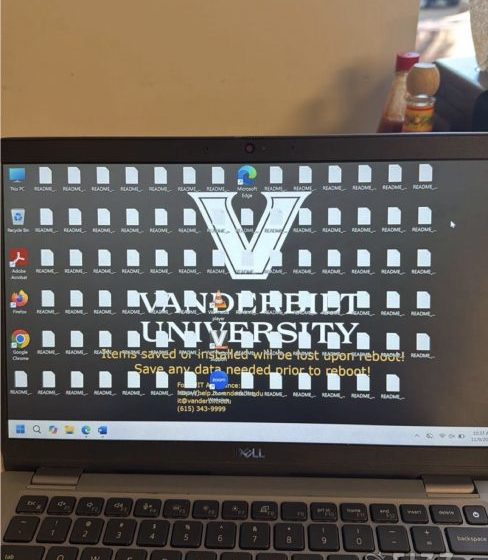
Vanderbilt computer displaying warning sound, as captured on November 9, 2026. (Video courtesy of anonymous Fizz user).
This story was updated on November 9, 2026 at 11:47 a.m. CST to include a statement from Vanderbilt University Information Technology and Vanderbilt University AlertVU.
Vanderbilt’s Wi-Fi networks experienced a cybersecurity incident, according to the university and VUIT. VUIT confirmed a violation to The Hustler.
In a statement at 10:06 a.m., Blair School of Music Dean Melissa Rose said VUIT suggested students disconnect from the network.
“Everyone is following VU’s protocols and waiting for further instructions. VUIT is working on it. For now, we are just asking everyone to stay completely off-grid until we know more,” Rose said.
Students have reported VUIT staff members entering classrooms across campus, alerting professors that school-provided computers are not safe to use. VUIT urged the Vanderbilt community to close all Microsoft Word documents, OneDrive and Dropbox folders.
In a statement issued at 11:26 a.m., VUIT urges the community to turn off university-issued devices and remain vigilant.
“(VUIT) is actively investigating and working to contain the situation. We ask all members of the University community to turn off University devices, disconnect from University WiFi, and remain extremely vigilant,” the statement said. “Take immediate action if you notice any unusual or suspicious activity.
At 11:45 a.m., Vanderbilt University’s AlertVU posted a message to the Vanderbilt community, asking them to make the same statement.
“If you need immediate assistance, contact the IT Help Desk (615-343-9999) using a separate device,” the release said.
BYOD ransomware is believed to be responsible for the attack. In a post on its live website, BYOD outlined the leaked information including social security numbers, full names, email addresses, among others. The Hustler has not yet confirmed this claim.
“If you didn’t already know, your databases are locked. We have your entire estate and research data. We have over a million (Social Security numbers), full names, email addresses, phone numbers, student and employee records, complete takeover of your DC, everything that was on your network,” the statement said. “Anyway, you know where to find us (contact tab). We will let you know when communication is established between our team and yours.”
According to the live website, the flaw was discovered at 9:50 a.m. CST. The Vanderbilt community did not receive communication until 11:26 a.m. CST. The origin of the breach is from the Coordinated Universal Time Zone, an area stretching from the south of the United Kingdom to northwest Africa.
Students on campus have reported pop-up tabs on university-provided devices containing messages similar to those on the BYOD live website.


Students also reported that professors canceled classes due to the violation. Junior Audrey Nguyen said she walked into class and her medicine, health and society professor informed students the class would be canceled. Nguyen hopes this incident will be resolved soon.
“I went to my (MHS class) and my teacher wrote ‘No WiFi, no class’ on the board. My teacher said the teachers were ordered not to go on Brightspace due to a cyber threat on campus,” Nguyen said. “I’m really surprised something like this would happen, but I hope it gets resolved soon.”
Laurie Woods, a criminology professor, told The Hustler that she experimented with pop-up tabs and live verbal messages in her classroom this morning. Woods said she hoped the incident would be brought under control soon.
“I received the message on the computer (issued by the university) with about 40 documents that said ‘Read me’ and a verbal message, which I shared with the students,” Woods said. “It’s out of our control, so all we can do is make the best of it. On the other hand, it reminds us of the power of the Internet and AI.”
This is a developing story and will be updated as information becomes available.
Gn usa