
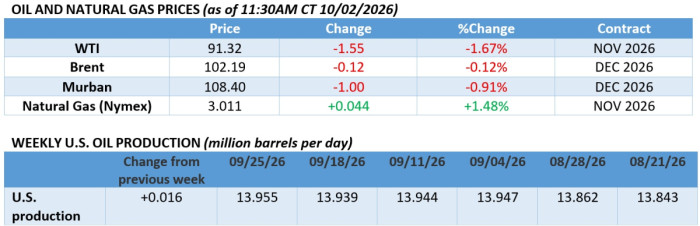

Physical oil markets are tightening sharply as Dated Brent rises above $120 despite ICE Brent sliding towards $101.


Friday October 2, 2026
The release of European diesel stocks, oil drones in the Strait of Hormuz and China’s reinstatement of its refined export ban all played a role in this week’s extremely volatile trade, with ICE Brent down to $101 a barrel. That said, the physical oil market has moved in the opposite direction, with Europe’s main physical benchmark, Dated Brent (which should technically support ICE Brent’s moves), surpassing $120 per barrel. This suggests that the physical market is much tighter than the headlines would like to admit.
OPEC+ is expected to keep its November oil targets stable. OPEC+ is expected to keep its November production targets unchanged at Sunday’s meeting as its major producers are still pumping 5 million bpd below pre-war levels, despite August output increasing by 630,000 bpd month-over-month to 25 million bpd.
Europe is moving towards a massive release of diesel stocks. EU governments are considering releasing 50 million barrels, or around 17%, of the EU’s emergency diesel stocks, more than 20 days after US President Donald Trump threatened to introduce a ban on diesel exports, although final volumes have yet to be confirmed.
The UN warns that fuel subsidies could exceed $1 trillion. The UNDP has warned that subsidies could exceed $1 trillion in 2026, as the US-Iran war, triple-digit oil prices and rising borrowing costs strain budgets, with government fuel assistance preventing 130 million people from falling below the poverty line of $6.85 a day.
China bans fuel exports amid Golden Week. Beijing suspended most export shipments of refined products in October, reinstating its previous export ban, with stocks of diesel about 20 million barrels below pre-war levels and gasoline 9 million barrels short of their target, triggering a massive rally in Asian cracks.
White House offers final tranche of SPR release. The U.S. Department of Energy proposed the latest SPR version of Trump’s 172 million barrel emergency withdrawal, offering 40 million barrels of sour crude for delivery from November to December, bringing the national total to 243 million barrels once delivered.
The Régie resolves the dispute relating to Trans Mountain network tolls. Canada’s energy regulator approved Trans Mountain’s new tolls, effective Jan. 1, 2027, ending an 18-month dispute over TMX’s C$34 billion in cost overruns, while firm shippers committing to at least 75,000 b/d over 20 years receive rates as low as $6.53 a barrel.
Seoul rejects Trump’s speech on LNG in Alaska. The South Korean government has rejected Donald Trump’s claim that it has committed to investing $54 billion in the Alaska LNG project as part of its $200 billion investment program, saying it will only participate if the project proves commercially viable.
Russia extends diesel export ban and hints it will be lifted. Russia has extended its ban on diesel exports until October, removing a nearly 10% market share of maritime supply as winter demand rises, while Deputy Prime Minister Novak suggested Moscow could lift it soon due to improving domestic supply prospects.
Gunvor reinvents itself and settles in Singapore. Global trading company Gunvor has announced its rebranding as Centalion, re-domiciling from Cyprus to Singapore following its management buyout in December 2025, with the move triggered by the US Treasury Department publicly labeling the company a “Kremlin puppet”.
China demands supply guarantees from Anglo-Teck. China’s antitrust regulator demands guaranteed concentrate flows before approving the $54 billion Anglo-Teck merger, leveraging its regulatory veto as China’s smelters – 60% of global refined production – face their worst shortage of raw materials in decades.
JERA takes over Japan’s SPR network. JERA, Japan’s largest power generation company, has launched a new oil storage company to consolidate Tokyo’s SPR stocks. The new company will assume operations at four domestic terminals holding 121 million barrels by April 2029, strengthening the country’s SPR capabilities.
Chinese lithium plunges on demand fears. Chinese lithium carbonate futures fell 25% last month to below 120,000 yuan ($17,900) a tonne, triggered by Beijing’s suspension of new battery factories amid a worsening macroeconomic outlook, defying expectations of persistent supply shortages to come.
“Panama considers state joint venture to restart key copper mine”. Panama’s government will recommend restarting Cobre Panama through a state partnership with Canadian mining company First Quantum (TSE:FM), after a three-year hiatus at the giant mine that once produced 1% of the world’s copper and 40% of the mining company’s revenue.
The Saudi pipeline is almost at full capacity. Throughputs on Saudi Arabia’s restarted East-West pipeline have climbed to nearly 6 million b/d, close to June-July levels, with around 4.5 million b/d available for exports from the Red Sea, restoring Saudi Arabia’s bypass of Hormuz despite continued Houthi strikes.
China’s coal rally hits three-year high. Prices of Chinese thermal coal jumped this week to 986 yuan per tonne ($147/tonne), extending an 11-week rise and gaining 25% since mid-July, following a drastic drop in Indonesian imports and continued mine safety measures in Shanxi state.
By Tom Kool for Oilprice.com
More important reading on Oilprice.com
Gn bussni