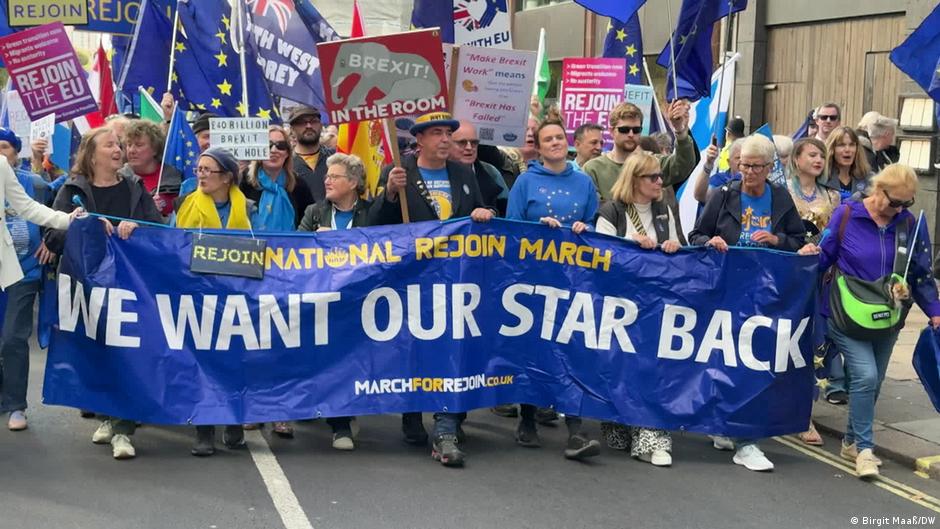

British Prime Minister Andy Burnham on Sunday became the first British leader to openly complain about Russian tampering in the Brexit referendum a decade ago.
Burnham, who took over from Keir Starmer in July, believes leaving the European Union has done “more harm than good” and opened the door to closer ties, including possibly reintegration into the bloc.
What did Burnham say?
Burnham told The Rest Is Politics podcast that he asked the question as soon as he arrived at Downing Street and received a “clear answer that yes, there was (a link to Russian interference)”.
He did not provide evidence of Kremlin efforts to influence the June 2016 vote, in which the UK decided to leave the EU by a majority of 52% to 48%..
With the rise of far-right parties in the UK and across the EU, Burnham said voters needed better information about efforts by rogue states to disrupt their democracies.
“It is important that these things are now clearly on the record and I believe they help German and French voters understand that some of this policy is instigated by our enemies, namely Russia,” he said.
Burnham described how German Chancellor Friedrich Merz told him in an interview in Berlin this week that the AfD was “clearly linked to Russia – funded, I believe”.
“There is certainly disinformation, disinformation coming out of Russia that is aimed at German politics,” Burnham added.
“Leaver” Johnson denied Russian interference
Burnham’s remarks on Brexit contrast with those of former Prime Minister Boris Johnson, who campaigned for leaving the EU. In 2020, Johnson said there was no evidence of Russian influence.
The British Parliament’s Intelligence and Security Committee found in 2020 that the government did not fully assess the impact that Russian state media and “troll” accounts may have had on the vote.
In its report, the Committee also found that the Kremlin sought to influence the Scottish independence referendum in 2014, which was rejected by voters.
British intelligence agencies believe Russia continues to spread disinformation to undermine public trust, alongside cyberattacks, sabotage and espionage. They say the problem is getting worse and artificial intelligence (AI) is often contributing to it.
Russia has long denied any interference in other countries’ elections or referendums.
After the Brexit vote, some British politicians were hit by anti-Russian hysteria.
How has the UK’s attitude towards Brexit changed?
Polling company YouGov regularly tracks whether the UK was right or wrong to vote to withdraw.
Since mid-2022, a majority of those surveyed have said Britain was wrong to leave. Last month, the “Bregret” camp rose to 60%, the highest ever.
Last month, Burnham said he would seek political consensus on the country’s future relationship with the EU, even suggesting he could campaign to bring Britain back into the EU at the next election.
EU officials welcomed the change in tone in London, while France and Spain spoke positively of rapprochement, including reintegration.
However, some experts remain skeptical. Professor Iain Begg of the London School of Economics believes reintegration would reopen deep political divisions, be complicated on both the EU and UK sides and would likely take years.
Edited by: Dmytro Hubenko
If you rely on our team for reliable reporting, please take a moment to select us as your preferred source on Google
Gn world