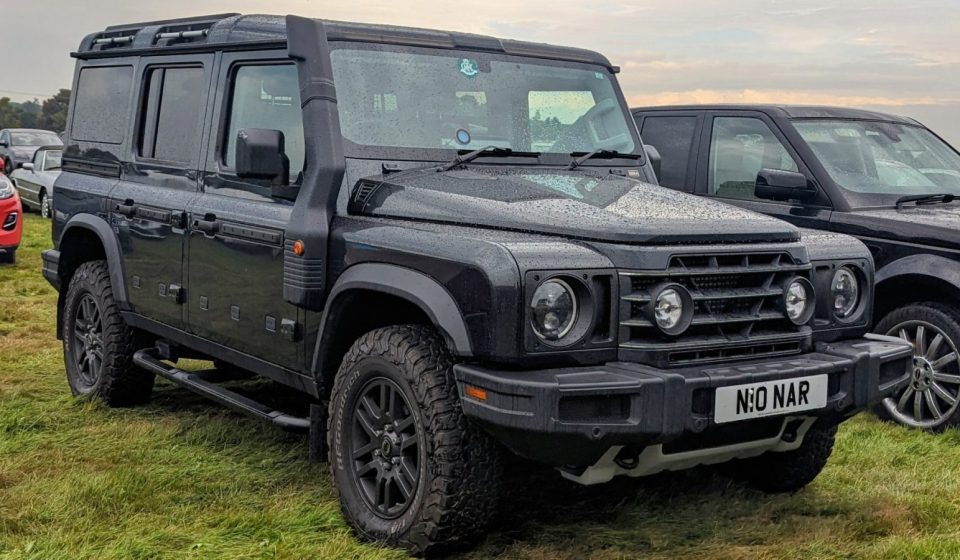
Ineos Grenadier Fieldmaster Edition (Photo: Calreyn88/Wikimedia Commons, CC BY-SA 4.0, cropped)
The French Mercedes factory built for the small Smart city car, and which Jim Ratcliffe transformed into the home of his homage to the Land Rover Defender, could soon build BYDs.
BYD today confirmed that it has entered into exclusive negotiations to acquire Ineos Automotive’s factory in Hambach, France. If it closes, it would be the Chinese giant’s second passenger car plant in the EU after Hungary, and the first time a Chinese automaker has purchased an existing car plant in Europe.
Ineos follows its customers in the United States
The other half of the deal is that Ineos is packing its bags. Alongside the announcement, Ineos Automotive announced plans to move Grenadier and Quartermaster production to the United States, which it said account for around 70% of its sales. It has pre-selected US sites, named none and aims to start production there in 2028.
The calculation is simple. Every Grenadier shipped from France to the United States is subject to a 15% tariff, and the Quartermaster pickup falls under the 25% tariff on imported pickups. When 7 out of 10 of your customers are American, building your trucks in Lorraine no longer makes sense.
Ineos says it will continue to build both models in Hambach “in the medium term” if the sale goes through, so the two companies would share the site for some time.
Neither party has disclosed a price or closing date, and the sale still needs to be subject to consultation with employee representatives. BYD will soon discover that France has nothing to do with China in terms of employee representation. It is not yet clear which BYD models will come out of Hambach and when. Ditto for the approximately 1,000 employees of the factory: BYD made no commitment on the number of employees it would retain.
BYD Executive Vice President Stella Li said the company wants to offer European consumers “vehicles built in France” using BYD technology.
A small factory with a long history
Hambach opened its doors in 1997 as “Smartville”, the Mercedes factory for the Smart Fortwo, and later built the fully electric Smart EQ Fortwo. Ineos bought it from Mercedes at the end of 2020 after abandoning its plan to build a new factory in Wales, and production of the Grenadier started in 2022. Ineos claims to have invested nearly 540 million euros in the site since 2019.
The capacity is approximately 30,000 Grenadiers per year. That’s not much by BYD standards. BYD sold 3,561,615 passenger vehicles globally in the first 10 months of the year, meaning 30,000 units represent less than three days of its production.
There’s also a bit of irony in who’s buying. Ineos unveiled its first electric vehicle, the Fusilier, in early 2024 while romanticizing gasoline cars at the same event. A few months later, he shelved the electric model indefinitely, blaming “reluctant consumer adoption” of electric vehicles. The company is now selling its only factory to the world’s largest electric vehicle manufacturer.
It’s no surprise. Last May, Stella Li said BYD was in talks with Stellantis and “other companies as well” to take over underutilized factories in Europe, and that BYD preferred owning and operating a factory rather than forming a joint venture. Hambach fits this description exactly.
BYD’s first European car plant, in Szeged, Hungary, began trial production earlier this year and is expected to reach mass production in early 2027, with the Dolphin Surf and Atto 2 first in line. BYD ultimately wants to produce more than 150,000 vehicles per year. Its plan for a separate factory in Türkiye has been suspended.
The motivation is regulatory. Chinese-made BYD electric vehicles are subject to a 17% countervailing duty in the EU on top of the standard 10% auto tariff, imported Chinese hybrids are now subject to quotas, and the EU’s proposed “Made in Europe” rules would tie electric vehicle subsidies and government contracts to the quantity of vehicle built locally. A French factory solves many of these problems in one fell swoop.
And BYD is not alone. Leapmotor began building the B10 at Stellantis’ Zaragoza factory in Spain in October, Dongfeng plans to build cars at a Stellantis factory in France, Geely is reportedly opening a Ford factory in Spain and Chery is already assembling vehicles in Barcelona.
Chery is the one BYD should keep an eye on. Through October, BYD registered 320,445 vehicles in Europe, an increase of 133%, according to Automotive News. The Chery group was just ahead with 320,631, up 235%. A gap of 186 cars.
Europe matters more than ever to BYD because its country is not doing well. The BYD brand’s sales in China fell 40% to 1,544,699 vehicles in the first 10 months, and its global passenger vehicle sales are down 2.7%.
Electrek’s point of view
This is a smart and cheap move for BYD. Building Szeged took years, including land disputes with private owners. Hambach has a skilled workforce, a paint shop, a supplier base on the German border and a motivated seller to leave. Entry into France isn’t much easier, but the easier one in France is still probably more difficult than anything BYD has encountered in China when it comes to rolling out new production capacity.
The 30,000 unit capacity is small, but BYD isn’t buying it for what it’s building today. It’s buying a “Made in France” label ahead of local content rules.
We can’t ignore the symmetry here either. Ineos is leaving Europe to build in the United States due to tariffs. BYD buys in Europe because of customs tariffs. It’s protectionism that’s moving factories. Europe keeps jobs, and workers who used to build smart electric vehicles could build electric vehicles again.
And yes, it’s funny that BYD is moving into the home of the Grenadier, a vehicle that exists because Ratcliffe loved the old Defender, days after a court in The Hague banned BYD’s Ti7 from the EU for violating Land Rover’s Defender design.
The real question is what BYD is putting at stake in Hambach. If they are battery electric cars, so much the better. If they are plug-in hybrids built to circumvent quotas, Europe is trading one gas 4×4 factory for another.
If you buy a BYD or other electric vehicle, pairing it with home solar can reduce your fuel costs to almost zero. With electricity rates up nearly 10% in the last year and expected to continue to rise, turning to solar power is one of the best ways to protect against rising costs. And with leasing and PPA options, you can do it without any upfront costs and start saving immediately. If you want to find the best deal, check out EnergySage. It’s a free service with hundreds of pre-screened installers competing for your business, so you save 20-30% compared to a stand-alone solution. No sales calls until you choose an installer. Get your free quotes here.


FTC: We use automatic, revenue-generating affiliate links. More.
Gn bussni