
While Republican candidate for Ohio governor Vivek Ramaswamy was criticized for releasing an attack ad featuring his Democratic challenger’s estranged mother, a mysterious news site was running an ad on Facebook reinforcing the controversial video.
The Buckeye Bulletin, which bills itself as an Ohio-based news platform committed to “trustworthy journalism” and “strict editorial standards,” suddenly emerged this spring and began releasing a steady stream of pro-Ramaswamy content.
The articles in the publication do not have a byline. There is no staff list. The website does not feature digital advertisements or invite readers to subscribe, but there is also no information on who funds it.
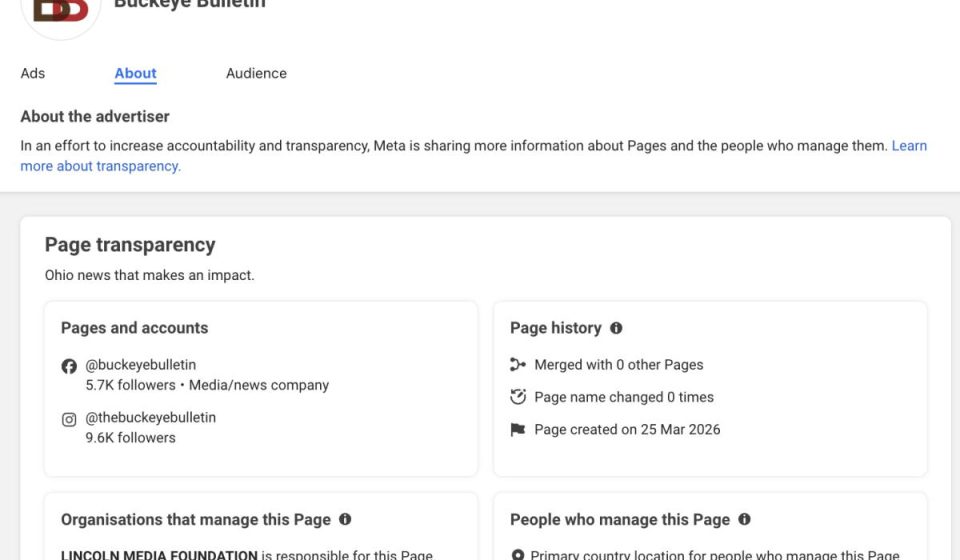
A closer look at the Buckeye Bulletin’s Meta ad data shows that its Facebook and Instagram accounts are run by the Lincoln Media Foundation, a nonprofit affiliated with the Orange County-based Lincoln Club, California’s oldest and largest conservative giving organization. IRS documents show the club and foundation are associated organizations and share at least two key officers.

Meta advertising data shows that the Lincoln Media Foundation manages the Buckeye Bulletin’s Instagram and Facebook accounts.
(Meta)
The Buckeye Bulletin, Lincoln Club and Lincoln Media Foundation did not respond to requests for comment.
The Bulletin appears to be a partisan site masquerading as a local news outlet in the run-up to the midterm elections, a strategy that political scientists call “pink slime” journalism.
This is not the first time that a “pink-slime” media outlet has been linked to the Lincoln Media Foundation. In 2024, Max Read, director of civic innovation at the Institute for Strategic Dialogue, has identified seven such putative opportunities.
With the exception of one site focused on Los Angeles, these media outlets have all targeted critical states for the 2024 presidential election, such as Georgia, Pennsylvania and Wisconsin. Read reported that the media group spent more than $63,000 on ads on Facebook and Instagram, generating up to 18 million impressions during the last election cycle.
“(These sites were) very clearly designed to try to influence the information environment ahead of the presidential election,” Read told the Times. “They had all started at the beginning of the year and were using advertising on Meta platforms to increase their engagement numbers.”
When the Times asked him to take a look at the Buckeye Bulletin, Read said it seemed to be “copy-and-pasting pretty much the same tactics they used in 2024, even as far as the aesthetic of the Facebook page and the Instagram account.”
“It seems like they realized it was working at some level in 2024 and it was worth doing it again this year,” he said.
Earlier this year, CalMatters identified another media outlet linked to the Lincoln Media Foundation called California Courier, which was circulating Facebook ads criticizing Gov. Gavin Newsom and the statewide redistricting measure, Proposition 50.
Since launching the Buckeye Bulletin’s Facebook and Instagram pages in March, the outlet has shared posts touting support for Ramaswamy — a biotech billionaire and former presidential candidate — as well as his platform for addressing Ohio’s health care crisis and his stance on religious freedom in schools.
Simultaneously, the outlet’s social media posts highlighted the refusal of her opponent — Amy Acton, Ohio’s former public health director — to debate, comments about how she “shut down” the state’s economy during the COVID-19 pandemic and a watermarked video of right-wing political activist Laura Loomer.
This week, the outlet drew attention to Ramaswamy’s controversial campaign ad featuring Acton’s ex-mother, Donna Arthur. In the ad, Arthur calls his daughter a liar and urges voters not to support her.
However, the ad failed to acknowledge that Arthur lost custody of her children after their stepfather, Arthur’s husband, was indicted for raping Acton when she was a child — an omission that drew harsh condemnation from Democrats and some Republicans, including Ohio’s Republican governor, Mike DeWine. Others, including President Trump and Vice President JD Vance, an Ohio native, have defended the ad.
Arthur and her husband fled to Pennsylvania after his indictment in 1978, where he died in 2004 without being brought back to Ohio to face the charge.
Between the political content of the Bulletin’s social media feeds are a handful of Reels related to non-political news, often featuring videos directly from local TV stations. These other publications are used to create a “veneer of real local journalism,” Read said.
The language used on the Bulletin’s About Us page displays markers of artificial intelligence such as generic mission statements, polished but repetitive wording, and vague assertions about journalistic standards, without any details about the publication’s staff.
Of the last 30 posts shared on the Bulletin’s Facebook page as of 5 p.m. Friday, 21 were about state or national politics and 10 were about the gubernatorial race. Engagement on posts covering Ramaswamy and Acton is still strong for a page with around 5,600 followers.
For example, an article published Wednesday on the PAC of the Ohio State Medical Assn. endorsing Ramaswamy received over 770 likes, 260 comments and 150 shares. Another video posted Wednesday with the title “Amy Acton refuses to debate, says her mother is lying about her” received more than 4,800 likes, 1,500 comments and 500 shares.
Meanwhile, an apolitical article published Wednesday about a chemical explosion in Toledo received two likes, no comments and no shares.
The unassuming social media user or person who clicked through to the website would have no idea of the Buckeye Bulletin’s apparent connection to a group of wealthy Southern California reposts.
The Lincoln Media Foundation was established by leaders of the historic Lincoln Club, which was founded in 1962 and once included members John Wayne and former President Richard Nixon.
Today, the club describes itself as home to California’s “most prominent business and thought leaders” and says it offers its members the opportunity to meet world leaders and “discover their hobbies come to life through a combination of extravagance and leisure.”
The foundation says it uses a digital approach to reach communities left out of the national conversation, but its website does not disclose that it has funded media outlets.
IRS records show the nonprofit’s financial activities increased significantly in 2024, the latest year for which data is available. The Lincoln Media Foundation reported revenue of $3.88 million in 2024, up from $738,000 in 2023, $453,000 in 2022 and $415,000 in 2021.
The Buckeye Bulletin’s Facebook and Instagram accounts spent just over $10,000 to boost their posts this year, according to Meta’s Ad Library.
That’s barely a drop in the bucket in Ohio, where hotly contested elections for governor and U.S. senator have drawn hundreds of millions of dollars in spending. But presenting a biased political view under the guise of local news tends to offer more bang for your buck than traditional ads, said Georgia Kernell, an associate professor in the UCLA departments of communications and political science.
“Voters are so fed up with ads; they now get tons of clear paid ads on radio, TV and their social media,” she said. “Anything that may seem different will be more likely to catch their attention.”
Presenting yourself as a traditional news source also increases the likelihood that viewers will believe the information presented is well-researched, she said.
Nik Usher, an associate professor of communications at the University of San Diego, said it’s unclear how much influence pink-slobber journalism has on voting behavior, but political strategists are willing to try any new approach to possibly make a difference in close races.
“This is a strategic effort to throw more spaghetti at the wall, hoping it sticks,” Usher said.
The creators of these partisan sites will further benefit from the fact that artificial intelligence tools are constantly removing content from news sites without a paywall.
NewsGuard researchers recently found that leading AI chatbots cite pink slime websites nearly half the time when users ask questions about candidates and issues in the midterm elections.
Democrats and Republicans have increasingly used pink journalism to influence voters in recent election cycles.
In 2020, The New York Times identified a network of 1,300 news sites that paid freelance writers to produce biased content for Republican groups and corporate PR firms. In 2024, the left-wing group Star Spangled Media used a site called Morning Mirror to promote Democratic candidates in unfavorable elections, according to a study by the Tow Center for Digital Journalism at the Columbia Journalism School.
More recently, the evolution of AI has increased the ease with which these websites can be populated with content, eliminating the need to pay writers and automating the production of social media posts.
Usher described pink slime websites as “public trust bombs” that take advantage of the gap created by the loss of independent local newspapers and further lower expectations for fair reporting.
“Once these types of sites are reported to the public, it further undermines distrust in political institutions, political parties and the media,” Usher said, “especially when AI is associated with these kinds of things.”
Gn usa