
LOS ANGELES — Nearly five months after an initial mistrial, a jury has found a man guilty of starting the devastating 2025 Palisades Fire in Los Angeles, which displaced thousands of people and became the most destructive wildfire in Los Angeles city history.
Jonathan Rinderknecht was found guilty Friday of two federal charges: destruction of property by fire and arson affecting property used in interstate commerce.
Sentencing was set for March 17.

Rinderknecht’s father and brother were in court for Friday’s sentencing. Defense attorney Steve Haney placed his hand on Rinderknecht’s back after the first guilty verdict was read.
It was the second federal trial against Rinderknecht, who prosecutors say started a brush fire early in the New Year 2025 that was quickly put out by firefighters but continued to smolder and, seven days later, erupted into the Palisades Fire.
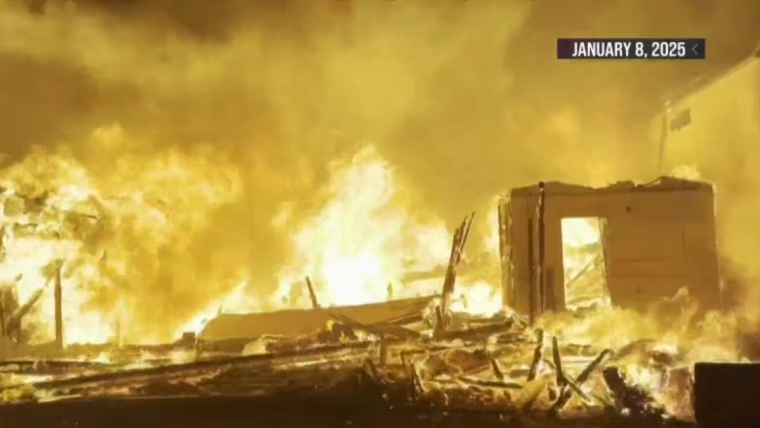
The January 7, 2025 inferno that ravaged Los Angeles was fueled by winds gusting up to 100 mph that fed off the very dry conditions.
Rinderknecht’s first trial in federal court in Los Angeles ended in June in a mistrial after jurors deadlocked 10-2 in favor of an acquittal.
His retrial began with jury selection on Nov. 2, and the panel of six men and six women began deliberating his fate on Wednesday.
Prosecutors alleged that Rinderknecht, a former Los Angeles resident who was then an Uber driver, started the prelude to the Palisades Fire, a much smaller fire known as the Lachman Fire.
Named after a nearby street, this fire was detected by environmental detection platforms at 12:12 a.m. on January 1, 2025 and was extinguished by firefighters after burning approximately five to eight acres of dense brush.
But even though firefighters extinguished the flames, the “lingering fire” continued to smolder underground and was reignited a week later by Santa Ana winds and grew into a monstrous Palisades fire, prosecutors said.
In the first trial, prosecutors portrayed Rinderknecht as a mad man against the world, citing passengers’ accounts of him angry at them on New Year’s Eve.
Rinderknecht “was angry all the time” and “believed he was being enslaved by the rich,” Assistant U.S. Attorney Danbee Kim told the court.
In the second trial, prosecutors seeking to convict Rinderknecht built a case against him using surveillance camera footage of his car driving in the Pacific Palisades neighborhood before the fire, GPS location information and a green BIC barbecue lighter.
“It’s not the traditional smoker’s lighter that I’m used to seeing,” LAPD Detective Matt Castellichio said for the prosecution.
Assistant U.S. Attorney Mark Williams said in closing arguments Wednesday that the DNA from the lighter matched that of Rinderknecht.
Defense attorney Haney said Rinderknecht earlier admitted to investigators that he had the lighter with him. He said investigators found it in the glove compartment of his rental car, not at the scene of the Lachman fire.
Rinderknecht, after dropping off a passenger in the Palisades, decided to climb what is called Hidden Buddha Hill in hopes of seeing fireworks in the distance and celebrating the new year, Haney said.
Haney said that when he spotted the fire, Rinderknecht called 911 several times, but his cellphone was out of range, prosecutors said.
Those calls, Williams told the jury, were intended to create an alibi and Rinderknecht had asked ChatGPT if anyone was at fault if a wildfire was caused by their cigarette.
Rinderknecht also recorded footage of the fire, Williams said.
“The only verdict you can reach is one of guilty,” Williams said in his closing argument Wednesday.
Haney said Rinderknecht should be acquitted because no one saw him start the fire, no cameras recorded the setting of the fire, and evidence at the site of the Lachman Fire had been compromised because the scene was open to the public for several days before being closed off by police.
Ed Nordskog, a retired arson and bomb investigator with the Los Angeles Sheriff’s Department, testified earlier for the defense that “it appears hundreds of people visited the scene before it was locked down.”
“In my experience, we call it a killer deal,” Nordskog testified.
The Palisades Fire has burned 23,448 acres, killed 12 people and destroyed 6,837 homes, businesses and other structures, according to the Los Angeles Fire Department.
Starting in the Santa Monica Mountains, it burned in the Pacific Palisades neighborhood, then spread quickly through the communities of Topanga and Malibu in Los Angeles County.
It took more than three weeks before firefighters were able to bring the fire under control and the fire was not completely brought under control until January 31, 2025.
Gn usa