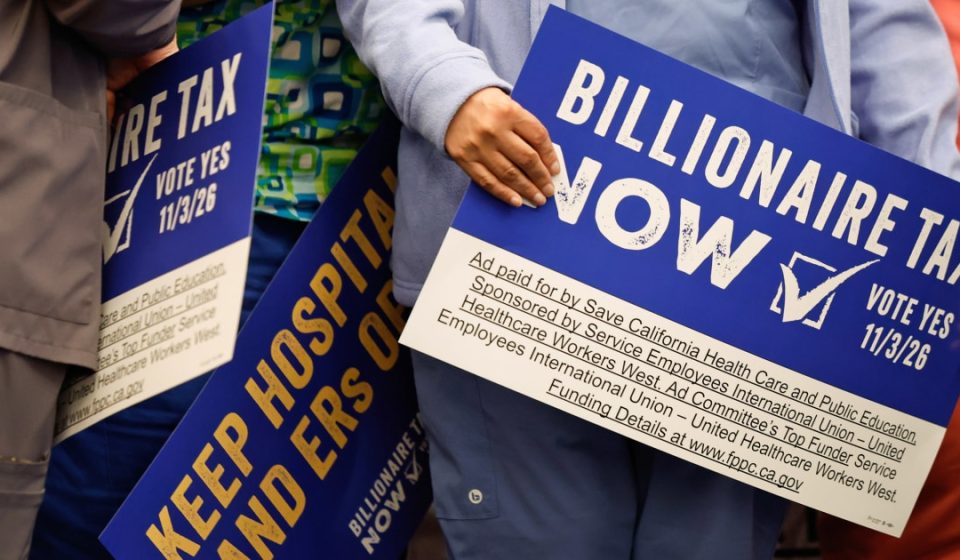
California poll: Voters support billionaire tax, but proposal falls short of majority support

A plurality of likely California voters support a proposal on the state’s November ballot that would impose a one-time wealth tax on the wealthiest Californians, but the measure still lacks majority support, according to a new NBCUniversal Local/Telemundo Station Group poll released Wednesday.
In the poll, 48% said they would vote “yes” to the proposal, while 38% said they would vote “no.” 14% say they are undecided.
The 10-point yes lead is outside the poll’s margin of error, which is plus or minus 4 percentage points for each side’s level of support.
The breakdown was almost identical among likely Hispanic voters, according to a follow-up survey in California: 50% said they would vote “yes,” 40% said they would vote “no” and 10% said they were undecided. Both surveys were conducted from September 21 to 24.
The so-called billionaires tax — which will appear on the November ballot as “Proposition 40” — would implement a one-time 5 percent tax on the assets of Californians whose net worth exceeds $1.1 billion, and require the state to spend 90 percent of new revenue on health care. The remaining 10% would be divided between education and food assistance programs.
In addition to the one-time tax on people worth more than $1.1 billion, the measure, if passed, would implement a lower tax on people worth between $1 billion and $1.1 billion. The taxes would apply retroactively to anyone living in the state starting Jan. 1, 2026.
The proposal has divided California’s Democratic leaders. Prominent supporters — including Rep. Ro Khanna, a potential 2028 presidential candidate, and Tom Steyer, a billionaire activist who ran unsuccessfully for governor — say it would help narrow revenue gaps and offset state budget shortfalls resulting from Medicaid cuts in President Donald Trump’s “big, beautiful bill.”
Opponents of the ballot measure, including Gov. Gavin Newsom and the Democratic candidate to succeed him this year, Xavier Becerra, argued the initiative would drive wealthy investors and technology executives out of the state.
The details of the proposal, spearheaded by the Service Employees International Union-United Healthcare Workers West, a large California healthcare worker union, also drew opposition from many other unions and Democratic groups. These groups took issue with the fact that other progressive policy priorities, such as public education and food assistance, would benefit far less from the new revenue than health care.
Many Democratic critics have also joined forces with some Republicans, many of whom have long argued that a wealth tax could destabilize California’s revenue streams by causing the ultra-wealthy to flee the state.
But the new poll shows California voters aren’t worried about the prospect of wealthy California residents leaving.
A total of 59% of respondents said they were “not” or “not too” concerned about this potential outcome, while a total of 41% said they were “very” or “somewhat” concerned about the rich leaving the state because of the vote. Among Hispanic voters, 62% said they were “not” or “not too” concerned, while 38% said they were “very” or “somewhat” concerned.
Notably, the poll also found that California voters were almost evenly split on whether they approved or disapproved of the job performance of Newsom, widely considered a 2028 presidential hopeful.
Forty-five percent of respondents said they approved of her job performance, while 46 percent said they disapproved. Another 9% said they weren’t sure. Hispanic voters were more positive about Newsom, with 54% approving and 38% disapproving of his performance as governor.
But when it came to what Democrats thought about Newsom’s possible 2028 run, they overwhelmingly said they would support him. When asked whether they would be inclined to vote for him if he ran as the Democratic Party’s nominee in the 2028 presidential election, 66% of Democrats surveyed said yes, 15% said no, and 19% said they were not sure.
Another November ballot measure, Proposition 39, would, if passed, require voters to present a government-issued ID when voting in person, while mail-in voters would have to provide the last four digits of a designated ID used during registration. Among likely voters, 49% said they would support the measure, while 42% said they would vote against it and 9% said they were undecided.
When asked about Proposition 39, 55% of Hispanic voters said they would vote “yes” to support it, while 38% said they would vote “no” and 7% said they were undecided.
California voters strongly said that cost of living and the economy were among the most important issues when deciding whether to vote, with 25% saying “cost of living/inflation” was most important and 23% saying “economy/jobs.” 15% said “immigration and law enforcement” were most important, while 11% cited health care and 10% cited “foreign policy and the war in Iran.” No other show registered at more than 5%.
Amid the focus on economic issues, a majority of respondents – 42% – said their “personal financial situation” was “the same” as it was four years ago. Thirty-six percent said the situation was “worse” compared to four years earlier, while 22% said the situation was “better.”
Meanwhile, most respondents (64%) in blue California overwhelmingly said they disapprove of the job President Donald Trump is doing. Another 31% said they approved and 5% said they were not sure.
When asked what impact they thought the conflict with Iran was having on the U.S. economy, more than two-thirds (67%) of respondents said the impact was “significant.” 16% said it had “some” impact, while 7% said “not much” and 8% said “none.”
Gn headline