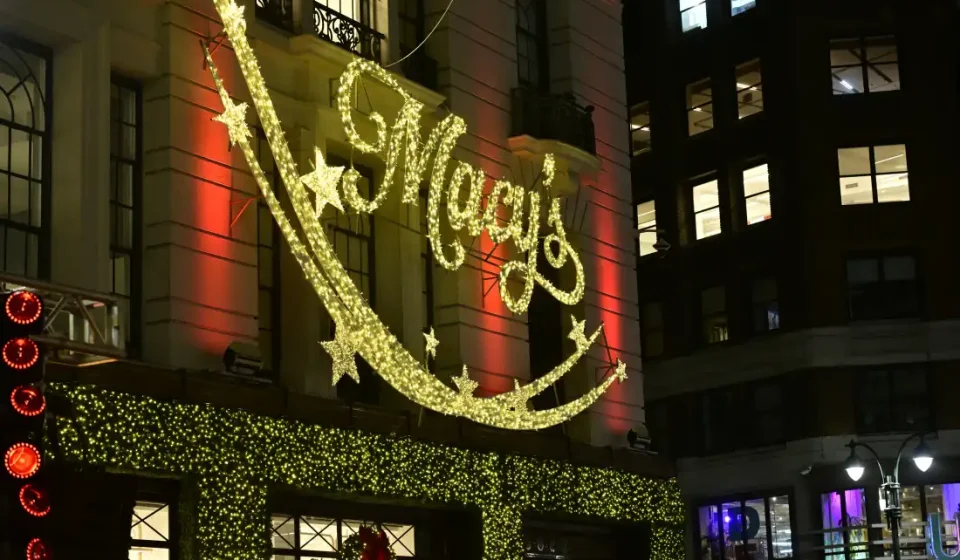

Macy’s flagship store in New York unveils its 2026 holiday display.
Eugene Gologursky/Getty Images
hide caption
Eugene Gologursky/Getty Images
Sign up to receive breaking news alerts and exclusive reporting from NPR
Leaving the Macy’s flagship store in New York, the Niesig family from Germany assesses their haul: sweatpants for mom, a Hurley jacket for dad, Ugg boots for their daughter. His son Mika, 16, is the only one left empty-handed.
“I like zip-up hoodies, and there was one from Levi’s that was pretty cool,” he says. “But ultimately I didn’t buy it because it was just a bit boring.”

As Macy’s celebrates the 100th annual Thanksgiving Day Parade this week, the department store finds itself at a crossroads. After years of questionable financial prospects, Macy’s is trying to reinvent itself as a luxury destination.
The retailer’s challenge is to retain its old buyers while attracting new customers, who may pay more for real leather and high-end brands.
How Macy Got Stuck in the Middle
Long before the pandemic, Macy’s was grappling with the decline of America’s middle class — and its own lack of fresh vision.
The department store sector, for starters, has become a challenge. Department stores are expensive. Online competition is tough. Shoppers are increasingly buying directly from their favorite brands.
And Macy’s faces its own battle. The chain is neither a discounter like Kohl’s or TJMaxx nor an upscale store like Bergdorf Goodman or Nordstrom. Macy’s has languished between the two.

“They were sort of in the middle,” says Michael Prendergast, who advises retailers and brands at consultancy Alvarez & Marsal. “Now, over time, that middle level has basically been crushed.”
When the pandemic hit, store closures led Macy’s to project an estimated $1.1 billion in losses. The value of its shares fell so low that the company was excluded from the major index, the S&P 500.
The exit is open
At one point, Macy’s seemed to be offering everything else at a discount just to get people to buy. something.
But it didn’t work.

A shopper with a bag from rival Target visits Macy’s in New York.
Michael M. Santiago/Getty Images
hide caption
Michael M. Santiago/Getty Images
The stores looked messy and chaotic. Buyers have regularly noted a lack of workers to help them on the ground. Over the course of 2023, sales at Macy’s fell nearly 7%.
Soaring inflation almost forced Macy’s hand.
As the so-called K-shaped economy has divided the country in recent years, people with less money have turned to Walmart or Target, who have stepped up their game. The wealthiest continue to be the spenders, but neither are Macy’s, who are turning to high-end stores.
“For their size and scale, the choice is almost made for them,” says Prendergast, who spent 20 years in the fashion business, including selling at Macy’s to Tommy Hilfiger.
“If you’re Macy’s, you say, ‘We’re still stuck in the middle, our customer base in the United States is stuck in the middle. Where can we go?’ And really, the only answer is up.”
The new vision of luxury
Luxury is now Macy’s big bet.
The retailer already owns the high-end Bloomingdale’s, with its designer brands. Macy’s also owns the luxury beauty chain Bluemercury.
In 2024, the boss of Bloomingdale’s took over the entire Macy’s company and announced a turnaround plan, “A Bold New Chapter”.

This included closing 150 stores and upgrading more than 300 others. Changes have been proposed to the website and staff. Stores began tackling clutter and adding prettier items.
“We needed to remove duplication and redundancies,” says Julie Walsh, senior vice president at Macy’s, whose team buys women’s accessories and beauty products, including shoes, jewelry and makeup.
“When you come to our floor now, it’s a little lighter,” she says. “So that the product that is on the floor appears meaningfully.”
Putting Higher Prices to the Test
In March, Macy’s finally reported a year of rising sales.
Bloomingdale’s high-end stores have continued to drive much of the company’s growth, but the changes also appear to be starting to pay off at Macy’s.
Fancier options — like real leather instead of faux, from brands like Ralph Lauren and Coach — have increased the retailer’s average selling price. It grew 9% last quarter, executives said in September. They described buyer visits as “very regular and very meaningful”.

A mall visitor enters a Macy’s department store in Towson, Maryland.
Stephanie Scarbrough/AP
hide caption
Stephanie Scarbrough/AP
Barb Anderson-Kerlin, a loyal Macy’s customer who visits the retailer’s flagship store in New York, says she noticed a difference within the chain after years of finding stores that seemed to wander in every direction.
“The department store was like bedding, towels, pots and pans, perfume,” she says. “Because I was going there and I was just overwhelmed. But now I feel like it’s easier to see where the marks are.”
How far can luxury sales take Macy’s?
Still, most shoppers at the flagship store seemed doubtful of Macy’s image as an upscale chain.
“If they want luxury,” says Chelsea Bates, visiting from Tennessee, “I would say serve champagne.” She laughs, but notes that other high-end competitors offer lounges and refreshments, like coffee.
Macy’s insists it’s not turning away from the middle class, just striving for more of it. It is not a question of choosing a completely new path, but of widening the road, a challenge for this divided economy.
“The strength of Macy’s is being able to serve our customers in all different categories and at all price points, and we’re not changing that,” Walsh says.
“What we do is make sure we have a top-quality product,” she says. “So it’s not to replace it, it’s an additive.”

One obstacle is how long Macy’s has spent building its mid-price reputation, Prendergast says. Breaking out of the mold is a difficult climb.
But, he says, if anyone can do it, maybe it’s Macy’s, which has outlasted many rivals in its 168 years of existence.
“They’re really last in this bracket for good reason,” Prendergast says. “Everyone likes to count Macy’s, and they continue to prove everyone wrong.”
Gn bussni