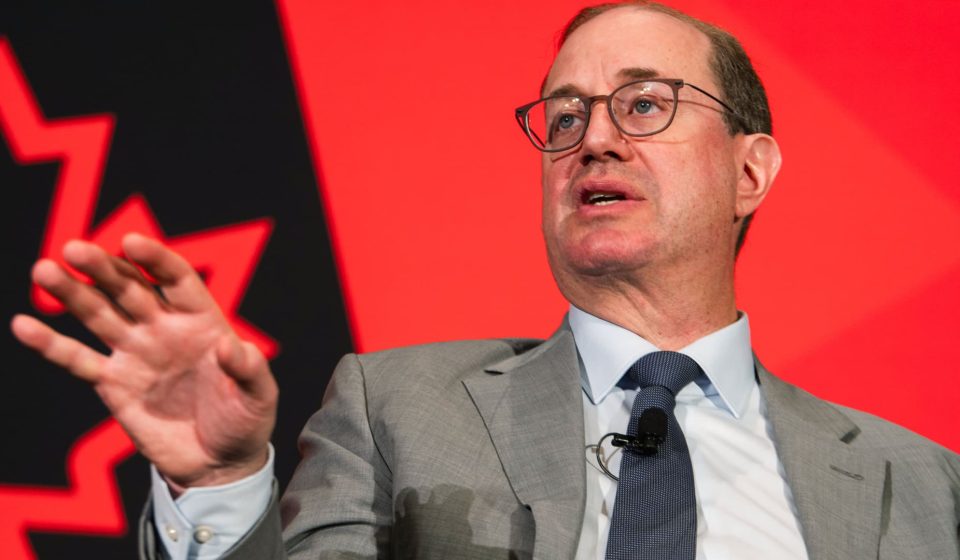
Canada’s ambassador to the United States warned Wednesday that tariffs imposed by President Donald Trump are raising investment costs and discouraging business expansion, as a new Federal Reserve study points to further price hikes for American consumers next year.
“Uncertainty increases the cost of capital,” Ambassador Mark Wiseman said at the B20 Summit, a gathering of global business leaders hosted in Washington by the U.S. Chamber of Commerce.
“If you’re thinking about building a new factory, adding a new ship, spending money on R&D, the more certainty you have, the more likely you are to do it,” said Wiseman, a former BlackRock executive who became Canada’s ambassador in February.
The warning comes as Washington and Ottawa struggle to resolve a tariff dispute affecting one of the United States’ most important trade relationships. The two countries traded about $570 billion in goods during the first nine months of 2026, according to U.S. Census Bureau data. That’s an increase from the same period in 2025, the first year of Trump’s second term, but lower than the comparable nine months in the previous three years, when Joe Biden was president.
U.S. tariffs on imports from Canada reached $10 billion in 2025, up from $400 million in 2024, according to the Congressional Research Service.
An October study by New York Fed researchers found that nearly 90% of tariff costs were passed on to U.S. importers, with about a quarter of tariff increases ultimately reaching consumer goods prices and further price pressures expected in 2027.
The results come as Labor Department data showed consumer prices rose a higher-than-expected 0.4% in October, reinforcing inflation fears after Republicans’ heavy losses in the midterms.
Trump has defended his tariffs as necessary to protect American manufacturers and workers, accusing Canada of discriminatory trade practices that disadvantage American exporters.
The two governments resumed negotiations after talks collapsed in August, with discussions focused on reducing tariffs on Canadian steel and automobiles. Trump imposed tariffs of up to 50% on some Canadian products, prompting retaliatory measures targeting billions of dollars of U.S. exports.
Wiseman called for the removal of tariffs imposed under Sections 232 and 338 of the U.S. Trade Act, saying a resolution would help businesses make long-term investment decisions.
“The sooner the better,” he said.
The political stakes have shifted after the midterm elections, with Democrats preparing to challenge Trump’s tariffs when they take control of Congress in January.
Canadian Prime Minister Mark Carney nevertheless declared on Tuesday that the Trump administration remained Canada’s main negotiating partner.
“We’ve had complete free trade with the United States since 1988,” Wiseman said, describing Canada’s goal as getting back “as close to free trade as possible” while creating the certainty businesses need.
European ambassadors echoed these concerns at the B20 summit. Germany’s Ambassador to the United States, Jens Hanefeld, said businesses could adapt to tariffs but faced an “ever-changing regulatory environment” that required them to spend more on lawyers to adapt to changing trade rules.
Speaking on the same panel, French Ambassador Aurélien Lechevallier called for greater cooperation in AI and energy rather than continued trade disputes.
“We’ve spent, I think, a lot of time over the last few years working and dealing with regulations and tariffs,” he said. “Companies are eager to do more business.”
Gn bussni